Copper Age: The Dawn of Metallurgy and Human Innovation
The Copper Age, also known as the Chalcolithic (from the Greek words for copper and stone), represents a pivotal transition in human history. Spanning roughly from 6500 BC to 3000 BC, this era marks the bridge between the Stone Age and the Bronze Age. It was a time of profound technological experimentation where humans first learned to manipulate metal, fundamentally altering how they created tools, conducted trade, and organized their societies.
This period began with cold working—the process of hammering near-pure copper ores into shape without heating them—and evolved into the complex science of smelting, where ores were heated to high temperatures to extract pure metal. This shift didn't happen simultaneously across the globe; instead, it emerged in various pockets of Africa, Asia, Europe, and the Americas, often independently.
Key Facts
- Timeline: Approximately 6500 BC to 3000 BC.
- Core Technology: Transition from hammering native copper (cold working) to high-temperature smelting.
- Oldest Evidence: Copper smelting evidence in Serbia dates back to c. 5000 BC; cold working in North America dates to c. 6500 BC.
- Global Reach: Developed independently in regions including the Near East, East Asia, Sub-Saharan Africa, and the Americas.
- Societal Impact: The rise of metal tools often led to a decline in specialized stone-tool craftsmanship.
The Evolution of Metallurgy
From Hammering to Smelting
The earliest metalworkers utilized native copper, which could be shaped through hammering. A prime example is the Old Copper complex of the North American Great Lakes, dating from around 6500 BC. However, the ability to extract copper from ore through heat—smelting—allowed for much greater production. The site of Belovode in Serbia provides some of the world's oldest securely dated evidence of high-temperature smelting, dating to approximately 5000 BC.
The Emergence of Alloys
As metallurgy advanced, humans began creating alloys—mixtures of two or more metals. Arsenical copper (or arsenical bronze) appeared around 4200 BC in eastern Turkey at sites like Norşuntepe and Değirmentepe. Furthermore, recent research suggests that tin bronze (copper alloyed with tin) developed in Europe as early as 4650 BC at the Pločnik site, potentially 1,500 years before similar alloys appeared in the Near East.
Regional Developments
The Near East and Asia
In the Near East, the transition to the Chalcolithic saw a shift in craft specialization. In the Tehran Plain of Iran, the introduction of copper tools coincided with a decline in the quality and aesthetic variety of stone tools, suggesting that household-based production replaced the complex Neolithic exchange networks.
In South Asia, the Chalcolithic period (4300–3300 BC) was characterized by high mobility and trade between the Indus Valley Civilisation, northern Iran, and southern Turkmenistan. In India, distinct farming communities such as the Ahar-Banas, Kayatha, Malwa, and Jorwe developed unique ceramic traditions alongside their use of copper.
Europe and the Americas
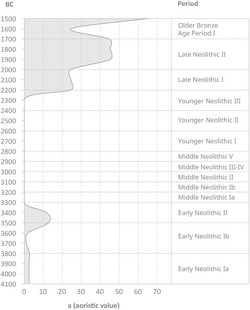
Europe's experience with copper varied by region. While some areas transitioned quickly, others, like Britain, had a shorter Chalcolithic period (2500–2200 BC) marked by the arrival of the Bell Beaker culture. Interestingly, many European cultures used stone axes modeled after copper designs, showing that the idea of copper tools spread faster than the metal itself.
In the Americas, evidence suggests that many early metal objects were cold-worked. While some archaeologists debate the extent of smelting, there is evidence of casting among the later Hopewellian and Mississippian peoples.
East Asia and Africa
In China, copper manufacturing appeared during the Yangshao period (5000–3000 BC), with evidence of smelting found in the Hongshan culture. Meanwhile, in the Aïr Mountains of Niger, independent copper smelting developed between 3000 and 2500 BC, continuing to evolve well into the second millennium BC.
Summary of Copper Age Characteristics
| Region | Key Timeline | Notable Feature | Key Site/Culture |
|---|---|---|---|
| North America | 6500–1000 BC | Extensive cold working | Old Copper complex |
| Europe | 5500 BC onwards | Early tin bronze development | Pločnik / Belovode |
| Near East | Late 5th Mill. BC | Arsenical copper alloys | Norşuntepe |
| South Asia | 7000–900 BC | Trade and pottery integration | Mehrgarh / Indus Valley |
| East Asia | 5000–3000 BC | Yellow River valley smelting | Yangshao / Hongshan |
| Africa | 3000–1500 BC | Independent smelting | Aïr Mountains |
Frequently Asked Questions
What is the difference between the Copper Age and the Bronze Age?
The Copper Age (Chalcolithic) is characterized by the use of pure copper or simple alloys like arsenical copper. The Bronze Age began when humans consistently alloyed copper with tin to create bronze, a much harder and more durable metal.
Did the Copper Age happen at the same time everywhere?
No. Metallurgy developed independently and at different times. For example, cold working appeared in North America around 6500 BC, while independent smelting in the Aïr Mountains of Africa didn't emerge until around 3000 BC.
How did copper affect the production of stone tools?
In some regions, such as the Tehran Plain in Iran, the rise of copper tools led to a collapse in the specialized networks used to procure high-quality stone, resulting in a decline in the quality and artistry of lithic (stone) artifacts.
What is "cold working" in ancient metallurgy?
Cold working is the process of shaping metal—specifically native copper—by hammering it into the desired form without heating it to a molten state.
Who was Ötzi the Iceman in relation to the Copper Age?
Ötzi, who lived around 3300 BC, is a famous example of the era's technology; he was found with a Mondsee copper axe, demonstrating the spread of copper tools in the Alps.