Middle Paleolithic Era: The Rise of Behavioral Modernity and Advanced Toolmaking
The Middle Paleolithic, also known as the Middle Stone Age in African archaeology, represents a pivotal chapter in human evolution. Spanning roughly from 300,000 to 50,000 years ago, this period serves as the bridge between the Lower and Upper Paleolithic subdivisions. It was a time of significant transition, occurring during the geological Chibanian (Middle Pleistocene) and Late Pleistocene ages.
During this era, anatomically modern humans began their migration out of Africa approximately 125,000 years ago, gradually replacing other hominid species such as Homo erectus and the Neanderthals. While dating varies by region—for instance, in Great Britain, the Early Middle Paleolithic is dated between 325,000 and 180,000 years ago—the era is globally defined by a leap in cognitive ability and social complexity.
Key Facts
- Timeline: Approximately 300,000 to 50,000 BP.
- Key Technology: Introduction of the Levallois (prepared-core) technique.
- Social Structure: Small, egalitarian band societies.
- Dietary Shifts: Integration of seafood and the use of fire for cooking.
- Behavioral Milestones: Earliest evidence of intentional burial, long-distance trade, and artistic expression.
The Emergence of Behavioral Modernity
Behavioral modernity refers to the suite of cognitive and social traits that characterize modern humans. While undisputed evidence became common in the Upper Paleolithic, the seeds were sown during the Middle Paleolithic. One of the most debated signs of this shift is the practice of intentional burial. Sites such as Krapina in Croatia (c. 130,000 BP) and the Qafzeh and Es Skhul caves in Israel (c. 100,000 BP) suggest a developing religious ideology or a concept of the afterlife, though some scholars argue these burials were for secular reasons.
Artistic expression also began to surface. At Blombos Cave, archaeologists discovered beads, bracelets, and ochre used as body paint. While some earlier patterns on elephant bones from Bilzingsleben may have been created by Homo erectus, the Middle Paleolithic saw a more consistent use of art and ritual.
Socially, these populations lived in egalitarian bands. This structure likely evolved to ensure the equal distribution of food and resources, preventing famine. Evidence suggests that both Neanderthals and early modern humans cared for their elderly, reflecting a high degree of social cohesion.
Nutrition and Survival Strategies
While hunting and gathering remained the primary food sources, Middle Paleolithic humans diversified their diets. They began supplementing their intake with seafood; for example, inhabitants in the Democratic Republic of the Congo hunted 1.8-meter long catfish using barbed points as early as 90,000 years ago. In Italy, evidence shows Neanderthals were cooking shellfish around 110,000 years ago.
To combat food scarcity, humans began smoking and drying meat for preservation. There is also significant evidence of cannibalism at various Neanderthal sites. While some anthropologists suggest this was a response to food shortages, others argue it may have been a religious practice or the result of animal predation and ritual defleshing (excarnation).
Technological Advancements
The most significant technological leap of this period was the Levallois technique, or the prepared-core technique, appearing around 200,000 BP. Unlike the earlier Acheulean methods, this approach involved preparing a stone core to strike off flakes of a predetermined size and shape. This allowed for the creation of more consistent tools, including stone-tipped spears—the first composite tools—created by hafting stone flakes onto wooden shafts.
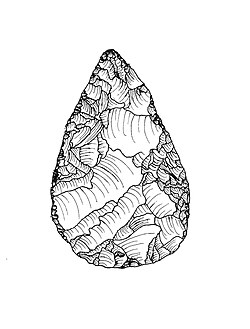
While Neanderthals utilized this technology to hunt large game, they primarily relied on ambush tactics and mêlée weapons, such as thrusting spears, rather than projectile weapons. Additionally, the widespread use of fire for cooking began around 250,000 years ago, which may have helped hominids survive in freezing climates by defrosting meat.
Summary of Middle Paleolithic Characteristics
| Feature | Description | Example/Evidence |
|---|---|---|
| Tool Technique | Levallois (Prepared-core) | Stone-tipped composite spears |
| Social Unit | Egalitarian Bands | Care for the elderly |
| Diet | Mixed Hunter-Gatherer | Shellfish, large catfish, smoked meat |
| Culture | Early Symbolic Behavior | Blombos Cave beads and ochre |
| Trade | Long-distance exchange | Trade of rare ochre (c. 120,000 BP) |
Notable Archaeological Sites
- Western Europe: Neandertal valley (Germany), Le Moustier (France), Axlor (Spain), and Grotte de Spy (Belgium).
- Middle East and Africa: Aterian sites (North Africa), Bisitun Cave (Iran), and Daş Salahlı (Azerbaijan).
- Open-air Sites: Biache-Saint-Vaast (France) and Veldwezelt-Hezerwater (Belgium).
Frequently Asked Questions
What is the difference between the Middle Paleolithic and the Middle Stone Age?
They are essentially synonyms. "Middle Paleolithic" is the term generally used for Europe, Asia, and Africa, while "Middle Stone Age" is specifically used within African archaeology.
What was the Levallois technique?
The Levallois technique was a sophisticated method of stone tool production where the core was carefully prepared before flakes were struck off. This allowed humans to create more controlled, consistent, and specialized tools, such as spear points.
Did Neanderthals have a religion?
Some anthropologists believe that intentional burials at sites like Krapina and the use of excarnation (ritual defleshing) suggest a developing religious ideology and a belief in an afterlife, though this remains a subject of scientific debate.
How did the division of labor work during this time?
While it was long assumed that men hunted and women gathered, some researchers suggest this strict sex-based division of labor did not actually exist until the Upper Paleolithic (after 45,000 years ago).
When did humans start cooking food?
Evidence suggests that the widespread use of fire for cooking began approximately 250,000 years ago, potentially aiding survival in cold regions by defrosting meat.