Copenhagen City Hall: A History of Six Architectural Eras
The current Copenhagen City Hall is a landmark of civic pride, but it is not the first building to serve this purpose. In fact, the present structure is the sixth city hall in the city's history. For centuries, the seat of municipal power shifted across the city center, evolving through various architectural styles and surviving devastating fires before settling in its current location.
Key Facts
- The current building is the sixth city hall of Copenhagen.
- Five of the six city halls were located near Gammeltorv and Nytorv.
- The current city hall was designed by architect Martin Nyrop.
- Construction of the current building took over ten years (1892–1905).
- The fifth city hall still exists today as the Copenhagen Court House.
The Early Medieval and Renaissance Halls
Copenhagen's first medieval town hall was situated at Gammeltorv (Old Square), the oldest square in the city and the heart of medieval market trade. Because of the age of the structure, historical records are sparse; there is no reliable information regarding its exact location, appearance, or date of construction.
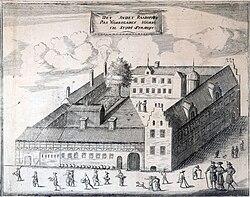
By the end of the 14th century, a second city hall was established at the corner of Nørregade and Studiestræde, positioned opposite the Church of Our Lady. This building eventually transitioned from a civic center to a bishop's palace.
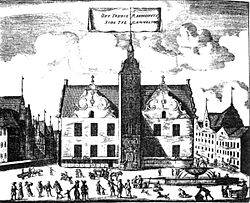
The third city hall returned to Gammeltorv around 1479. Between 1608 and 1610, King Christian IV oversaw its reconstruction into a Renaissance building—a style characterized by its symmetry and classical influence—featuring curved gables and a slender octagonal stair tower. This building served the city until it was destroyed by the great Copenhagen fire of 1728.
Baroque and Neoclassical Transitions
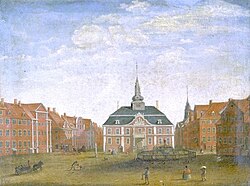
Following the 1728 disaster, a fourth city hall was immediately constructed on the same site. Designed by J.C. Ernst and J.C. Krieger, this building was crafted in the Baroque style, known for its ornate detail and grandeur. However, this structure met a similar fate to its predecessor, burning down during the great Copenhagen fire of 1795.
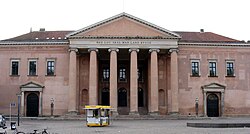
The path to the fifth city hall was fraught with delays due to the outbreak of the English Wars and a shortage of building materials. Completed in 1815, this version was located at Nytorv. Architect Christian Frederik Hansen designed it in the Neoclassical style, which emphasizes simplicity and the proportions of ancient Greek and Roman architecture. This building was intended to house both the city hall and a court house; today, it continues to serve the city as the Copenhagen Court House.
The Modern Era: The Sixth City Hall
By the late 19th century, Copenhagen had expanded so rapidly that the Nytorv building became inadequate. The city required a larger, more representative structure to reflect its growth. Following an architectural competition, the commission was awarded to architect Martin Nyrop, with Vilhelm Fischer serving as the supervisor of works.
Construction began in 1892 and spanned more than a decade. The sixth and current city hall was finally inaugurated on 12 September 1905, marking a new chapter in the city's administrative history.
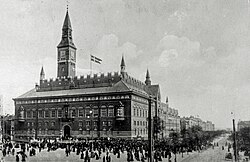
Summary of Copenhagen's City Halls
| Building | Location | Architectural Style / Note | Fate / Current Status |
|---|---|---|---|
| First | Gammeltorv | Medieval (Unknown) | Unknown |
| Second | Nørregade & Studiestræde | Later used as Bishop's Palace | Replaced |
| Third | Gammeltorv | Renaissance (Christian IV) | Destroyed by fire (1728) |
| Fourth | Gammeltorv | Baroque (Ernst & Krieger) | Destroyed by fire (1795) |
| Fifth | Nytorv | Neoclassical (C.F. Hansen) | Now Copenhagen Court House |
| Sixth | Current Location | Martin Nyrop | Inaugurated 1905 (Current) |
Frequently Asked Questions
How many city halls has Copenhagen had?
Copenhagen has had a total of six city halls throughout its history.
Where were the first five city halls located?
The first five were located at or near Gammeltorv and Nytorv, approximately 500 meters northeast of the current city hall's location.
What happened to the third and fourth city halls?
Both were destroyed by fire: the third in the great Copenhagen fire of 1728 and the fourth in the great fire of 1795.
What is the fifth city hall used for today?
The fifth city hall, designed by Christian Frederik Hansen, still exists and is currently used as the Copenhagen Court House.
Who designed the current Copenhagen City Hall?
The current city hall was designed by architect Martin Nyrop, with Vilhelm Fischer acting as the supervisor of works.