Conrad Habicht: The Mathematician and Confidant of Albert Einstein
While history often focuses on the singular genius of Albert Einstein, the development of his most revolutionary ideas occurred within a supportive network of intellectuals. Among the most significant of these figures was Conrad Habicht (1876–1958), a Swiss mathematician whose lifelong friendship with Einstein provided a window into the early years of modern physics.
Habicht was more than just a contemporary; he was a trusted peer who witnessed the personal and professional milestones of Einstein's early career in Bern. From the founding of an informal intellectual circle to the exchange of letters regarding the nature of the universe, Habicht played a quiet but essential role in the social fabric surrounding Einstein's scientific awakening.
Key Facts
- Co-founder of the Olympia Academy: Established an informal discussion group with Einstein and Maurice Solovine from 1902 to 1904.
- Personal Witness: Served as one of only two witnesses at Albert Einstein's 1903 wedding to Mileva Marić.
- Scientific Correspondent: Received Einstein's 1905 letters describing his Annus mirabilis (miracle year) papers and his work on quanta.
- Collaborative Inventor: Co-invented a meter for measuring very small electric potentials (millivolts) with Einstein and his brother, Paul Habicht.
- Academic Career: Taught mathematics and physics for 44 years across Schiers and Schaffhausen.
The Olympia Academy and Early Association
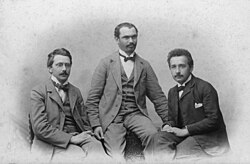
Between 1902 and 1904, Conrad Habicht, Maurice Solovine, and Albert Einstein formed the Olympia Academy. This was an informal circle of friends based in Bern who met regularly to engage in deep discussions regarding physics and philosophy. This intellectual sanctuary allowed Einstein to refine his thinking during a formative period of his life.
The bond between the men extended beyond academia. Habicht and Solovine were the only two witnesses present at Einstein's wedding to Mileva Marić in 1903, underscoring the deep personal trust Einstein placed in them.
Scientific Correspondence and Insights
Habicht was a primary recipient of some of the most important letters in the history of science. In 1905, Einstein wrote to Habicht to describe his Annus mirabilis papers—the series of groundbreaking publications that fundamentally changed our understanding of space, time, and matter. Habicht also received correspondence regarding the concept of quanta and Einstein's initial attempts to explain the perihelion advance of Mercury (the slight shift in the orbit of Mercury that general relativity eventually explained).
Academic Life and Professional Contributions
Born in Schaffhausen to Johann Conrad Habicht, a merchant, and Susanna Elisabetha Oechslin, Conrad Habicht pursued a rigorous education in mathematics and physics across Zurich, Munich, and Berlin. He earned his doctorate in 1903 at Bern, where his dissertation focused on the series of circles by Steiner.
Habicht's professional life was dedicated to education. He spent 11 years teaching university-level mathematics and physics in Schiers, Canton of the Graubünden, and another 33 years at the Schaffhausen Canton high school before retiring in 1948. Beyond the classroom, he was a talented violinist and later directed a local music academy.
Publications and Inventions
Habicht was a prolific writer, though he published exclusively in Swiss German. His works included:
- A biography of Gustav Kugler (1874–1939), the Rector of the Schaffhausen Canton school.
- Five editions of mathematics texts, including his dissertation.
- Six books (across 10 editions) published between 1943 and 1947 regarding the Swiss worldview.
- An educational article on the technical supervision of students.
In a practical application of his scientific knowledge, Habicht collaborated with Einstein and his brother, Paul Habicht—who was an innovator in automobile engine development—to invent a meter designed to measure very small electric potentials in millivolts.
Summary of Conrad Habicht's Life
| Category | Details |
|---|---|
| Lifespan | December 28, 1876 – October 23, 1958 |
| Education | Doctorate from Bern (1903); studied in Zurich, Munich, and Berlin |
| Key Association | Co-founder of the Olympia Academy with Albert Einstein and Maurice Solovine |
| Teaching Career | Schiers (11 years) and Schaffhausen Canton high school (33 years) |
| Notable Invention | Millivolt meter for small electric potentials |
Later Years and Legacy
After retiring from teaching in 1948, Habicht remained active in the arts, directing a music academy until 1958. Although he and Solovine had lost contact with Einstein for a period, they regained their connection in 1947. Habicht passed away four years after a serious accident, leaving behind a wife, four children, and ten grandchildren.
The enduring nature of his relationship with Einstein was highlighted in 2000 with the publication of a book containing their German-language correspondence, preserving their intellectual and personal exchange for future historians.
Frequently Asked Questions
What was the Olympia Academy?
The Olympia Academy was an informal circle of friends founded by Conrad Habicht, Maurice Solovine, and Albert Einstein in Bern between 1902 and 1904. The group met to discuss philosophy and physics.
How was Conrad Habicht connected to Einstein's personal life?
Habicht was a close personal friend of Einstein and served as one of the only two witnesses at Einstein's wedding to Mileva Marić in 1903.
What scientific documents did Habicht receive from Einstein?
Habicht received letters from Einstein regarding his 1905 Annus mirabilis papers, the nature of quanta, and Einstein's early work on the perihelion advance of Mercury.
Did Conrad Habicht contribute to any inventions?
Yes, Conrad Habicht, along with his brother Paul and Albert Einstein, invented a meter used for measuring very small electric potentials in millivolts.
What was Habicht's professional background?
Habicht was a mathematician and physicist who taught at the university level in Schiers and spent over three decades teaching at the Schaffhausen Canton high school.