Coins: The Evolution of Currency and Numismatic Art
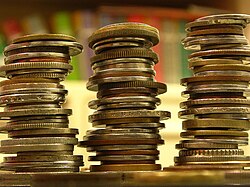
A coin is a small, typically round and flat object used primarily as a medium of exchange or legal tender. To facilitate efficient trade, coins are standardized in weight and produced in large quantities at a mint—a specialized facility for manufacturing currency. Most coins are issued by a government and feature images, numerals, or text to certify their value.
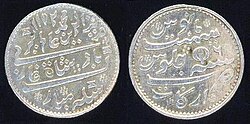
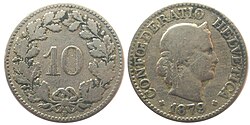
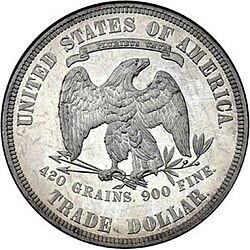
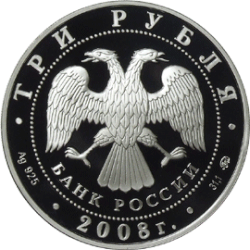
In numismatics, the two faces of a coin are referred to as the obverse (the front, often called "heads") and the reverse (the back, often called "tails"). While the obverse traditionally depicts a prominent person or national emblem, the reverse typically carries additional information or symbolic imagery.
Key Facts
- Standardization: Coins are produced with uniform weights and materials to ensure consistency in trade.
- Composition: Historically made from precious metals like gold and silver, modern coins often use base metals or bimetallic combinations.
- Portraiture: The practice of placing actual rulers' portraits on coins began in Lycia during the 5th century BC.
- Legal Tender: Most coins are government-issued and recognized by law as valid for the payment of debts.
- Variety: While most are round, coins can be square, polygonal, or even triangular.
The Origins of Coinage
![A siglos found in the Kabul valley, 5th century BC. Coins of this type were also found in the Bhir Mound hoard.[26][27]](/images/d1/c9/d1c92ad7381581aece829f7aff779c6d3465772dac0ffca71fcb8868d406064d.jpg)
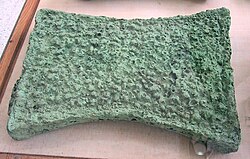
Before the invention of coins, societies used standardized metal pieces. In the Late Bronze Age, oxhide ingots—metal cast in the shape of an ox hide—represented standardized values for trade.
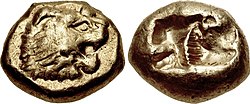
The transition to true coinage began in various regions. In China, early metal currency appeared as Tongbei around 1100 BC, with a coin factory operating in Henan between 640 and 550 BC. In the West, the Lydians and Ionians are credited with significant innovations around 600 BC, utilizing electrum (a natural alloy of gold and silver).
![The earliest inscribed coinage: electrum coin of Phanes from Ephesus, 625–600 BC. Obverse: Stag grazing right, ΦΑΝΕΩΣ (retrograde). Reverse: Two incuse punches, each with raised intersecting lines.[9]](/images/10/3d/103d9b8799f19b24233cba74e125a56463841d7c3c36b52b6ff1f08b42854dd7.jpg)
King Croesus (c. 560–546 BC) further revolutionized the system by introducing pure gold and silver coins, moving away from the mixed electrum of his predecessors.
Ancient and Classical Coinage
The Rise of Portraiture
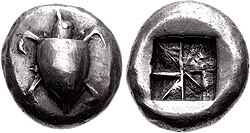
Early coins typically depicted gods or stereotypical figures. The first actual portraits of rulers appeared in Lycia during the 5th century BC. While the Achaemenid Empire used stylized busts on their sigloi and darics, the Athenian general Themistocles may have issued one of the earliest datable portrait coins while serving as Governor of Magnesia on the Meander (c. 465–459 BC).
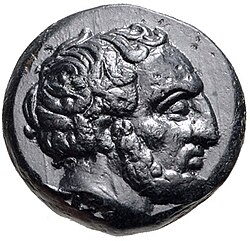
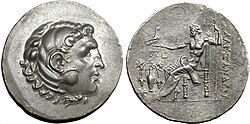
Following Alexander the Great, the practice of depicting the issuing ruler became a standard feature of coinage. The Indo-Greeks later produced some of the finest numismatic art, blending realism with idealization in large gold and silver coins.
Regional Developments
In Asia, the Eastern Zhou dynasty produced round coins during the Warring States Period (c. 300–220 BC). In the Philippines, tiny engraved gold coins known as Piloncitos have been discovered, alongside larger gold barter rings.
![The Piloncitos are tiny engraved gold coins found in the Philippines, along with barter rings, which are gold ring-like ingots. These barter rings are bigger than softballs in size and are made of pure gold from the Archaic period (c. 10th to 16th century).[86]](/images/04/92/04920b6d1b3d01a738a228e8420cb85fd2cddf5b2e629843b35d94e208dfdbef.jpg)
Medieval and Early Modern Transitions
![Athenian coin (c. 500/490–485 BC) discovered in the Shaikhan Dehri hoard in Pushkalavati, Pakistan. This coin is the earliest known example of its type to be found so far east.[35]](/images/4b/7f/4b7fe09d060e3cca7e61d31a86e20762e9bfc02022cc04ebcced555426141008.jpg)
In 800 AD, Charlemagne implemented reforms that established the silver penny as the standard denomination in Western Europe. However, the Middle Ages saw frequent debasement—the practice of reducing the precious metal content of a coin while maintaining its face value.
Italy became a center of monetary influence during this era. The Florentine florin, introduced in the 13th century, became one of the most important gold coins for international trade and taxes, while the Venetian sequin dominated Mediterranean commerce.
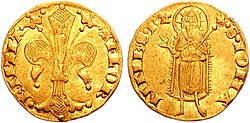
By the 16th century, Genoese banking grew in importance as the Spanish Empire funneled wealth from the Americas through the Bank of Saint George, though the Genoese lira eventually depreciated in the 17th century.
Modern Coinage and Value
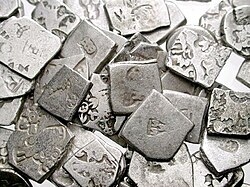
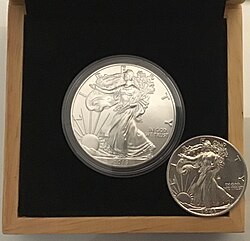
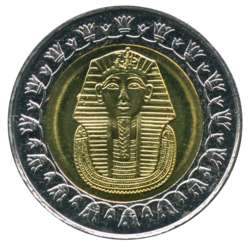
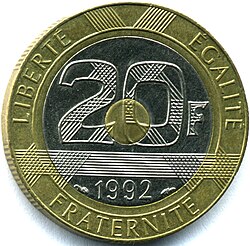
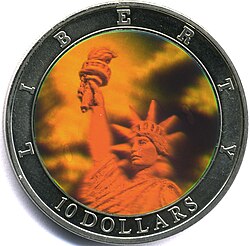
Modern coins vary widely in material and design. Some are bimetallic (made of two different metals) or feature holographic elements. Some countries also issue bullion coins, which are valued primarily for their precious metal content rather than their face value.
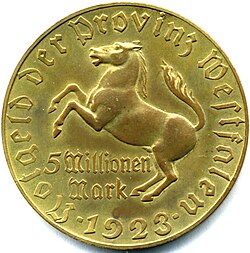
The United States provides a unique example of inflation's impact; the one-cent coin has remained largely unchanged since 1856, though its purchasing power has plummeted. In some cases, the raw metal content (copper, nickel, or zinc) exceeds the coin's fiat value (the value assigned by government decree).
Diverse Shapes and Features
While the circle is dominant, many nations use alternative shapes to help users (including the visually impaired) distinguish denominations. Examples include the twelve-sided Australian 50-cent coin, square coins from Aruba, and triangular commemorative coins from the Isle of Man.
| Period/Region | Key Innovation/Coin | Approximate Date | Significance |
|---|---|---|---|
| Lydia/Ionia | Electrum Coins | c. 600 BC | Early standardized metal currency |
| Lydia (Croesus) | Pure Gold/Silver | c. 560 BC | Shift to pure precious metals |
| Lycia | Ruler Portraiture | 5th Century BC | First use of actual human portraits |
| Western Europe | Silver Penny | 800 AD | Charlemagne's standardization |
| Florence | Florin | 13th Century | Major gold coin for international trade |
Frequently Asked Questions
![Chinese round coins, Eastern Zhou dynasty – Warring States Period, c. 300–220 BC. Four Hua (四化, 30mm, 6.94 g). Legend Yi Si Hua ([City of] Yi Four Hua).](/images/6d/24/6d247d5f9c0aedc0f258ff52ef67ce24611ca4727afcad34b0aad1abce71cceb.jpg)
What is the difference between the obverse and reverse of a coin?
The obverse is the "heads" side, which typically features a portrait or national emblem. The reverse is the "tails" side, which usually contains the coin's denomination and other symbolic imagery.
What does "debasement" mean in the context of coinage?
Debasement occurs when a government reduces the amount of precious metal (like gold or silver) in a coin, often replacing it with a cheaper base metal, while keeping the coin's face value the same.
What is a bullion coin?
A bullion coin is a coin minted from precious metals, such as gold or silver, whose primary value is derived from its metal content rather than its status as legal tender for daily transactions.
Are all coins round?
No. While most are round, coins can be square, triangular, decagonal, or have wavy edges. These shapes are often used for aesthetic reasons or to help distinguish between different denominations.
What is fiat value?
Fiat value is the legal value assigned to a coin by a government, regardless of the actual market value of the metal used to make the coin.