Coevolution: How Species Shape Each Other's Evolution
In the intricate web of life, species do not evolve in isolation. Instead, they often engage in a biological dance known as coevolution. This process occurs when two or more species reciprocally affect each other's evolution through natural selection. When one species develops a new trait, it exerts selective pressure on another species, which must then adapt to survive or thrive, creating a continuous cycle of mutual change.
The concept was touched upon by Charles Darwin in his 1859 work, On the Origin of Species, where he discussed the interactions between flowering plants and insects. Darwin used the term coadaptation to describe how these organisms evolve through reciprocal changes. By the 1940s, this phenomenon was observed in human-induced settings, such as breeding programs where crop plants and pathogens evolve in a constant cycle of resistance and counter-resistance.
Key Facts
![The pollinating wasp Dasyscolia ciliata in pseudocopulation with a flower of Ophrys speculum[1]](/images/d3/83/d383e58c827ad4c996d8e6bfb5e6daf4b98e6e4d1f1db0b532ca25d8ea323547.jpg)
- Reciprocal Influence: Coevolution requires that two or more species exert selective pressure on one another.
- Diverse Forms: It can manifest as mutualism (beneficial to both) or antagonism (beneficial to one, harmful to the other).
- Broad Impact: Coevolution drives major evolutionary transitions, including the development of sexual reproduction.
- Beyond Biology: The term is applied in other fields, including economics, sociology, and computer algorithms.
Types of Coevolutionary Relationships
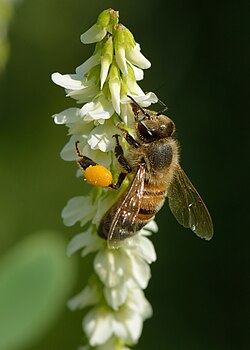
Mutualism
Mutualism is a form of coevolution where both species benefit from the interaction. One of the most prominent examples is the relationship between flowering plants and their pollinators.
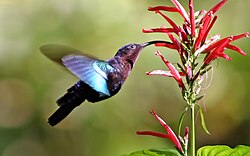
Insects and birds have evolved specialized traits to access nectar, while plants have evolved structures to ensure pollen is transferred. For instance, long-tongued bees and long-tubed flowers often coevolve in groups known as guilds.
![Long-tongued bees and long-tubed flowers coevolved, whether pairwise or "diffusely" in groups known as guilds.[49]](/images/3d/77/3d77b5db632b76c1a1d8010f27ba19f4430170be1037f048417d1050bf457e67.jpg)
Other specialized mutualisms include the relationship between figs and fig wasps, where the wasp pollinates the flower while the fig provides a place for the wasp to lay its eggs.
![A fig exposing its many tiny matured, seed-bearing gynoecia. These are pollinated by the fig wasp, Blastophaga psenes. In the cultivated fig, there are also asexual varieties.[24]](/images/43/43/43432260c5abd231caefef8fd99ec9e87bfa9e938d9c82ba1f86276c0e5d2877.jpg)
Similarly, certain acacia trees provide protein-rich Beltian bodies to Pseudomyrmex ants, which in turn protect the tree from herbivores.
![Pseudomyrmex ant on bull thorn acacia (Vachellia cornigera) with Beltian bodies that provide the ants with protein[25]](/images/d1/26/d126526c01565f1ee5ef6cacad784e20246490dadb546721c90216727ff04812.jpg)
Antagonistic Coevolution
Not all coevolution is friendly. Antagonistic coevolution occurs when species compete or prey upon one another, often leading to an evolutionary arms race.
This is frequently seen in predator-prey dynamics, where predators evolve better hunting techniques and prey evolve better defenses.
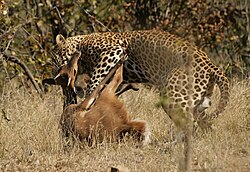
Host-parasite relationships also follow this pattern. Parasites evolve to bypass host defenses, while hosts evolve new ways to resist infection. This dynamic is sometimes linked to the evolution of sexual reproduction, as genetic diversity helps hosts stay ahead of rapidly evolving pathogens.
Brood parasitism is another extreme example, where a species like the common cuckoo tricks another bird into raising its young.
![Brood parasite: Eurasian reed warbler raising a common cuckoo[37]](/images/fb/e8/fbe8145511d2b7e266a4523aa485a0f07103a301234ae39e2f77329762cef03d.jpg)
Competition and Sexual Conflict
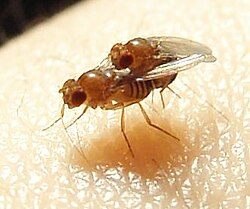
Coevolution can also occur within a species or between competitors. Sexual conflict, for example, occurs when the evolutionary interests of males and females differ, leading to reciprocal adaptations in mating behaviors, as seen in Drosophila melanogaster.
Theoretical Frameworks and Applications
The Geographic Mosaic Theory
The geographic mosaic theory of coevolution suggests that coevolution does not happen uniformly across a species' entire range. Instead, it occurs in a patchwork of "hot spots" (where selection is intense) and "cold spots" (where it is weak), driven by local environmental conditions and genetic variation.
Coevolution Outside Biology
The principles of coevolution have been adopted by other disciplines to describe how complex systems interact:
- Economics and Sociology: Scholars like John Gowdy and Richard Norgaard suggest that the economy, society, and the environment are linked in a coevolutionary relationship.
- Computer Science: In system development and algorithms, coevolution is used to evolve coadapted subcomponents or optimize procedures.
- Astronomy: The term is used to describe the joint evolution of galactic nuclei and globular cluster systems.
| Type | Nature of Interaction | Example |
|---|---|---|
| Mutualism | Both species benefit | Bees and flowering plants |
| Antagonism | One benefits, one is harmed | Predators and prey |
| Parasitism | Parasite benefits at host's expense | Cuckoos and host birds |
| Sexual Conflict | Conflicting reproductive interests | Mating dynamics in fruit flies |
Frequently Asked Questions
What is the difference between coevolution and coadaptation?
While often used interchangeably, coevolution refers to the reciprocal genetic change in two species over time, whereas coadaptation refers to the resulting state of being well-suited to one another.
Can coevolution happen between a human and another species?
Yes. An example is the human-induced coevolution seen in agriculture, where the development of disease-resistant crop varieties forces pathogens to evolve new ways to infect the plants.
What is an evolutionary arms race?
An evolutionary arms race is a form of antagonistic coevolution where two species continuously develop adaptations and counter-adaptations, such as a prey species evolving better camouflage and a predator evolving better eyesight.
How does coevolution affect biodiversity?
Coevolution can drive diversification. For example, the reciprocal evolution between plants and butterflies is thought to have contributed to the vast number of species within both groups.
Does coevolution always benefit the species involved?
No. In mutualism, both benefit, but in antagonistic coevolution (like parasitism or predation), one species typically benefits at the expense of the other.