Coast Guard Air Station San Francisco: A History of Maritime Rescue
Established as one of the longest-tenured tenants at San Francisco International Airport (SFO), Coast Guard Air Station San Francisco has served as a critical hub for maritime safety and security for over eight decades. From its inception in the early 1940s to its modern operations, the station has evolved its fleet and capabilities to meet the demanding needs of the California coastline.
Key Facts
- Established: February 15, 1941.
- Primary Mission: Maritime Search and Rescue (SAR) along 300 miles of coastline from Point Conception to Fort Bragg.
- Operational Scope: Includes Homeland Security, Law Enforcement, Environmental Protection, and Cliff Rescue.
- Historical Significance: Played a vital role in constructing secret LORAN stations during World War II.
- Current Fleet Evolution: Transitioned from fixed-wing aircraft to advanced rotary-wing helicopters like the HH-65 series.
Early Years and World War II
The air station began operations on February 15, 1941, initially utilizing a PBY-5 Catalina and two RD-4 Dolphins. Shortly after, on November 1, 1941, the personnel and aircraft were placed under Navy command. During this period, the base was known as both Naval Auxiliary Air Facility Mills Field and Coast Guard Air Station, San Francisco.
Throughout World War II, the station focused on coastal patrols and Search and Rescue (SAR). In 1943, the station was tasked with a highly classified mission: aiding the construction of Long Range Navigation (LORAN) stations—a radio navigation system—in the North Pacific. The PBY-5 Catalina proved essential to this effort, transporting the necessary supplies, building materials, and personnel to complete the Aleutian LORAN chain.
Post-War Evolution and the Shift to Helicopters
Control of the air station returned to the Coast Guard on June 30, 1946. The late 1940s marked a technological shift with the arrival of the first helicopter, the HO3S-1 Dragonfly, in 1947. By the early 1950s, the aging World War II fixed-wing aircraft were replaced by the Grumman HU-16 Albatross. Known affectionately as the "Goat," this general-purpose amphibian became a versatile platform for both SAR and Law Enforcement (LE).
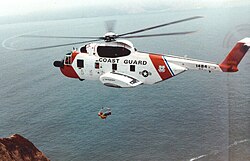
The station's capabilities further expanded in 1963 with the introduction of the HH-52A Sea Guard helicopter, which offered superior flight characteristics over previous models.
The End of Fixed-Wing Aviation
For 37 years, fixed-wing aviation was a staple of the San Francisco station, including the operation of C-130s. However, this era ended in 1978 when the C-130s were relocated to the newly established Coast Guard Air Station Sacramento.
Modern Fleet and Expanded Missions
The 1990s and 2000s saw a rapid succession of aircraft upgrades to maintain operational efficiency. In 1991, the HH-60 J-Hawk replaced the HH-3F Pelican as the medium-range SAR helicopter. By June 1996, four HH-65s were transferred from San Diego to San Francisco. This fleet evolved into the HH-65B in 2001 with upgraded avionics, and finally into the HH-65C in 2006 following the installation of Turbomeca Arriel 2C2-CG engines.
While the aircraft have changed, the core mission remains the same: protecting 300 miles (480 km) of coastline. Today, the station's responsibilities have expanded to include:
- Homeland Security and Maritime Law Enforcement.
- Environmental Protection and Aids to Navigation.
- Logistics and specialized Cliff Rescue operations.
Administrative Changes and Point Mugu
Between 2016 and 2024, the station underwent a period of administrative expansion. Following the closure of Coast Guard Air Station Los Angeles and the expiration of its lease at LAX, its component units were reassigned to Air Station San Francisco. These units operated out of Naval Air Station Point Mugu (part of Naval Base Ventura County) until the commissioning of the new Coast Guard Air Station Ventura in November 2024.
| Era/Year | Aircraft Model | Type/Role |
|---|---|---|
| 1941 | PBY-5 Catalina / RD-4 Dolphin | Fixed-wing / Amphibian |
| 1947 | HO3S-1 Dragonfly | First Helicopter |
| Early 1950s | Grumman HU-16 Albatross | General Purpose Amphibian |
| 1963 | HH-52A Sea Guard | Rotary-wing SAR |
| 1991 | HH-60 J-Hawk | Medium-range SAR |
| 1996-2006 | HH-65 (B and C variants) | Modern SAR Helicopter |
Frequently Asked Questions
What is the primary area of responsibility for Air Station San Francisco?
The station is responsible for maritime Search and Rescue along 300 miles (480 km) of coastline, stretching from Point Conception to Fort Bragg.
What role did the station play during World War II?
Under Navy command, the station conducted coastal patrols and SAR. It was also instrumental in transporting personnel and materials to build secret Long Range Navigation (LORAN) stations in the North Pacific.
When did the station stop using fixed-wing aircraft?
Fixed-wing aviation ended in San Francisco in 1978 when the C-130 aircraft were moved to Coast Guard Air Station Sacramento.
What is the current primary aircraft used by the station?
The station transitioned to the HH-65 series, specifically upgrading to the HH-65C in 2006, which features Turbomeca Arriel 2C2-CG engines.
Why were units moved to Point Mugu between 2016 and 2024?
Following the permanent closure of Coast Guard Air Station Los Angeles and the expiration of its lease at LAX, component units were administratively reassigned to Air Station San Francisco and housed at NAS Point Mugu until CGAS Ventura opened in November 2024.