Clines in Biology: Mapping the Gradients of Life
In the natural world, biological traits rarely change in sudden, isolated jumps. Instead, many species exhibit gradual shifts in characteristics across their geographic ranges. In biology, this measurable gradient in a single trait is known as a cline. Whether it is a change in genetic markers like allele frequency or physical traits like body size and skin pigmentation, clines provide a visual map of how species adapt to their environments.
The term was coined by Julian Huxley in 1938, derived from the Greek word klinein, meaning "to lean." While often confused with the term ecotype—which refers to a population differing in multiple characters—a cline specifically describes the variation of a single, specific trait. Because a single population can possess multiple independent clines, Huxley described them as an "auxiliary taxonomic principle," meaning they are used to understand variation rather than to define new subspecies or species.

Key Facts
- A cline is a spatial gradient in a single biological trait across a geographic range.
- Clines can be genetic (e.g., blood type) or phenotypic (e.g., body size).
- The two primary drivers of clines are natural selection and gene flow.
- Clines can arise through primary differentiation or secondary contact.
- Ring species are a unique phenomenon where clinal variation eventually prevents interbreeding at the ends of a range.
The Drivers of Clinal Variation
Clines are typically the result of a tug-of-war between two opposing evolutionary forces: selection and gene flow (migration). Selection acts as a diversifying force, pushing populations to adapt to local environmental conditions. Conversely, gene flow acts as a homogenizing force, spreading genetic material between populations and blurring distinct boundaries.
Primary Differentiation
Clines often develop through primary differentiation, where populations gradually change as they spread into new environments. While high levels of gene flow can "swamp" local adaptations, restricted gene flow—often due to limited dispersal ranges—allows geographic differentiation to take hold. If migration ceases entirely, these populations may eventually undergo speciation.
A famous example is the peppered moth (*Biston betularia*) in the UK. During the Industrial Revolution, coal soot darkened tree trunks in northern England. This environmental shift created a selective pressure where darker (melanic) moths were better camouflaged than lighter ones. This resulted in a cline where melanic morphs became more frequent in polluted northern regions compared to the lighter populations in the west.

Secondary Contact
Another way clines form is through secondary contact. This occurs when two populations that were previously isolated in allopatry (geographic separation) expand their ranges and meet. This meeting creates an intermediate zone of genetic or phenotypic blending.
For a cline to remain stable after secondary contact, there must be a selective pressure preventing the two groups from merging into one homogenous population. If the populations were highly different to begin with, the resulting cline might be very steep. Over time, however, increased genetic admixture usually erodes these differences, making the cline shallower.

Clinal Structure and Classification
The steepness of a cline—its gradient—indicates how rapidly a trait changes over a distance. A steep cline suggests rapid change, perhaps due to a sudden environmental boundary or strong selection against hybrids. A shallow cline suggests gradual change or long-term gene flow that has smoothed out differences.
The width of a cline is inversely related to its slope: a steep slope results in a narrow width, while a shallow slope results in a wide width.
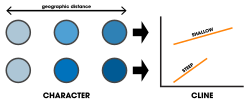
Huxley's Categories of Clines
Julian Huxley classified clines into two main categories based on how they transform across a range:
- Continuous Clines: These occur in populations that can interbreed throughout their entire range. They can be smooth (a uniform gradation) or stepped (a shallow gradient interrupted by steep sections). Stepped clines can be horizontal (uniform populations connected by sharp changes) or oblique (a "stepped ramp" where each population also shows its own internal gradation).
- Discontinuous Stepped Clines: These occur in allopatric populations with little to no gene flow. The trait changes sharply between groups, even if there is slight variation within the groups themselves.

Clines and the Process of Speciation
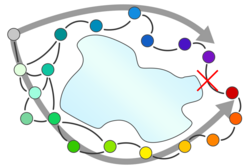
Historically, scientists believed that complete geographic isolation was required for speciation (allopatric speciation). However, the discovery of ring species challenged this. In a ring species, populations are connected in a continuous chain of interbreeding groups around a geographic barrier, yet the populations at the two terminal ends of the chain are so different they can no longer interbreed. This suggests that clines can indeed be a precursor to the formation of new species.

Ecogeographical Rules and Real-World Examples
Many observed clines are so consistent they are referred to as ecological "rules." These include:
- Gloger's Rule: Observations that avian plumage pigmentation tends to correlate with humidity, with birds in arid equatorial regions often being darker than those in less arid areas.
- Bergmann's Rule: The principle that homeotherms (warm-blooded animals) in colder climates tend to be larger than their counterparts in warmer climates. This is likely due to a smaller surface-area-to-volume ratio, which aids in heat conservation.
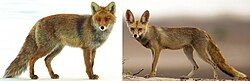
Other notable examples include:
- Human Blood Types: Clines in Type B and Type A blood frequencies have allowed scientists to trace ancient human migrations.
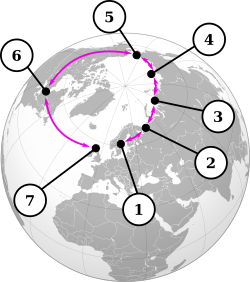
- Larus Gulls: A complex example of interbreeding populations forming a ring around the Arctic.
| Term | Definition | Key Driver/Feature |
|---|---|---|
| Cline | A geographic gradient in a single trait. | Selection vs. Gene Flow |
| Primary Differentiation | Clines formed during initial range expansion. | Local adaptation |
| Secondary Contact | Clines formed when isolated populations meet. | Hybrid zones |
| Ring Species | A chain of populations where terminal ends cannot interbreed. | Speciation precursor |
Frequently Asked Questions
What is the difference between a cline and an ecotype?
A cline refers to the variation of a single specific trait across a range, whereas an ecotype refers to a population that differs from others in multiple characters.
Can a cline exist without natural selection?
Yes, it is theoretically possible for clines to be generated by genetic drift alone, particularly in small populations over short distances. However, these are often "transient clines" that are unstable and random.
What causes a cline to be "steep"?
A steep cline can be caused by strong selective pressures, a sudden change in the environment, or by two highly differentiated populations that have only recently come into contact.
How do clines help us understand human history?
By studying clines in human traits, such as blood type frequencies, scientists can infer patterns of ancient migration and genetic admixture between different populations.
What is Bergmann's Rule?
Bergmann's Rule is an ecological observation that animals in colder climates tend to be larger than those in warmer climates to help conserve body heat.