Clara Zetkin: Pioneer of Socialist Feminism and International Women's Day
Clara Zetkin was a formidable force in the early 20th-century struggle for workers' rights and gender equality. A devoted Marxist and political strategist, she bridged the gap between the labor movement and the fight for women's liberation, arguing that true equality for women could only be achieved through the dismantling of capitalist structures. From her early days in exile to her role in the German Reichstag, Zetkin's life was a testament to her unwavering commitment to the proletariat.
Background and Education
Born Clara Josephine Eißner in July 1857 in the Saxon village of Wiederau, she was the eldest of three children. Her father, Gottfried Eissner, was a devout Protestant schoolmaster and organist, while her mother, Josephine Vitale, was a highly educated woman of French descent from Leipzig. Clara's intellectual foundation was laid at the Leipzig Teachers' College for Women, where she first encountered the emerging Sozialdemokratische Partei Deutschlands (SPD), or Social Democratic Party.
The political climate of the 1870s proved hostile to socialist ideals. Following the 1878 ban on socialist activities imposed by Otto von Bismarck, Zetkin sought refuge in Zürich and later Paris. In France, she trained as a journalist and translator and became a key figure in the foundation of the Socialist International. It was during this period that she adopted the name of her partner, Ossip Zetkin, a Russian Jewish Marxist. Together they had two sons, Maxim and Konstantin. After Ossip's death in June 1889, Clara moved to Stuttgart, later marrying artist Georg Friedrich Zundel in 1899.
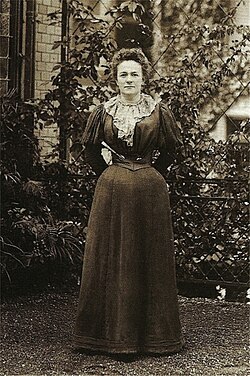
Early Engagement in the Social Democratic Party
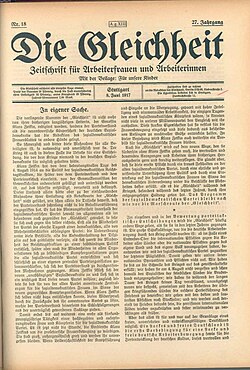
Zetkin's political awakening was rooted in the Marxist approach to women's liberation. By 1878, she had joined the Socialist Workers' Party (SAP), a precursor to the SPD formed by the merger of the ADAV (founded by Ferdinand Lassalle) and the SDAP (founded by August Bebel and Wilhelm Liebknecht). Upon her return to Germany after a decade of exile, she took the helm of Die Gleichheit (Equality), the SPD's newspaper for women, a position she held for 25 years.
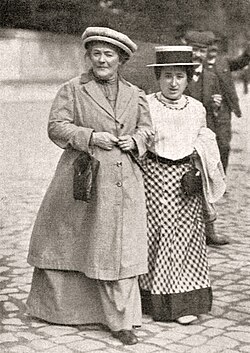
During this era, Zetkin formed a profound political and personal bond with Rosa Luxemburg. For two decades, they stood as the vanguard of the SPD's far-left wing. Together, they fiercely opposed the "Revisionism" of Eduard Bernstein, who advocated for an evolutionary transition to socialism rather than a revolutionary one.
The Fight for Women's Rights
Zetkin's vision for women's rights was inextricably linked to socialism. She championed equal opportunities and women's suffrage, but she remained a staunch critic of bourgeois feminism—the movement led by middle-class women. Zetkin argued that bourgeois feminism served as a tool to divide the working class, whereas she believed women's liberation must be a collective effort of all workers, regardless of gender.
One of her most enduring legacies is the establishment of International Women's Day (IWD). In August 1910, at an International Women's Conference in Copenhagen, Zetkin and Käte Duncker proposed an annual day to promote women's suffrage. The first IWD was observed on March 19, 1911, drawing over a million participants across Germany, Austria, Denmark, and Switzerland.
Opposition to War and the Shift to Communism
The outbreak of World War I created a rift within the SPD. Zetkin, alongside Karl Liebknecht and Rosa Luxemburg, rejected the party's policy of Burgfrieden (a political truce with the government to avoid strikes during the war). Her anti-war activism, including the organization of an international socialist women's anti-war conference in 1915, led to multiple arrests and a period of "protective custody" in 1916.
This disillusionment led her to co-found the Spartacist League and the Independent Social Democratic Party of Germany (USPD) in 1916-1917. Following the German Revolution, she joined the newly formed Communist Party of Germany (KPD) in January 1919. Zetkin represented the KPD in the Reichstag from 1920 until 1933.
Role in the Comintern
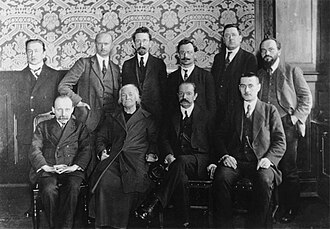
Zetkin's influence extended globally through the Communist International (Comintern). She presided over the international secretariat for women and chaired the Second International Conference of Communist Women in Moscow in 1921. It was at this conference that the date of International Women's Day was officially changed to March 8, the date it remains today.
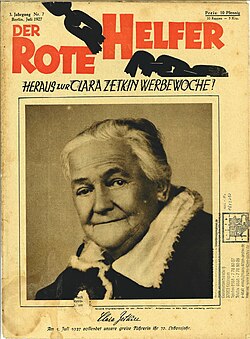
Despite her high standing, Zetkin was not afraid to challenge the Soviet leadership. She opposed Joseph Stalin's 1928 directive to split communist trade unions from the main socialist federation, making her one of only three executive members to vote against the move.
Exile, Death, and Legacy
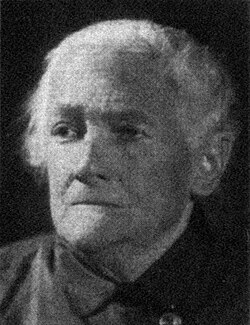
The rise of the Nazi Party in 1933 and the subsequent Reichstag fire led to the banning of the KPD. Zetkin fled to the Soviet Union for her final exile. She passed away in Arkhangelskoye, near Moscow, in 1933 at the age of 75. She was buried in the Kremlin Wall Necropolis, with her funeral attended by prominent communists, including Joseph Stalin and Nadezhda Krupskaya.
Zetkin's legacy remains complex. While she was a pioneer for women's rights, her philosophy clashed with the "second-wave" feminism of the 1960s and 70s. While later movements often excluded men to create women-only spaces, Zetkin believed that the liberation of women required the active cooperation of men within the working class.
Key Facts
- International Women's Day: Proposed by Zetkin in 1910; the date was later finalized as March 8 in 1921.
- Journalism: Edited Die Gleichheit for 25 years, growing its circulation forty-fold by 1910.
- Political Affiliations: Member of the SAP, SPD, USPD, and KPD.
- Legislative Role: Represented the KPD in the German Reichstag from 1920 to 1933.
- Core Philosophy: Opposed "bourgeois feminism," advocating instead for a socialist approach to women's liberation.
| Period | Organization/Role | Key Contribution/Event |
|---|---|---|
| 1878 | Socialist Workers' Party (SAP) | Initial entry into organized socialist politics. |
| 1891–1917 | Editor of Die Gleichheit | Mobilized female working class toward socialism. |
| 1910 | International Women's Conference | Proposed the creation of International Women's Day. |
| 1916–1917 | Spartacist League / USPD | Opposed WWI and the SPD's pro-war stance. |
| 1920–1933 | KPD / Reichstag | Represented the Communist Party in the German parliament. |
| 1921 | Comintern Conference | Established March 8 as International Women's Day. |
Frequently Asked Questions
What is the difference between Zetkin's views and bourgeois feminism?
Zetkin believed that bourgeois feminism focused on the needs of middle- and upper-class women, which she argued divided the working class. She believed women's liberation could only be achieved through a socialist revolution that freed all workers from capitalist exploitation.
How did Clara Zetkin contribute to International Women's Day?
Zetkin proposed the idea of a dedicated women's day at a 1910 conference in Copenhagen to promote suffrage. Later, while chairing a 1921 conference in Moscow, she helped establish March 8 as the permanent date for the observance.
Why did Zetkin leave the SPD?
Zetkin left the SPD due to its policy of Burgfrieden during World War I, which involved a truce with the government and a refusal to strike. She viewed this pro-war stance as a betrayal of socialist principles.
What was the significance of the newspaper Die Gleichheit?
Die Gleichheit (Equality) served as a primary tool for mobilizing working-class women. Under Zetkin's leadership, it addressed issues such as child labor, women's suffrage, and worker strikes, significantly increasing the political consciousness of women in the labor movement.
Where did Clara Zetkin spend her final days?
After the Nazi party banned the KPD in 1933, Zetkin went into exile in the Soviet Union, where she died in Arkhangelskoye, near Moscow.