Christian Art: The Evolution of Angelic Imagery
Because angels are defined as pure spirits without a fixed physical form, artists throughout history have enjoyed immense creative freedom in how they portray these celestial beings. From the early catacombs of Rome to the grand mosaics of the Byzantine Empire and the refined canvases of the Renaissance, the visual language of angels has shifted to reflect the theological, political, and aesthetic values of each era.
The Early Church: From Men to Winged Messengers
In the earliest stages of Christian art, angels were typically depicted as young men. This anthropomorphic approach—assigning human characteristics to non-human entities—was rooted in biblical descriptions, such as those in Genesis 19:5 and Daniel 8:15, where the angel Gabriel appears in the "likeness of man."
Interestingly, the earliest known Christian image of an angel, found in the middle of the third century in the Cubicolo dell'Annunziazione (Catacomb of Priscilla), shows Gabriel without wings. This wingless depiction was common on early lamps, reliquaries, and sarcophagi, including the Sarcophagus of Junius Bassus. In some early frescoes, angels were replaced entirely by symbols, such as a dove or the Hand of God.
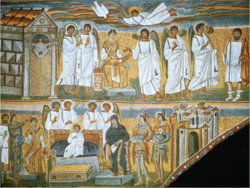
The transition to winged angels began around the time of Theodosius I (379–395), as seen on the Prince's Sarcophagus. These images were heavily influenced by the winged Victories of classical art. Saint John Chrysostom explained that wings did not imply that angels physically possessed them, but rather served as a symbol of their sublimity—indicating their ability to descend from the highest heavens to interact with humanity.
Higher Orders of Angels
As artistic traditions evolved, multi-winged angels—often appearing as only a face surrounded by wings—emerged. These representations of cherubim and seraphim (the highest ranks of the angelic hierarchy) were influenced by Persian art. Unlike messengers on Earth, these beings are typically depicted in heavenly contexts, such as the pendentives (the curved triangular sections supporting a dome) of churches.
Byzantine Art: Imperial Influence and Military Might
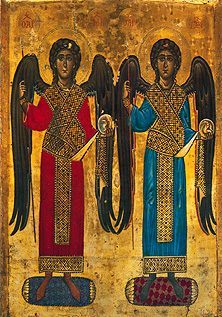
Byzantine artists blended classical Greek influences with the rigid iconography of the Imperial court. Some scholars, such as Amelia R. Brown, suggest that the depiction of angels was influenced by the appearance of court eunuchs. These officials often possessed distinctive skeletal structures and fine features, wearing white tunics decorated with gold—a look that mirrored the "comely" and refined aesthetic desired for celestial beings.
The portrayal of angels also took on a military character. Archangel Michael, acting as God's military agent, was often shown in Late Antique military uniforms. This included the loros—a jeweled, gold pallium reserved for the Imperial family and their closest guards. While some angels wore simple long robes, the military dress of the archangels persisted in Eastern Orthodox icons well into the modern era.
Medieval and Renaissance Transformations
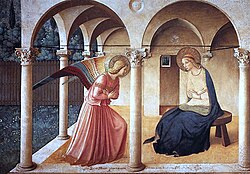
Medieval art continued to build upon Byzantine foundations but added layers of ecclesiastical symbolism. In scenes of the Annunciation, Gabriel was often dressed as a deacon, wearing a cope over a dalmatic. This specific choice of vestment served a theological purpose: it signaled that angels, despite their power, could not perform the Eucharist, thereby reinforcing the prestige and necessity of the human clergy.
While early Christian art favored white robes, the medieval period introduced brilliant colors for senior angels. By the Early Renaissance, painters like Jan van Eyck and Fra Angelico began depicting angels with multi-colored wings, blending spiritual beauty with contemporary feminine ideals of grace.
The Rise of the Putto
During the Italian Renaissance, the classical erotes or putto (plump, winged infants) reappeared. In English, these are often called "cherubs," though they differ from the high-ranking biblical cherubim. These figures often appear in groups, sometimes as winged heads, acting as attendants or amusing the infant Christ in Holy Family scenes. This era also saw a distinction between these religious figures and the mythological Eros and Cupid, who used arrows to inspire romantic love.
Victorian and Modern Interpretations
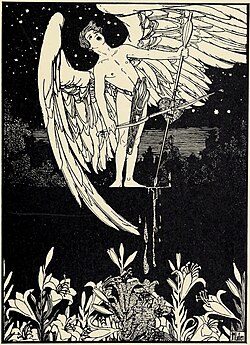
In the late 19th century, the Pre-Raphaelite painters moved away from classical norms. Using model Jane Burden Morris, artists like Edward Burne-Jones created a new Victorian prototype: an angel with long dark hair and androgynous features, which became a staple of paintings and stained glass.
Angelic imagery persisted into the 20th century, evolving into large-scale modern works. A notable example is the 1963–68 mosaic mural Angels of the Heavenly Host by Charles Lutyens in St Paul's, Bow Common.
Key Facts
- Early Depictions: The first Christian angels (3rd century) were wingless and appeared as young men.
- Symbolism of Wings: Wings were adopted from classical "Victory" figures to symbolize the sublimity of nature, not physical anatomy.
- Byzantine Influence: Angelic attire often mirrored the dress of Imperial court eunuchs and the Emperor's bodyguard (the loros).
- Ecclesiastical Hierarchy: Medieval angels were often dressed as deacons to show they were outranked by priests regarding the Eucharist.
- Renaissance Shift: The "cherub" in Renaissance art is derived from the classical putto rather than the biblical high-ranking cherubim.
| Period | Primary Visual Characteristics | Key Influences |
|---|---|---|
| Early Church | Wingless young men; later winged pairs | Biblical text; Classical Victories |
| Byzantine | Imperial tunics, gold loros, military armor | Court eunuchs; Imperial guards |
| Medieval | Deacon's vestments (cope and dalmatic) | Church hierarchy and clergy prestige |
| Renaissance | Multi-colored wings; putti (winged infants) | Classical erotes; feminine ideals of grace |
| Victorian | Androgynous features, long dark hair | Pre-Raphaelite aesthetics (Jane Burden Morris) |
Frequently Asked Questions
Why were early Christian angels depicted without wings?
Early artists followed biblical descriptions of angels appearing as men. The use of wings was a later development, borrowed from classical art to symbolize the spiritual nature and sublimity of the beings.
What is the significance of the loros in Byzantine art?
The loros was a jeweled gold pallium worn by the Byzantine Imperial family and their closest guards. In art, it was used to depict archangels, such as Michael, as high-ranking military agents of God.
Why were medieval angels often dressed as deacons?
By dressing angels in the vestments of a deacon, artists indicated that angels could not perform the Eucharist. This reinforced the spiritual authority and prestige of the human priesthood.
What is the difference between a biblical cherub and a Renaissance cherub?
In biblical hierarchy, cherubim are high-ranking celestial beings, often depicted as multi-winged faces. In Renaissance art, "cherubs" are actually based on the classical putto—small, plump, winged children.
How did the Pre-Raphaelites change the image of the angel?
They moved away from traditional forms, using the androgynous features and long dark hair of model Jane Burden Morris to create a distinct Victorian prototype for angels in painting and glasswork.