Man of Sorrows: The Evolution of a Devotional Icon
The Man of Sorrows is a profound biblical term and a powerful artistic motif that serves as a visual meditation on the suffering of Jesus Christ. Rooted in the prophetic writings of the Hebrew Bible, this image transitioned from a scriptural prefiguration of the Messiah into one of the most influential devotional icons of the Middle Ages and the Renaissance, particularly across Northern Europe.
Unlike narrative scenes that tell a story, the Man of Sorrows is an Andachtsbild—a type of devotional image detached from a specific chronological event in the Passion. Its primary purpose was to facilitate mystical contemplation, allowing the viewer to focus intensely on the physical and spiritual agony of Christ.
Key Facts
- Biblical Origin: Derived from the "Servant songs" in Isaiah 53 of the Hebrew Bible.
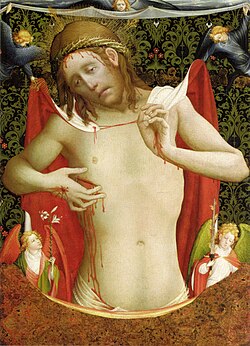
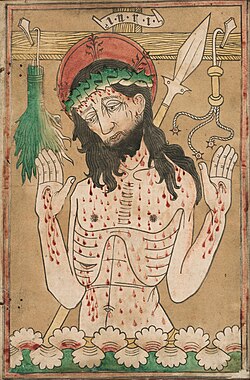
- Visual Markers: Typically depicts Christ naked above the waist, displaying the wounds of the Passion (ostentatio vulnerum).
- Core Purpose: Designed for private meditation and mystical contemplation rather than theological study.
- Regional Variations: German depictions often show Christ with open eyes looking at the viewer, while Italian versions frequently retained the closed eyes of Byzantine originals.
- Historical Peak: Gained immense popularity in the 13th century and surged during the Jubilee Year of 1350.
Biblical Foundations
The term "Man of Sorrows" (Hebrew: ’îš maḵ’ōḇōṯ*; Latin: vir dolōrum) originates from Isaiah 53:3. This passage describes a figure who is "despised and rejected of men, a Man of sorrows, and acquainted with grief." The scripture emphasizes that this figure bore the griefs and iniquities of others, being wounded and bruised to bring healing to the people.
These verses provided the theological framework for the image, framing Christ not just as a historical figure, but as the eternal bearer of human suffering.
The Development of the Iconography
The visual tradition evolved from the Byzantine epitaphios image, dating back possibly to the 8th century. A significant precursor was the Imago Pietatis (Christ of Pity), a Byzantine mosaic icon brought to the church of Santa Croce in Gerusalemme in Rome during the 12th century.
By the 13th century, the image became a staple of Western sculpture, painting, and manuscripts. Its popularity reached a peak during the Jubilee Year of 1350, when a papal indulgence of 14,000 years was granted to those who prayed before the Roman icon.
Artistic Variations and Symbolism
While the core image depicts Christ with the wounds of the Crucifixion, including the spear-wound in his side, various sub-forms emerged:
- Arma Christi: The inclusion of the "Instruments of the Passion," such as the cross or the Crown of Thorns.
- Eucharistic Emphasis: Depictions where blood flows from Christ's wounds into a chalice.
- Celestial Support: Angels appearing to support the slumped figure of Christ or hold the instruments of his torture.
- The Throne of Mercy: A representation of the Trinity where God the Father supports a diminutive Man of Sorrows.
Theological Interpretations
The Man of Sorrows often represented the dual nature of Christ. By showing him as both dead (as a man) and yet conscious or alive (as God), the image bridged the gap between human mortality and divine eternity. This is particularly evident in the Christus dolens (suffering Christ) and the Pensive Christ variations.
![Man of Sorrows (c. 1485–1495), an especially complex version by Geertgen tot Sint Jans, Dutch, 25 × 24 cm[4]](/images/f1/d5/f1d536b90690ad07e3cf693e3abeac3b0e1ed7e77f1116a591ea2ea6a76f9f4a.jpg)
Summary of Iconographic Elements
| Feature | Common Depiction | Regional/Specific Variation |
|---|---|---|
| Eyes | Open or Closed | Open in Germany; Closed in Italy (Byzantine style) |
| Posture | Half-length, slumped head | Full-length figures appeared in 13th-century Southern Germany |
| Attributes | Wounds of the Passion | Addition of Arma Christi or a chalice for blood |
| Context | Isolated devotional image | Integrated into the "Mass of Saint Gregory" vision |
Frequently Asked Questions
What is the difference between the Man of Sorrows and a Crucifixion scene?
A Crucifixion scene is a narrative depiction of the event of Christ's death on the cross. The Man of Sorrows is an Andachtsbild, meaning it is a non-narrative, devotional image intended for meditation, often showing Christ after the descent from the cross.
What does "ostentatio vulnerum" mean?
Ostentatio vulnerum is a Latin term meaning the "showing of the wounds." In art, it refers to the specific feature where Christ prominently displays the wounds on his hands and side to the viewer.
How did the Jubilee Year of 1350 affect this image?
The Jubilee Year significantly boosted the image's popularity because the Roman icon of the Man of Sorrows was granted a papal indulgence of 14,000 years for those who prayed in its presence.
Which biblical book provides the basis for the Man of Sorrows?
The iconography is primarily based on the "Servant songs" found in Isaiah 53 of the Hebrew Bible, which describes the Messiah as a man of sorrows acquainted with grief.
What is the relationship between the Man of Sorrows and the Mass of Saint Gregory?
The Mass of Saint Gregory is a traditional narrative where Saint Gregory the Great has a vision of the Man of Sorrows; the icon of the suffering Christ is the central figure of that vision.