Chinamax Shipping Standards and Vessel Specifications
In the world of global maritime logistics, ship size standards are critical for ensuring that massive vessels can safely enter and exit ports. While many are familiar with the constraints of the Panama or Suez canals, the Chinamax standard represents a different approach to vessel scaling, focusing on port capacity and the demands of high-volume raw material imports.
What is Chinamax?
Chinamax is a set of ship measurement standards designed to ensure that vessels can utilize specific harbors when fully laden. Unlike other maritime standards, Chinamax is not defined by the physical constraints of locks, bridges, or narrow channels. Instead, it is based on port provisions and the infrastructure required to handle the massive dry-bulk shipments—primarily iron ore—that China receives from across the globe.
The standard was originally developed to facilitate the transport of very large loads of iron ore from Brazilian port facilities operated by the mineral firm Vale. Ships that meet these specifications, such as the Valemax bulk carriers, allow for maximum efficiency in transporting raw materials over long distances.
Technical Specifications
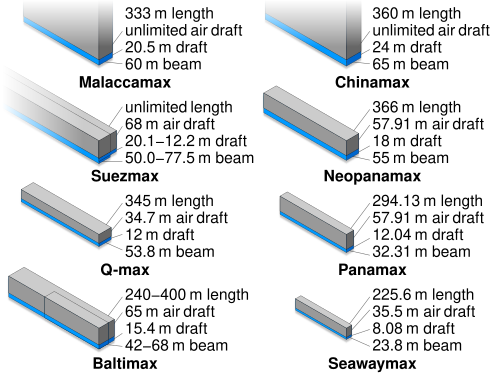
A vessel classified under the Chinamax standard is defined by its maximum dimensions and carrying capacity. These measurements ensure that the ship can dock at "Chinamax-compatible" harbors without running aground or exceeding the width of the berth.
| Characteristic | Measurement (Metric) | Measurement (Imperial) |
|---|---|---|
| Maximum Length Overall | 360 m | 1,181 ft |
| Maximum Beam (Width) | 65 m | 213 ft |
| Maximum Draft (Depth) | 24 m | 79 ft |
| Deadweight Tonnage (DWT) | 400,000 DWT | N/A |
The Deadweight Tonnage (DWT), which refers to the total weight a ship can carry including cargo, fuel, and stores, reaches up to 400,000 tons for these vessels, making them some of the largest bulk carriers in existence.
Chinamax vs. Other Shipping Standards
It is important to distinguish Chinamax from other common industry terms like Suezmax and Panamax. While the latter two are determined by the physical dimensions of the Suez and Panama canals respectively, Chinamax is determined by the capabilities of the destination ports and the volume of the cargo being moved.
Container Shipping Trends
While the Chinamax standard is heavily associated with dry-bulk ore carriers, the trend toward larger vessels has also influenced container shipping. Recent classes of container ships intended for trade with China have focused on lengths of approximately 400 meters, provided that deep-water container terminals are available to accommodate them.
Key Facts
- Purpose: Developed primarily for transporting iron ore from Brazil to China.
- Defining Factor: Based on port infrastructure rather than canal locks or bridges.
- Example Vessel: The Valemax bulk carrier is a prime example of this size class.
- Maximum Draft: 24 meters (79 ft), requiring deep-water harbors.
- Maximum Length: 360 meters (1,181 ft).
Frequently Asked Questions
What determines if a port is Chinamax-compatible?
A port is considered Chinamax-compatible if its infrastructure, including berth depth and width, can accommodate a ship with a 24m draft, 65m beam, and 360m length overall.
How does Chinamax differ from Panamax?
Panamax is determined by the physical dimensions of the Panama Canal locks, whereas Chinamax is determined by port provisions and the requirements of massive dry-bulk shipments.
Which company was instrumental in the development of this standard?
The standard was originally developed to support the transport of iron ore from Brazilian facilities operated by the mineral firm Vale.
Are container ships also classified as Chinamax?
While the Chinamax standard is primarily associated with bulk carriers like the Valemax, modern container ships trading with China have adopted similar scales, often reaching lengths of around 400 meters for use in deep-water terminals.