Panama Canal Ship Size Limits: Panamax and Neopanamax Standards
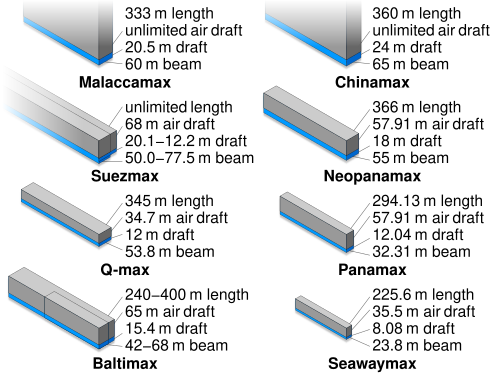
The Panama Canal serves as one of the world's most critical maritime shortcuts, but its utility is governed by strict physical constraints. To ensure safe passage, the Panama Canal Authority (ACP) defines specific size criteria known as Panamax and New Panamax (or Neopanamax). These standards dictate the maximum dimensions a vessel can have to successfully navigate the canal's lock systems and clear its overhead bridges.
These requirements do more than just regulate traffic; they have fundamentally influenced global naval architecture, shaping the design of cargo ships, passenger liners, and military vessels for over a century.
Key Facts
- Panamax limits have been in effect since the canal opened in 1914.
- New Panamax standards were introduced with the opening of the third set of locks on June 26, 2016.
- The Bridge of the Americas, Centennial Bridge, and Atlantic Bridge set the absolute height limits for all transiting ships.
- TEU (Twenty-foot Equivalent Unit) capacity increased from 5,000 for Panamax to 14,000 for New Panamax vessels.
- DWT (Deadweight Tonnage) limits rose from 52,500 tonnes to 120,000 tonnes with the expansion.
The Panamax Standard
The original Panamax specifications are based on the dimensions of the canal's first lock chambers. Each chamber measures 33.5 m (110 ft) wide and 320.0 m (1,050 ft) long, though the usable length is 304.8 m (1,000 ft). Because the margins are so slim, some ships pass through with only centimeters of clearance.
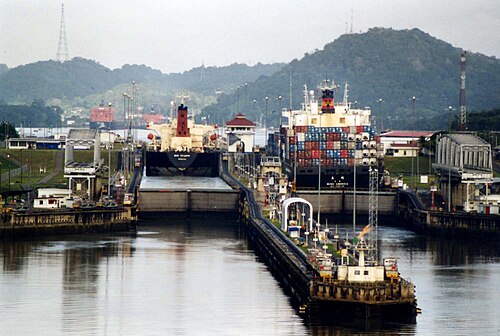
The most restrictive point for draft—the vertical distance between the waterline and the bottom of the hull—is the south sill of the Pedro Miguel Locks. The maximum allowable draft is 12.04 m (39.5 ft) in Tropical Fresh Water (TFW), a density standard based on Lake Gatún. During exceptionally dry seasons, the ACP may reduce this limit to prevent ships from grounding.
Panamax Records and Constraints
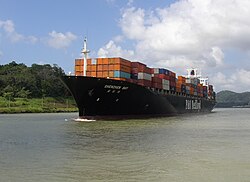
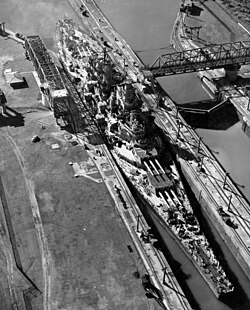
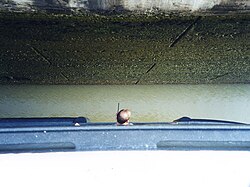
Historically, the San Juan Prospector (now Marcona Prospector) holds the record as the longest ship to transit the original locks at 297 m (973 ft). The tightest fits were recorded by South Dakota and Iowa-class battleships, which had a beam (width) of 32.97 m (108 ft 2 in), leaving less than 15 cm (6 in) of space between the hull and the lock walls.
The Neopanamax Expansion
To address increasing global trade and congestion, the Panama Canal underwent a massive expansion. Following a 2006 referendum approved by 78% of Panamanian voters, a third set of larger locks was constructed. These locks opened in 2016, introducing the Neopanamax classification.
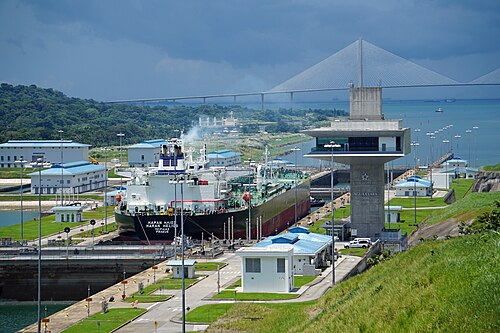
The new locks are significantly larger, measuring 427 m (1,401 ft) in length and 55 m (180 ft) in beam. This allowed the ACP to increase the maximum vessel length to 366 m (1,201 ft) and the maximum draft to 15.2 m (50 ft). While the beam was initially set at 49 m (161 ft), it was expanded to 51.25 m (168.1 ft) in June 2018 to accommodate ships with 20 rows of containers.
Comparison of Vessel Specifications
| Feature | Panamax (Original) | New Panamax (Neopanamax) |
|---|---|---|
| Max Length | 289.6 m (950 ft) | 366 m (1,201 ft) |
| Max Beam (Width) | 32.3 m (106 ft) | 51.25 m (168.1 ft) |
| Max Draft | 12.04 m (39.5 ft) | 15.2 m (50 ft) |
| Max Height | 57.9 m (190 ft) | 57.9 m (190 ft) |
| Cargo Capacity (TEU) | 5,000 | 14,000 |
| Tonnage (DWT) | 52,500 | 120,000 |
Global Impact on Ports and Shipping
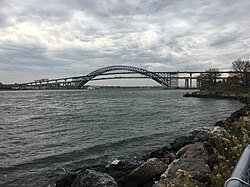
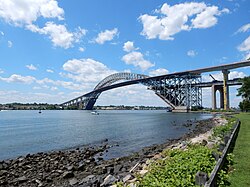
The shift toward Neopanamax vessels forced ports worldwide to upgrade their infrastructure. In the United States, ports in New York, New Jersey, Norfolk, and Baltimore deepened their harbors to at least 15 m (50 ft). A notable project was the $1.7 billion raising of the Bayonne Bridge in New York to 66 m (215 ft) to allow these larger ships to reach the Port Newark–Elizabeth Marine Terminal.
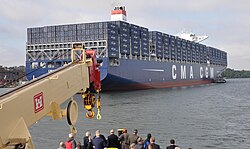
Beyond the US, Canada expanded the South End Container Terminal in Halifax, and the UK built the Liverpool2 terminal. In Mexico, the government is developing the Interoceanic Corridor of the Isthmus of Tehuantepec, including the expansion of the port of Salina Cruz with a depth of 24 m (79 ft) to provide a land-based alternative to the canal.
This evolution has had a harsh impact on older fleets. Demand for original Panamax ships plummeted, leading some owners to sell relatively young vessels for scrap or invest in widening their hulls to remain competitive.
Post-Panamax and Specialized Vessels
Ships that exceed these limits are categorized as Post-Panamax, Super-Panamax, or Capesize. The first Post-Panamax ship was the RMS Queen Mary in 1934, which was too wide for the canal and had to travel around Cape Horn to reach California in 1967.
Military design was also affected. Until World War II, the US Navy ensured all warships could fit through the canal. However, the Japanese Yamato-class battleships (1940) and the proposed US Montana-class battleships exceeded these limits, marking a shift in naval strategic design.
Frequently Asked Questions
What is the difference between Panamax and Neopanamax?
Panamax refers to the size limits of the original 1914 locks, while Neopanamax refers to the larger limits enabled by the third set of locks opened in 2016. Neopanamax ships can be longer, wider, deeper, and carry significantly more cargo.
Why is the height limit the same for both ship types?
Both Panamax and Neopanamax ships must pass under the Bridge of the Americas at Balboa harbor, which limits the maximum vessel height to 57.9 m (190 ft) from the waterline.
How does water level affect ship transit?
The maximum allowable draft is dependent on the water level of Lake Gatún. During exceptionally dry seasons, the Panama Canal Authority may reduce the permitted draft to ensure ships do not hit the bottom of the canal.
What happens to ships that are too large for the canal?
Ships that exceed Neopanamax limits are called Post-Panamax or Capesize. These vessels cannot use the canal and must take alternative routes, such as sailing around the southern tips of South America or Africa.
What is a TEU in the context of the Panama Canal?
TEU stands for Twenty-foot Equivalent Unit, a standard measure of cargo capacity based on a 20-foot long shipping container. The expansion increased the canal's capacity from 5,000 TEU to 14,000 TEU per ship.