Chavín Culture: The Religious and Artistic Powerhouse of the Early Andean Horizon
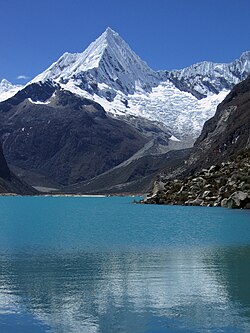
Emerging around 900 BCE in the northern Andean highlands of Peru, the Chavín culture established itself as one of the most influential pre-Columbian civilizations of the Early Horizon period. Centered in the Mosna Valley—where the Mosna and Huachecsa rivers converge—this society thrived at an altitude of 3,150 meters (10,330 ft), spanning the diverse ecological zones of the quechua, suni, and puna. More than just a local settlement, the Chavín created a widespread cultural and religious phenomenon that extended its reach far across the Peruvian coast and highlands.
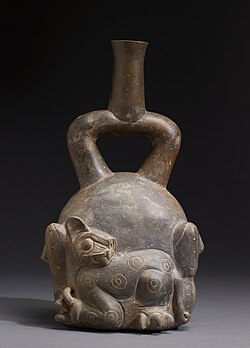
The civilization is defined by a sophisticated intensification of religious cults, the development of advanced metallurgy and textiles, and a distinct style of ceramics closely tied to their ceremonial centers.
Key Facts
- Period: Early Horizon (900 – 250 BCE).
- Type Site: Chavín de Huántar, located in the Ancash Region of Peru.
- Primary Diet: Based on C3 foods like potatoes and quinoa; maize was not a dietary staple.
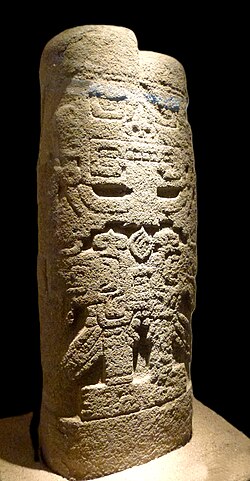
- Key Deity: The Lanzón, a 4.53-meter carved granite shaft.
- Architectural Focus: Monumental temples with complex internal galleries and external plazas.
- Influence: Spread to coastal sites like Caballo Muerto and northern sites like Pacopampa.
Architectural Engineering and the Sacred Center
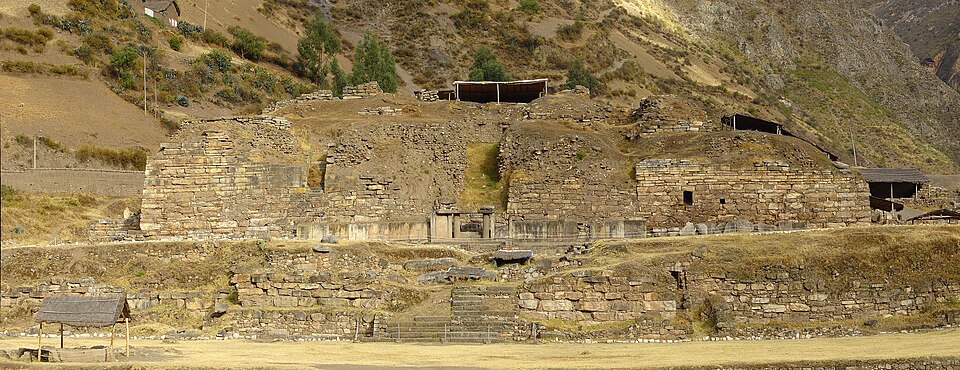
The site of Chavín de Huántar represents a massive engineering achievement and served as the nucleus for one of the first large-scale political entities in the central Andes. The architecture is divided into two primary categories: internal architecture, consisting of galleries, ventilation shafts, drainage canals, and passageways; and external architecture, which includes terraces, platform mounds, and expansive plazas.
Construction occurred in two major phases. The "Old Temple" was built between 900 and 500 BCE, followed by the "New Temple" from 500 to 200 BCE. Interestingly, the site lacks typical residential structures or evidence of generalized weaponry, suggesting its primary purpose was ceremonial rather than residential or military.
Evolution of the Site
The monumental center evolved through at least 15 construction phases. Early stages featured separate buildings, which later transitioned into a contiguous U-shaped arrangement during the Expansion Stage. By the Black and White Stage, the major plazas—the Plaza Mayor, Plaza Menor, and the Circular Plaza—were completed. The final layout featured a U-shaped arrangement bisected by an east-west axis that intersected the Lanzón.
Art and Iconography
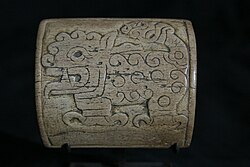
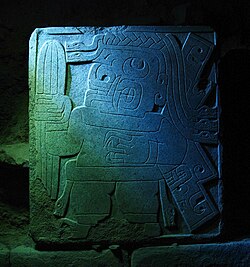
Chavín art is the first recognizable, widespread artistic style in the Andes. It is characterized by a fascination with binaries—such as the sun and moon, or sky and water—and the creation of hybrid beings that blend human features with animals like jaguars, serpents, crocodiles (caymans), and crested eagles.
The most iconic artifact is the Lanzón, a 4.53-meter granite shaft located in a gallery of the Old Temple. Carved with the image of a fanged deity, the Lanzón was designed to be viewed only partially and segmentally due to the limited openings of its chamber, adding to its mystical aura.
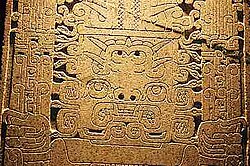
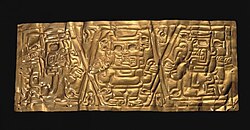
Other notable artistic expressions include the use of gold for crowns and necklaces, as well as ceremonial shell trumpets. These trumpets often featured incised designs of high-ranking individuals surrounded by snakes, symbolizing the ability to communicate with supernatural beings.
Social Development and Diet
While some historians once believed that maize cultivation drove Chavín social complexity, carbon isotope analysis of human bones has debunked this. The evidence shows a diet primarily consisting of potatoes and quinoa (C3 foods), which are more resistant to the frost and irregular rainfall of high-altitude environments than maize (a C4 food).
Stages of Cultural Growth
- Urabarriu (900–500 BCE): Characterized by small, dispersed residential areas and a diet of deer, camelids, and shellfish. Ceramics were produced in dispersed centers.
- Chakinani (500–400 BCE): A transitional period where residents migrated closer to the ceremonial center and the domestication of the llama increased.
- Jarabarriu (400–250 BCE): A period of dramatic population growth and the emergence of a proto-urban pattern. This stage saw increased social differentiation and specialized ceramic production.
Religion, Ritual, and the Afterlife
Religion was the heartbeat of Chavín society. The Lanzón was viewed as a founding ancestor with oracle powers and served as the focal point of the Old Temple. Rituals were scaled according to the space: the Square Plaza could accommodate 5,200 people, while the intimate gallery of the Lanzón could hold only about 15.
Recent archaeological discoveries using all-terrain robots have revealed that the underground galleries also served as burial sites. Some remains were found face-down and covered by rocks, leading researchers like John Rick to suggest that these individuals—likely the temple's builders—may have been sacrificed.
Sphere of Influence
Due to its strategic location at a trade crossing between the Amazon jungle and the coastal deserts, Chavín influence spread far and wide. Evidence of this "horizon" includes:
- Pacopampa: Temple renovations reflecting Chavín style.
- Caballo Muerto: Adobe structures in the Moche Valley showing Chavín influence.
- Garagay: Iconography featuring heads with mucus emanating from nostrils.
- Cerro Blanco: Discovery of characteristic Chavín ceramics.
| Feature | Details |
|---|---|
| Time Period | 900 – 250 BCE (Early Horizon) |
| Primary Location | Mosna Valley, Ancash Region, Peru |
| Key Architecture | Old and New Temples, U-shaped plazas, internal galleries |
| Main Crops | Potatoes and Quinoa |
| Symbolic Animals | Jaguar, Serpent, Cayman, Eagle, Llama |
| Successor Cultures | Moche, Lima, Nazca |
Frequently Asked Questions
What was the purpose of the galleries in Chavín de Huántar?
The galleries served multiple purposes: they were sites for intimate religious rituals, ventilation and drainage systems for the temple, and, as discovered recently, the final resting place for some of the temple's builders.
Did the Chavín people rely on maize for their survival?
No. Isotopic analysis of human remains indicates that potatoes and quinoa were the primary staples of their diet, as these crops were better adapted to the high-altitude Andean environment than maize.
Who was the Lanzón?
The Lanzón was the central deity of the Chavín culture, depicted as a 4.53-meter carved granite shaft. It was believed to be a founding ancestor with oracle powers and was the focal point of the Old Temple.
How did the Chavín culture influence other regions?
Because they were located at a trade crossroads between the coast and the jungle, their religious iconography, ceramic styles, and architectural techniques spread to other sites, including Pacopampa and Caballo Muerto.
What animals are most prominent in Chavín art?
The most prominent animals include the jaguar, serpent, cayman (crocodile), and various birds of prey like eagles and hawks, often blended with human features to create hybrid deities.