Paracas Culture: Masters of Andean Textiles and Ancient Medicine
Existing between approximately 800 BCE and 100 BCE, the Paracas culture was a sophisticated Andean society located in the modern-day Ica Region of Peru. Known for their mastery of irrigation, water management, and an unparalleled skill in textile arts, the Paracas people left behind a rich archaeological record. Much of our current knowledge stems from the Paracas Peninsula, where Peruvian archaeologist Julio Tello began formal investigations in the 1920s.
Key Facts
- Timeline: Approximately 800 BCE to 100 BCE (Early Horizon).
- Location: Ica Region, southern coast of Peru.
- Artistic Legacy: Renowned for some of the finest Pre-Columbian textiles and intricate ceramics.
- Medical Skill: Practiced trepanation (skull surgery) and intentional cranial deformation.
- Social Structure: Organized into autonomous local chiefdoms rather than a centralized government.
- Successor: Transitioned into the Nazca culture.
Social and Political Organization
Unlike many later Andean empires, the Paracas lacked a single central figurehead. Instead, the society was composed of local chiefdoms that maintained economic and political autonomy. These disparate groups were unified by shared trade networks and a common religion.
Early Paracas communities were influenced by the Chavín sphere of interaction, adopting versions of the Chavín cult. However, by the middle period (500–380 BCE), this influence waned, and the Paracas began developing a more distinct cultural identity. This era was not entirely peaceful; evidence of violent battle wounds, obsidian knives, and trophy heads suggests frequent conflict between chiefdoms.
One significant site, Cerro del Gentil in the Upper Chincha Valley (c. 550–200 BCE), served as a hub for large-scale feasts. Research involving strontium isotope testing indicates that attendees traveled from great distances, suggesting that the Paracas intentionally built wide-reaching alliances. A termination ritual around 200 BCE marked the end of the site's use, involving massive offerings of pottery and baskets, including bird feathers from far northern Peru.
The Art of Paracas Ceramics
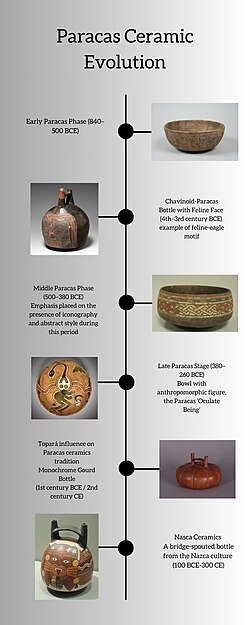
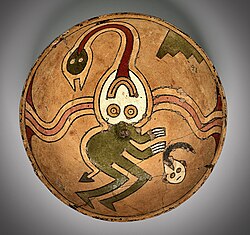
Ceramics provide a vital timeline for understanding Paracas development. Archaeologists categorize these wares based on burial complexes such as Paracas Cavernas, Paracas Necropolis, and Ocucaje.
Evolution of Style
- Early Phase (840–500 BCE): Heavily influenced by the Chavín culture, featuring "chavinoid" elements such as the feline-eagle motif. A recurring theme during this period was the representation of full feline faces.
- Middle Period (500–380 BCE): A shift toward a unique Paracas identity, characterized by expanded trade and a religious framework that emphasized elaborate burial offerings.
- Late Phase (380–260 BCE): Ceramics became more homogenized. This period saw the rise of the "Oculate Being," a prominent supernatural creature in their iconography.
![Ceramic Bottle with Feline Face, 4th–3rd century BCE. The face of a snarling feline decorates the side of the vessel chamber, directly under the whistle spout.[1]](/images/3e/26/3e267f1468e830b88f823cf75d61b8d995949e492f861b4b2313e4492d872ef5.jpg)
Mummy Bundles and Textile Mastery
The arid climate of the Peruvian coast has preserved organic materials that would otherwise have decayed. The most striking examples are the mummy bundles found at the Great Paracas Necropolis, specifically in the Wari Kayan section.
In these burials, bodies were bound with cords in a seated position, facing north, and wrapped in multiple layers of ornate, finely woven textiles. These bundles, often shaped like a seed or a human head, contained bright colored garments, headdresses, and jewelry made of shell beads and sheet gold. Both men and women were adorned, and some individuals bore tattoos.
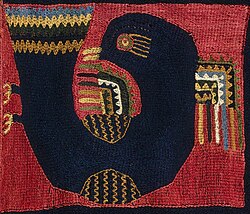
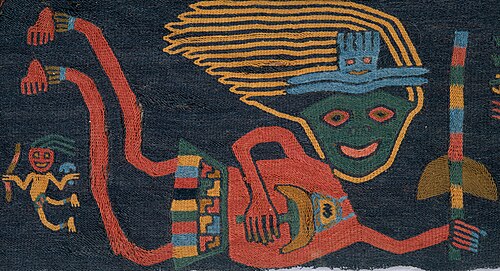
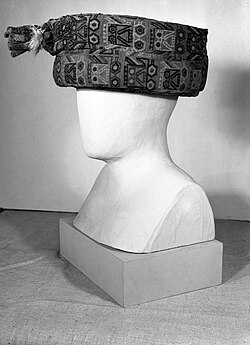
These textiles are considered some of the finest ever produced in the Pre-Columbian Americas. Unfortunately, the Necropolis was heavily looted between 1931 and 1933, leading to many of these priceless artifacts being smuggled into international markets.
Ancient Medical Practices
The Paracas people are well-known for their advanced, albeit risky, surgical and cranial practices.
Cranial Modification
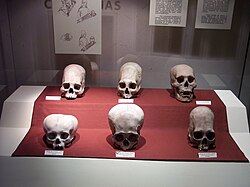
Artificial cranial deformation was practiced to alter the shape of the skull, often as a marker of social identity or status.
Trepanation
Trepanation—the surgical process of drilling or cutting a hole into the skull—was surprisingly common. By analyzing bone healing, archaeologists estimate that approximately 40% of patients survived long-term, while 39% died during or shortly after the procedure. While some estimates suggest trepanation occurred in up to 40% of the population, sampling biases make this high figure unlikely.
Geoglyphs and the Nazca Transition
Recent drone surveys in the Palpa province have revealed geoglyphs (large ground drawings) that predate the famous Nazca lines by a thousand years. Unlike the Nazca lines, which are mostly on valley floors, Paracas geoglyphs are often located on hillsides. This suggests they were intended to be viewed by humans—perhaps to demarcate territory—rather than being exclusively for the gods.
The transition from Paracas to the Nazca culture was once thought to be caused by an "invasion" of the Topará culture around 150 BCE. However, recent radiocarbon dating suggests the decline of the Paracas and the transition to Nazca were already underway before the Topará tradition emerged.
| Feature | Description |
|---|---|
| Time Period | c. 800 BCE – 100 BCE |
| Political Structure | Autonomous local chiefdoms |
| Primary Art | Embroidered textiles and polychrome ceramics |
| Key Sites | Wari Kayan, Cerro del Gentil, Paracas Peninsula |
| Medical Practices | Trepanation and cranial deformation |
| Geoglyphs | Hillside figures predating Nazca lines |
Frequently Asked Questions
What are Paracas mummy bundles?
Mummy bundles are deceased individuals placed in a seated position, bound with cords, and wrapped in multiple layers of highly intricate, embroidered textiles and garments, often accompanied by jewelry and offerings.
How did the Paracas people modify their skulls?
They practiced artificial cranial deformation to change the shape of the head and performed trepanation, which involved cutting or drilling holes into the skull for medical or ritual reasons.
What is the difference between Paracas and Nazca geoglyphs?
Paracas geoglyphs are generally older and located on hillsides, making them visible to people on the ground. Nazca lines are typically on the desert floor and are less visible from the ground.
Who were the Topará people in relation to the Paracas?
The Topará were a tradition whose ceramics appear in late Paracas and early Nazca sites. While once thought to be invaders who caused the Paracas decline, evidence now suggests the Paracas-Nazca transition was already happening before the Topará emerged.
What was the "Oculate Being"?
The Oculate Being was a supernatural creature with prominent eyes that became a major motif in late Paracas ceramics and iconography.