Chameleons: Masters of Adaptation and Color Change
Chameleons are among the most specialized reptiles on Earth, belonging to the family Chamaeleonidae. Known for their extraordinary ability to change color, unique visual systems, and highly efficient hunting mechanisms, these lizards have evolved a suite of adaptations that allow them to thrive in diverse environments. From the tiny terrestrial species of Madagascar to the large, ornate arboreal varieties, chameleons represent a fascinating study in evolutionary biology.
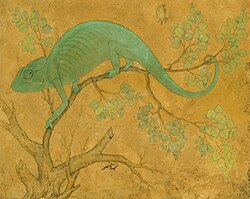
Historically, chameleons have captured human imagination for centuries, appearing in early natural history texts and art. Their presence in the fossil record dates back significantly, with Anqingosaurus brevicephalus from the Middle Paleocene of China (approximately 58.7–61.7 million years ago) being the oldest described species.

Key Facts
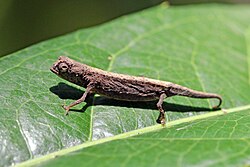
- Size Range: Varies from the tiny Brookesia nana (22 mm) to the large Furcifer oustaleti (68.5 cm).
- Color Mechanism: Use specialized cells called iridophores to shift colors for communication and thermoregulation.
- Hunting: Employ a ballistic tongue with a cup-like end to capture prey with extreme speed.
- Reproduction: Most species are oviparous, meaning they lay eggs in holes dug in the ground.
- Physical Traits: Characterized by prehensile tails and independently mobile eyes.
Physical Characteristics and Diversity
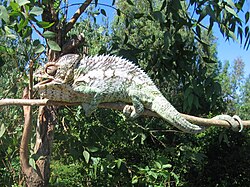
Chameleons exhibit a vast range of body structures and sizes. While some species are miniaturized, others possess striking facial ornamentations. For example, Trioceros jacksonii is known for its horn-like projections, while Chamaeleo calyptratus features a large cranial crest. Many species are sexually dimorphic, with males typically displaying more elaborate ornamentation than females.
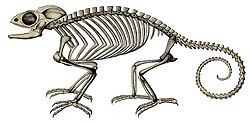
Their anatomy is perfectly tuned for an arboreal (tree-dwelling) lifestyle. Nearly all species possess prehensile tails, which act as a fifth limb to grip branches when the lizard cannot use all four feet simultaneously.
Species Comparison
The following table outlines common species often encountered in captivity, highlighting the diversity in their size and lifespan.
| Scientific Name | Common Name | Male Length | Female Length | Typical Colour | Lifespan |
|---|---|---|---|---|---|
| Chamaeleo calyptratus | Veiled chameleon | 35–60 cm | 25–33 cm | Green/Light | ~5 years |
| Trioceros jacksonii | Jackson's chameleon | 23–33 cm | 25–33 cm | Green/Light | 5–10 years |
| Furcifer pardalis | Panther chameleon | 38–53 cm | 23–33 cm | Darker colours | ~5 years |
| Rieppeleon brevicaudatus | Bearded pygmy chameleon | 5–8 cm | N/A | Brown/Beige/Green | 3–5 years |
| Rhampholeon spectrum | Spectral pygmy chameleon | 8–10 cm | 5–10 cm | Tan/Gray | 3–5 years |
| Rhampholeon temporalis | Usambara pitted pygmy | 6–10 cm | 5–9 cm | Gray/Brown | 5–11 years |
The Science of Color Change
Contrary to popular belief, color change is not solely for camouflage. It is primarily used for social signaling and thermoregulation. This process is driven by iridophores, which are specialized cells containing nanocrystals of guanine. By altering the lattice structure of these crystals, chameleons can change the wavelength of light they reflect.
![Colour change and iridophore types in panther chameleons: (a) Reversible colour of two males, one relaxed (m1), and one excited (m2). During excitation, background skin shifts from the baseline state (green) to yellow/orange, and both vertical bars and horizontal mid-body stripe shift from blue (m1) to whitish (m2). (b) Red dots show change in the CIE chromaticity chart of a male with green skin. white line: optical response in numerical simulations using a face-centred cubic lattice of guanine crystals with lattice parameter indicated with black arrows. (c) Haematoxylin and eosin staining of a cross-section of white skin showing the epidermis and the two thick layers of iridophores. (d) TEM images of guanine nanocrystals in S-iridophores in the excited state and three-dimensional model of an FCC lattice (shown in two orientations). (e) TEM image of guanine nanocrystals in D-iridophores.[18]](/images/76/c0/76c02f5cfa2d5a78249ec91aad6973619c1f52c1774d77f6b3fdbc52b88b63cd.png)
For instance, in panther chameleons, an excited male may shift from a baseline green to yellow or orange, while specific body stripes may shift from blue to whitish. This complex communication system allows chameleons to convey dominance, submission, or mating readiness to other members of their species.
Sensory and Hunting Adaptations
Chameleons possess one of the most unique visual systems in the animal kingdom. Their eyes can move independently, providing a panoramic view of their surroundings and allowing them to track prey and predators simultaneously without moving their bodies.
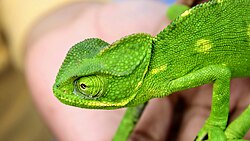
Once prey is spotted, the chameleon utilizes a ballistic tongue. This specialized apparatus launches with incredible speed, using a cup-like end to adhere to the insect and pull it back into the mouth. This mechanism is so efficient that it maintains high performance even at low temperatures.
Reproduction and Life Cycle
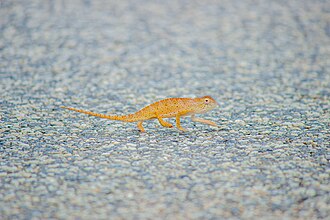
Most chameleons are oviparous. After copulation, females dig holes ranging from 10 to 30 cm deep to deposit their eggs. Clutch sizes vary dramatically between species: small Brookesia species may lay only two to four eggs, whereas the veiled chameleon can lay between 20 and 200 eggs.
Incubation periods also vary. While many eggs hatch within four to 12 months, Parson's chameleon (Calumma parsoni) has an exceptionally long incubation period, typically taking between 400 and 660 days to hatch.
Frequently Asked Questions
Why do chameleons change color?
While camouflage is one reason, color change is primarily used for social communication (such as signaling dominance or mating intent) and thermoregulation (adjusting body temperature by absorbing or reflecting sunlight).
How does the chameleon's tongue work?
Chameleons use a ballistic projection mechanism. The tongue is launched rapidly from the mouth, using a specialized muscular apparatus and a sticky, cup-like tip to capture prey instantly.
What is the smallest species of chameleon?
The male Brookesia nana is one of the world's smallest reptiles, with a maximum total length of approximately 22 mm.
How long do chameleon eggs take to hatch?
Hatching times vary by species, generally ranging from four to 12 months. However, some species like Parson's chameleon can take up to 660 days.
Do all chameleons have prehensile tails?
Nearly all species have prehensile tails, which they use to grip branches and maintain stability, especially when moving between twigs.