Central European University: A History of Academic Freedom and Relocation
The Central European University (CEU) stands as a testament to the pursuit of democratic values and the challenges of maintaining academic independence in a shifting political landscape. Founded in the wake of the Cold War, the institution was designed to foster open societies—societies characterized by the rule of law, transparency, and the protection of human rights—across Central Europe.
From its humble beginnings as a series of lectures to its current status as a global research institution in Vienna, CEU's journey reflects the broader geopolitical tensions between liberal education and nationalist governance.
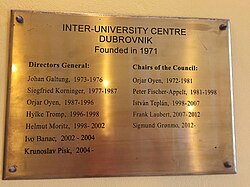
Early Years and Foundation (1989–1993)
The seeds of CEU were sown in the spring of 1989 at the Inter-University Centre Dubrovnik in Yugoslavia (now Croatia). During a period of historic regional change, a group of scholars from Budapest, Oxford, Prague, and Warsaw gathered to discuss the necessity of an independent, international university.
While an initial attempt to establish the university in Bratislava, Slovakia, failed due to opposition from nationalist politicians, the institution was officially founded in 1991. The vision was to create a Western-modeled institution that would educate a new generation of regional leaders to guide democratic transitions. This tri-city vision, spanning Prague, Budapest, and Warsaw, received support from prominent figures including Czech President Václav Havel, Hungarian President Árpád Göncz, and Polish historian Bronislaw Geremek.
Although classes began in Prague with approximately 100 students from 20 countries, political and financial conflicts with the Czech government, led by Prime Minister Václav Klaus, forced the university to move its primary operations to Budapest in January 1993. The Prague presence eventually ended in 1997.

The Budapest Era (1993–2017)
During its two decades in Budapest, CEU evolved from a regional focus to a global one. The university became a hub for democracy promotion and human rights, pioneering the region's first master's degree programs in environmental sciences and gender studies. It also established the Center for Media, Data and Society, a leading research center for communication and information policy.
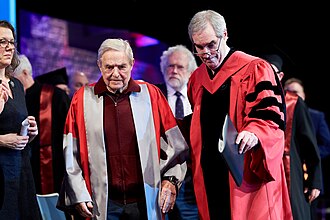
The university's growth was supported by significant funding from its founder, George Soros. In 2005, Soros pledged $202 million to the endowment, which reached a valuation of $880 million by 2010. Leadership transitioned over the years, with Rector Yehuda Elkana succeeded by John Shattuck in 2009, and Michael Ignatieff taking office as the fifth president and rector in October 2017.
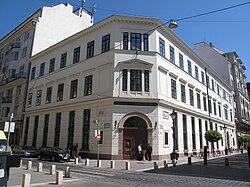
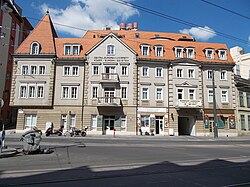
The Conflict and Relocation (2017–2019)
The university's stability was disrupted in March 2017 when the Hungarian government, under Prime Minister Viktor Orbán, introduced amendments to the National Higher Education Act. These regulations specifically targeted foreign-operating universities, requiring them to have agreements with their other country of operation and maintain a campus there to offer comparable degrees.
Because CEU's operating agreement was between the State of New York and Budapest, and it lacked a physical campus in the US, the university argued these laws were discriminatory. Critics and international observers, including the first Trump administration and the European Court of Justice, expressed concern that the legislation was a targeted attack on academic freedom due to the university's association with George Soros.
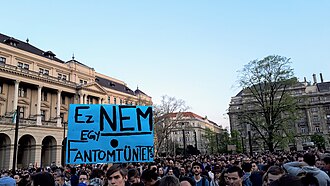
The tension sparked widespread protests in Budapest, with thousands of students and academics marching toward Parliament to support the institution. Despite legal challenges and international pressure, the Hungarian government refused to sign an agreement allowing CEU to continue its US-accredited programs in Hungary.

Establishment in Vienna (2019–Present)
In December 2018, CEU announced it would relocate the majority of its operations to Vienna, Austria, starting in September 2019. A small fraction of locally accredited programs remained in Budapest to allow current students to complete their degrees.
The relocation was validated legally in October 2020, when the European Court of Justice ruled that the Hungarian "lex CEU" legislation was incompatible with European Union law. In 2021, Shalini Randeria became the university's sixth rector and its first female leader. However, her tenure ended in resignation in November 2024 following internal leadership criticism, leading to the appointment of Carsten Q. Schneider as Interim President and Rector (serving August 1, 2025, to July 31, 2026).

In recent years, the university has faced external pressures, including being designated as an "undesirable" organization by Russia in 2023. It has also been a site of intense internal debate and protest regarding the conflict in Gaza, reflecting its ongoing commitment to being a forum for complex global discourse.
Key Facts
- Founded: 1991, following the fall of the Socialist Bloc.
- Founder: George Soros, who provided significant endowment funding.
- Original Locations: Prague, Budapest, and Warsaw.
- Current Primary Campus: Vienna, Austria (relocated from Budapest in 2019).
- Legal Victory: The European Court of Justice ruled Hungary's restrictive laws incompatible with EU law in 2020.
- First Female Rector: Shalini Randeria (appointed 2021).
| Period | Location/Phase | Key Event |
|---|---|---|
| 1989–1991 | Dubrovnik / Bratislava | Conceptualization and failed attempt in Slovakia. |
| 1991–1993 | Prague | Initial classes held; first 100 students. |
| 1993–2017 | Budapest | Expansion into global research and human rights. |
| 2017–2019 | Budapest to Vienna | Legal battle with Hungarian government and relocation. |
| 2019–Present | Vienna | Establishment of the Vienna campus. |
Frequently Asked Questions
Why did CEU move from Budapest to Vienna?
CEU relocated because the Hungarian government introduced legislation that made it impossible for the university to continue its US-accredited programs in Budapest, which the university and international bodies viewed as a targeted attack on its academic freedom.
Who is the founder of Central European University?
The university was founded by George Soros, a philanthropist and businessman who provided the primary financial endowment to support the institution's mission of promoting open societies.
What is the significance of the European Court of Justice ruling in 2020?
The court ruled that the "lex CEU" legislation passed by the Hungarian government was incompatible with European Union law, effectively validating the university's claim that the laws were discriminatory.
Who is the current leadership of CEU?
Following the resignation of Shalini Randeria, Carsten Q. Schneider was elected as the Interim President and Rector, serving from August 1, 2025, to July 31, 2026.
What was the original goal of the university?
The original goal was to create a Western-modeled, international graduate school in Central Europe to educate regional leaders and foster democratic transitions after the fall of the Socialist Bloc.