Celje History: From Roman Colony to Modern Slovenian City
Celje is a city with a deep and complex heritage, evolving from a prehistoric settlement into a vital urban center in modern Slovenia. Its history is marked by the influence of great empires, the rise of powerful noble families, and the turbulent shifts of ethnic and political identity over two millennia.
Bronze Age and Antiquity
The roots of Celje stretch back to the Hallstatt era (an early Iron Age culture), where the first settlements appeared. During Celtic times, the area was known to Ancient Greek historians as Kelea. Evidence suggests that the Celts used the region to coin Noric money, establishing it as an early economic hub.
In 15 BC, the region was incorporated into the Roman Empire as Civitas Celeia. By AD 45, under the reign of Emperor Claudius, it was granted municipal rights as municipium Claudia Celeia. The city flourished as a wealthy, densely populated colony, featuring marble palaces, wide squares, and defensive walls. Its grandeur earned it the nickname Troia secunda, or the "small Troy." A critical Roman road connected Celeia to Pannonia via Aquileia, and the city became famous throughout the Empire for its Temple of Mars. Around 320, under Emperor Constantine I, Celeia was incorporated into Aquileia.
Medieval and Early Modern Period
The transition to the Middle Ages was violent; Slavic tribes razed the city during the Migration period of the 5th and 6th centuries. However, the settlement was rebuilt in the Early Middle Ages. The first written record of the city appears as "Cylie" in the Chronicle of Wolfhold von Admont, written between 1122 and 1137.
Between 1341 and 1456, Celje served as the seat of the Counts of Celje, who achieved princely status in 1436. The town grew in importance, gaining market-town status in the early 14th century and official town privileges from Count Frederick II on April 11, 1451. Following the extinction of the Counts of Celje in 1456, the Habsburgs of Austria inherited the region, administering it through the Duchy of Styria.
To ensure security, city walls and a defensive moat were constructed in 1473. These fortifications helped the town withstand Turkish incursions and a major Slovene peasant revolt in 1515, during which the peasants captured the Old Castle.
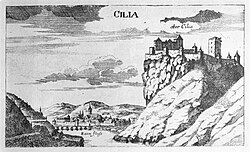
The era of the Protestant Reformation saw many local nobles convert to Protestantism, though the Counter-Reformation eventually returned the region to Roman Catholicism.
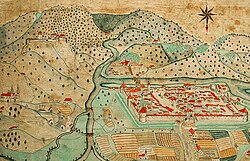
The Late Modern Era and Industrialization
During the Napoleonic Wars, Celje became part of the Austrian Empire. Following the Austro-Prussian War and the 1867 Austro-Hungarian Compromise, it was integrated into the Austrian-ruled section of Austria-Hungary.
The 19th century brought rapid modernization. The Vienna-Trieste railway line reached Celje on April 27, 1846, and the local secondary school (founded in 1808) began teaching in Slovene in 1895. Infrastructure continued to improve with the installation of the first telephone line in 1902 and the arrival of electric power in 1913.
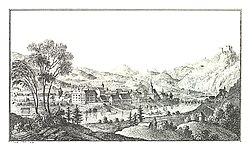
The turn of the century was marked by ethnic tension. Celje became a center for German nationalism; the 1910 census indicated that 66.8% of the population was German. This influence was epitomized by the German Cultural Center (Deutsches Haus), opened in 1907 and now known as the Celje Hall. Meanwhile, the National Hall (Narodni dom), which currently houses the mayor's office and town council, was built in 1896 to serve the community.
With the collapse of Austria-Hungary after World War I in 1918, Celje joined the Kingdom of Serbs, Croats and Slovenes (later Yugoslavia), triggering a period of rapid industrialization and population growth.
World War II and Its Aftermath
Nazi Germany occupied Celje in April 1941. The Gestapo arrived on April 16, followed shortly by SS leader Heinrich Himmler, who inspected the Stari pisker prison. The city suffered significant damage from Allied bombing targeting military installations and communication lines, which severely impacted the National Hall.
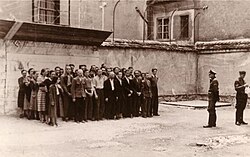
The human cost of the war was devastating. Out of a pre-war population of 20,000, 575 people were lost, primarily young adults aged 20 to 30. Over 1,500 residents were deported to Serbia or the German interior, 1,000 were imprisoned, and approximately 600 "stolen children" were taken to Nazi Germany for Germanization. Today, the monument Vojna in mir (War and Peace) by Jakob Savinšek commemorates this era.
Following the war, the remaining German-speaking population was executed or expelled. Approximately 25 mass graves were created in and around the city, containing ethnic German civilians and militia members from Croatia, Serbia, and Slovenia who had collaborated with the Nazis.
Independent Slovenia
Celje became part of the sovereign state of Slovenia following the Ten-Day War in 1991. In a significant religious milestone, Pope Benedict XVI established the Diocese of Celje on April 7, 2006, as part of the Archdiocese of Maribor.
Key Facts
- Ancient Name: Known as Kelea to Greeks and Civitas Celeia to Romans.
- Roman Status: Called Troia secunda (Small Troy) due to its wealth and architecture.
- Noble Rule: Seat of the Counts of Celje from 1341 to 1456.
- Infrastructure: Railway arrived in 1846; electricity in 1913.
- WWII Impact: 575 deaths and 600 "stolen children" taken to Germany.
- Modern Status: Seat of the Diocese of Celje since 2006.
| Era | Key Entity/Ruler | Significant Milestone |
|---|---|---|
| Antiquity | Roman Empire | Established as municipium Claudia Celeia (AD 45) |
| Middle Ages | Counts of Celje | Attained princely status (1436) |
| Early Modern | Habsburgs | Construction of city walls and moat (1473) |
| Late Modern | Austria-Hungary | Arrival of railway (1846) and electrification (1913) |
| 20th Century | Yugoslavia / Nazi Germany | Rapid industrialization followed by WWII occupation |
| Contemporary | Republic of Slovenia | Independence (1991) and new Diocese (2006) |
Frequently Asked Questions
Why was Celje called "Troia secunda"?
During the Roman period, the city was so wealthy and densely populated—featuring multi-storied marble palaces and wide streets—that it was compared to the legendary city of Troy.
Who were the Counts of Celje?
The Counts of Celje were the ruling noble family of the city from 1341 to 1456, eventually achieving princely status in 1436 before their line died out.
What was the impact of the 1910 census on the city's identity?
The 1910 census revealed that 66.8% of the population was German, reflecting the strong German nationalism of the time, which led to the construction of the German Cultural Center.
What happened to the population of Celje after World War II?
Following the war, the remaining German-speaking residents were either executed or expelled from the region.
When did Celje become part of independent Slovenia?
Celje became part of independent Slovenia in 1991, following the Ten-Day War.