CELAC: Strengthening Integration Across Latin America and the Caribbean
The Community of Latin American and Caribbean States (CELAC) is a significant intergovernmental bloc comprising 33 nations. Established to foster deeper regional integration, CELAC serves as a platform for cooperation among states in Latin America and the Caribbean, aiming to reduce external hegemony in the region's political and economic spheres.
Often viewed as an alternative to the Organization of American States (OAS), CELAC includes all OAS member states except for the United States and Canada. Notably, it also includes Cuba and Nicaragua, ensuring a comprehensive representation of the region's sovereign states. With a combined population of approximately 600 million people, the bloc represents a massive demographic and economic force on the global stage.
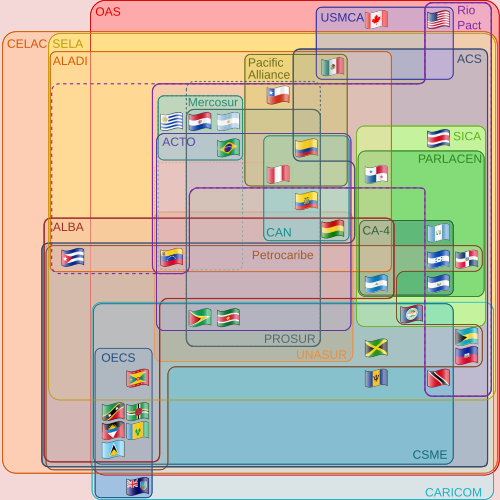
Key Facts
- Established: Formally created on December 3, 2011, via the Declaration of Caracas.
- Membership: 33 member states from Latin America and the Caribbean.
- Official Languages: Spanish, Portuguese, French, English, and Dutch.
- Population: Approximately 600 million (2011 estimate).
- Primary Goal: To deepen regional integration and increase autonomy from North American influence.
The Path to Formation
Early Initiatives (2008–2010)
The foundations of CELAC were laid through separate initiatives by Brazil and Mexico. In December 2008, the Lula administration in Brazil organized the first Latin American and Caribbean Summit on Integration and Development (CALC) in Bahia. This summit resulted in the Bahia Declaration, which prioritized social development, food security, human rights, and South–South cooperation—the process of exchange and cooperation among developing countries.
Simultaneously, Mexico's Calderón administration proposed the Latin American and Caribbean Union (ULC). These two paths converged in February 2010 at the Latin American and Caribbean Unity Summit in Playa del Carmen, Mexico, where the 33 attending states agreed to create CELAC.
Formal Establishment in 2011
Although planned for mid-2011, the inaugural summit was delayed due to the health of Venezuelan President Hugo Chávez. The summit eventually took place on December 2 and 3, 2011, in Caracas. The signing of the Declaration of Caracas officially established the bloc, with early discussions focusing on the global economic crisis and the need for increased regional trade and economic cooperation.
Organizational Structure and Governance
CELAC operates through six primary organs and is led by a President pro tempore, a temporary presiding officer. The organization's primary mechanism for decision-making is the Summit of Heads of State and Government.
Summit History
Since its inception, CELAC has held numerous summits to address regional challenges. While some scheduled meetings (such as those in 2018, 2019, and 2020) did not take place, the bloc has maintained a steady cadence of high-level meetings in cities such as Santiago, Havana, and Mexico City.
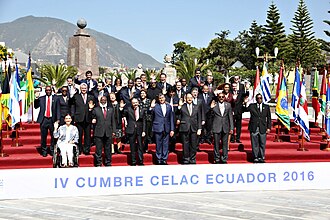
Recent and upcoming summits include the VIII Summit in Kingstown, Saint Vincent and the Grenadines (March 2024), the IX Summit in Tegucigalpa, Honduras (April 2025), and the X Summit in Medellín, Colombia (March 2026).
![ESO exhibition area at the CELAC–EU summit in Santiago[39]](/images/d7/51/d751e9e42587682aee5d443c75db688b12902ce8c641fa992706ec4f1ee85a9e.jpg)
Member State Profile
The diversity of CELAC is reflected in its linguistic makeup. While Spanish is the most prevalent language, the bloc incorporates the various colonial legacies of the region.
| Language | Number of Member States | Example Country |
|---|---|---|
| Spanish | 18 | Argentina |
| English | 12 | Jamaica |
| Portuguese | 1 | Brazil |
| French | 1 | Haiti |
| Dutch | 1 | Suriname |
Frequently Asked Questions
How does CELAC differ from the OAS?
The primary difference is membership; CELAC excludes the United States and Canada, whereas the OAS includes them. Additionally, CELAC includes Cuba and Nicaragua, positioning itself as a more autonomous regional alternative.
What was the purpose of the Declaration of Caracas?
The Declaration of Caracas, signed on December 3, 2011, served as the founding document that formally established CELAC as a regional bloc.
Which countries led the creation of CELAC?
The creation of CELAC was largely driven by initiatives from Brazil (through the CALC summits) and Mexico (through the proposal of the Latin American and Caribbean Union).
What are the main goals of the organization?
CELAC aims to deepen political and economic integration among Latin American and Caribbean states and to reduce the hegemony of external powers in the region's internal affairs.
How many official languages does CELAC use?
CELAC has five official working languages: Spanish, Portuguese, French, English, and Dutch.