Cavalry and Infantry Charges: The Evolution of Shock Tactics in Warfare
In the history of combat, a charge is an offensive maneuver where combatants advance toward the enemy at maximum speed to force a decisive close-quarters engagement. Known as the dominant shock attack, the charge has served as the pivotal moment in countless battles, designed to break the enemy's will and formation through sheer momentum and aggression.
While ancient warfare relied on massed formations, modern charges have evolved. Today, they typically involve small fireteams using high-rate-of-fire weapons to strike specific defensive positions, such as bunkers or concertainers, rather than large bodies of troops charging a fortified line.
Key Facts
- Shock Value: The primary goal of a charge is to break the enemy's formation, often through fear or physical impact.
- Infantry Evolution: Tactics shifted from the Greek phalanx to the bayonet charge, and eventually to small-unit fireteam assaults.
- Cavalry Requirements: Successful heavy cavalry charges required a combination of high morale, elite training, quality equipment, and disciplined mounts.
- Firepower Impact: The introduction of repeating rifles and machine guns in the mid-19th century significantly reduced the viability of massed charges.
- Modern Application: Melee charges are now largely extinct, replaced by armored fighting vehicles and air assaults.
Infantry Charge Tactics
Infantry charges have varied wildly across cultures and eras, adapting to the weaponry of the time. In classical Greece, the phalanx utilized an ordered approach march that culminated in a final charge to contact.
The Highland Charge
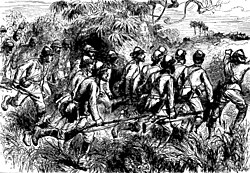
Developed by Scottish and Irish troops in the late 16th century, the Highland charge was a response to the rise of firearms. This tactic combined an initial volley of musketry with a rapid transition to hand-to-hand combat using melee weapons. While initially effective, it was eventually countered by disciplined defensive bayonet tactics.
The Bayonet Charge
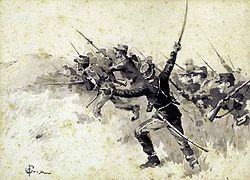
The invention of the bayonet in the late 17th century transformed infantry tactics. Through the 19th and early 20th centuries, the bayonet charge became the standard offensive maneuver. Interestingly, historical analysis suggests that few of these charges resulted in actual melee combat; usually, the opposing side fled before contact was made. Fixing bayonets served primarily as a morale booster and a signal of willingness to kill at close quarters.
The Banzai Charge
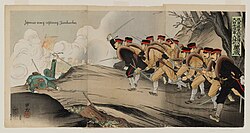
Used by the Imperial Japanese Army during the Pacific War, the "Banzai charge" refers to human wave attacks where infantry armed with swords and bayonets swarmed enemy positions. The name derives from the battle cry "Tennōheika Banzai", meaning "Long live His Majesty the Emperor."
Cavalry Charges and the Power of Momentum
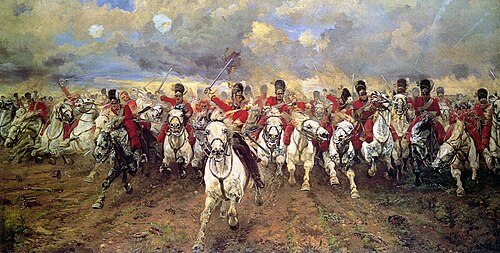
Cavalry charges exploited the physical and psychological shock of mounted troops. However, their success was highly conditional. Historians note that when infantry stood firm or used improvised fortifications, horses often refused to gallop into the dense mass, leading to the charge's failure.
The Medieval Era
The Middle Ages saw a revolution in cavalry tactics during the 7th to 11th centuries. The combination of the frame saddle, stirrups, and the technique of couching the lance (tucking it under the arm) allowed riders to utilize the full momentum of the horse. This was devastatingly effective, as seen at the Battle of Dyrrhachium in 1081.
By the Hundred Years' War, the rise of professional pikemen and longbowmen forced knights to be more cautious. Disciplined formations of pikes or halberds could stop most charges, leading many knights to dismount and fight as elite heavy infantry.
The Decline and Rare Successes
For a cavalry charge to succeed against unbroken heavy infantry, the unit needed a perfect blend of discipline, high-quality armor, and horses specifically trained for the stress of a head-on collision. Only elite units, such as Polish hussars or French cuirassiers, consistently maintained these standards.
The 20th Century and Beyond
Despite the dominance of industrial weaponry, cavalry charges occurred sporadically into the 20th century. Notable examples include the 1917 capture of Beersheba by the Australian 4th Light Horse Brigade (mounted infantry) and the 1918 charge by the Jodhpur and Mysore Lancers at Haifa.
World War II saw several attempts, including successful charges by Polish cavalry during the Invasion of Poland. However, the failure of the Soviet 44th Cavalry Division at the Battle of Moscow—where 2,000 men were killed by artillery and machine guns—highlighted the obsolescence of the tactic. The last successful cavalry charge of the war occurred at the Battle of Schoenfeld on March 1, 1945.
In the 21st century, the tactic has almost entirely vanished, with a rare exception during the early stages of the war in Afghanistan, where Green Berets utilized horses in a daring charge.
Summary of Notable Historical Charges
| Battle/Event | Date | Type | Outcome |
|---|---|---|---|
| Battle of the Golden Spurs | 1302 | Cavalry | Defeat; proved infantry could defeat heavy cavalry. |
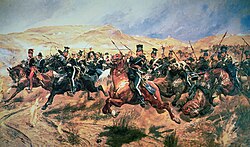
| Charge of the Light Brigade | 1854 | Cavalry | Heavy casualties; no strategic objective achieved. |
| Pickett's Charge | 1863 | Infantry | Repulsed with substantial loss. |
| Battle of Mars-la-Tour | 1870 | Cavalry | Success; reinforced the Prussian left flank. |
| Battle of Beersheba | 1917 | Mounted Infantry | Success; captured the town. |
Frequently Asked Questions
Why did bayonet charges often avoid actual fighting?
Most bayonet charges were psychological tools. The sight of a determined force fixing bayonets often broke the enemy's morale, causing them to flee before the two sides actually engaged in hand-to-hand combat.
What made the medieval cavalry charge so effective?
The effectiveness came from the synergy of the frame saddle, stirrups, and couched lances, which allowed the rider to transfer the horse's full kinetic energy into the point of the lance.
How did firearms change the nature of the charge?
Firearms introduced a race between the speed of the advance and the rate of fire. As repeating rifles and machine guns increased the rate of fire, massed charges became suicidal, leading to the development of small-unit tactics.
Can cavalry charges still be used today?
In conventional warfare, they have been replaced by armored vehicles and air assaults. However, similar techniques are still used by mounted police for riot control to disperse crowds.
What was the "Infantry Revolution"?
The Infantry Revolution refers to the period, highlighted by events like the Battle of the Golden Spurs, where well-disciplined and heavily armed infantry began to consistently defeat previously "invincible" heavy cavalry.