Battle of Cambrai 1917: The Evolution of Tank Warfare
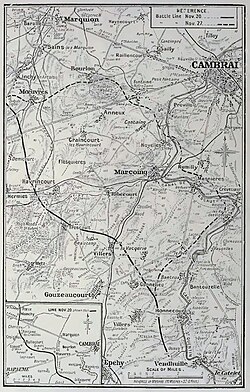
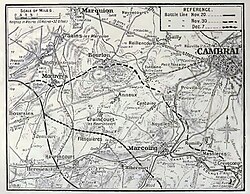
The Battle of Cambrai, fought between November 20 and December 7, 1917, stands as a pivotal moment in the First World War. Located in the Nord département of France, the town of Cambrai served as a critical supply hub for the Siegfriedstellung (known to the British as the Hindenburg Line). The objective was clear: by capturing Cambrai and the strategic Bourlon Ridge, the British could threaten the rear of the German lines to the north.
This engagement is most famous for the mass employment of tanks, but it was actually a sophisticated synthesis of new military doctrines. It combined the artillery-infantry tactics advocated by Major General Henry Tudor with the tank raid strategies developed by J.F.C. Fuller. Together, under the command of General Julian Byng, these elements created a new form of industrial warfare.
Key Facts
- Dates: 20 November – 7 December 1917.
- Primary Innovation: Large-scale coordination of tanks, infantry, and predicted artillery fire.
- British Strength: 15 infantry divisions, 4 cavalry divisions, 1,003 guns, and 476 tanks.
- German Strength: 20 infantry divisions and approximately 1,194–1,240 guns.
- Outcome: Initial British breakthrough followed by a massive German counter-attack.
The British Offensive: A New Approach
The battle commenced at 06:30 on November 20 with a predicted bombardment—artillery fire calculated without the need for preliminary registration shots, which helped maintain the element of surprise. This was followed by a creeping barrage and smoke screens to mask the advance of the infantry and the Tank Corps.
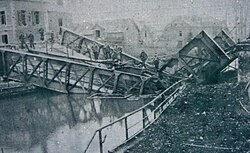
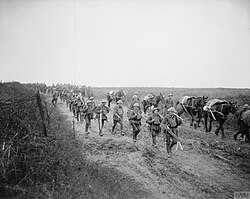
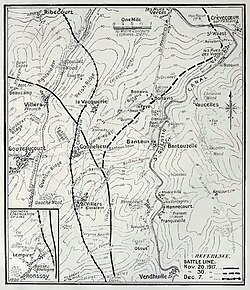
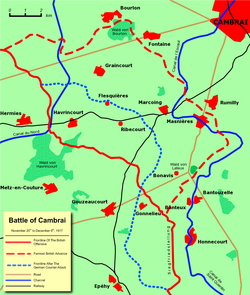
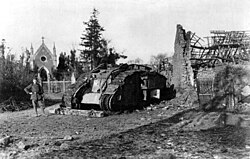
The attacking force consisted of the III Corps and IV Corps, supported by nine battalions of the Tank Corps. The initial results were stunning. The British penetrated the Hindenburg Line, advancing up to 5 miles (8 km) in some sectors. The 20th (Light) Division successfully captured a bridge across the Canal de Saint-Quentin at Masnières, though the victory was short-lived when the structure collapsed under the weight of a Mark IV tank.
The Struggle for Bourlon Ridge
Despite the early success, the British failed to secure Bourlon Ridge on the first day. As the offensive continued into November 21, the momentum slowed. The Mark IV tank, while revolutionary, proved mechanically unreliable and vulnerable to German artillery and infantry defenses. By the second day, only half of the tanks remained operational.
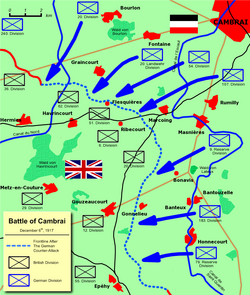
The 62nd (2nd West Riding) Division and later the 40th Division fought fierce battles to take the ridge. However, the Germans rapidly reinforced the area, leaving the British exposed in a salient—a piece of land that protrudes into enemy territory, making it vulnerable to attack from multiple sides.
The German Counter-Attack
Recognizing the vulnerability of the British salient, the German 2nd Army launched a massive counter-attack on November 30. The German advance in the south was unexpectedly swift, nearly capturing the commanders of the 12th (Eastern) and 29th Divisions. This offensive spread across 8.1 miles (13 km), nearly severing the link to Bourlon.
Analysis and Aftermath
While the battle ended in a tactical stalemate, it provided a blueprint for the Hundred Days Offensive of 1918. The integration of sound ranging, infantry infiltration tactics, and close air support matured at Cambrai. It proved that the deadlock of trench warfare could be broken through combined-arms coordination.
| Category | British Empire (Approx.) | Germany (Approx.) |
|---|---|---|
| Total Casualties | 44,207 (Third Army/Tank Corps/RFC) | 54,720 |
| Killed/Died of Wounds | 10,042 (General BEF stats) | 8,817 |
| Prisoners of War | c. 6,000 | 11,105 |
| Tanks Lost (Nov 20) | 179 (65 destroyed, 71 mechanical, 43 other) | N/A |
Frequently Asked Questions
Was the Battle of Cambrai the first time tanks were used?
No, tanks had been used earlier in 1917, but Cambrai was one of the first instances where they were employed en masse and coordinated with infantry and artillery as part of a unified tactical plan.
Why did the British fail to hold Bourlon Ridge?
The failure was due to a combination of mechanical breakdowns of the Mark IV tanks, the rapid arrival of German reinforcements, and the exhaustion of British divisions, which left them exposed in a salient.
What was the significance of the Hindenburg Line?
The Hindenburg Line (Siegfriedstellung) was a heavily fortified German defensive system. The British success in penetrating this line on the first day of the battle demonstrated that such fortifications could be breached using combined-arms tactics.
How did the German army respond to the tank threat?
The Germans utilized specialized anti-tank tactics, including the use of field artillery (such as Field Artillery Regiment 108) and rapid infantry counter-attacks to neutralize the British armored advantage.
What is the long-term legacy of the battle?
The battle is remembered as a laboratory for modern warfare. The techniques developed here—specifically the coordination of tanks, infantry, and air support—were essential for the Allied victories in 1918.