Causeways: Engineering, History, and Environmental Impact
A causeway is a raised track, road, or railway constructed upon an embankment across low-lying, wet terrain or a body of water. Unlike bridges, which rely on piers to support a roadway, causeways are primarily supported by earth, stone, masonry, or concrete. These structures serve as vital transportation corridors, connecting islands to mainlands or bridging gaps in challenging landscapes.
Key Facts
- Composition: Typically built from earth-fill, concrete, masonry, or wood.
- Primary Function: Provides a stable transit route across wet or shallow water areas.
- Distinction: Differs from a viaduct (which uses arches) and a bridge (which uses piers).
- Global Scale: Examples range from Neolithic wooden tracks to massive international links like the King Fahd Causeway.
- Environmental Risk: Can disrupt water currents, separate wildlife populations, and alter salinity levels.
Etymology and Origins
The term "causeway" is derived from the earlier form "causey," which traces back to the Latin word calx, meaning heel. This refers to the ancient technique of consolidating earthworks by trampling the soil—often using flocks of sheep or human labor—to compact and harden it layer by layer. This method of "stamping firm" is mirrored in the French word chaussée and the Welsh word sarn (and its verb sarnu, meaning to trample).
Historical Evolution
Humanity has utilized causeways for millennia to overcome geographical barriers. One of the oldest known examples is the Sweet Track in the Somerset Levels of England, dating back to the Neolithic age (approximately 3807 or 3806 BC). This early walkway consisted of oak planks supported by pegs of ash, oak, and lime driven into peat.
In the Americas, the Aztec city-state of Tenochtitlan employed causeways to support both roads and aqueducts. Similarly, in 14th-century East Africa, the Husuni Kubwa palace in Kilwa featured causeways built from reef and coral blocks. These structures served a dual purpose as breakwaters, protecting the shore and allowing mangroves to flourish.
Engineering and Construction
Modern causeways are often constructed using a cofferdam—a structure consisting of two parallel retaining walls made of concrete or steel sheet piles anchored together. This allows engineers to create a dry work area to build the embankment.
In many regions, causeways function as dikes, separating two bodies of water with different levels or salinity (salt water versus fresh water). The hardened crest of the dike provides a road for public service and maintenance access while slowing erosion during overflows.
| Name | Location | Key Feature |
|---|---|---|
| Johor–Singapore Causeway | Singapore/Malaysia | Supports over 100 million annual border crossings |
| King Fahd Causeway | Bahrain/Saudi Arabia | 25-km long international link |
| Afsluitdijk | Netherlands | Prominent dike doubling as a causeway |
| Churchill Barriers | Orkney, Scotland | WWII military defenses linking five islands |
| Lake Pontchartrain Causeway | Louisiana, USA | Major water-crossing infrastructure |
Global Examples and Applications
Causeways are prevalent in coastal regions. In Florida, they frequently connect barrier islands to the mainland, often incorporating a higher bridge section to allow tall vessels to pass. Examples include the NASA Causeway, which links Titusville to the Kennedy Space Center.
In Europe, the Afsluitdijk in the Netherlands stands as a primary example of a dike serving as a causeway.
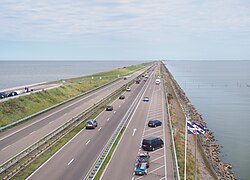
Other significant structures include the Hindenburgdamm rail link in Germany and the various causeways in the Outer Hebrides of Scotland, which link islands such as Benbecula and North Uist.
Environmental and Logistical Challenges
While efficient for transport, causeways introduce several disadvantages. Unlike bridges or tunnels, they act as physical barriers that prevent shipping through the straits they cross, unless specific gates are installed.
Ecologically, causeways can disrupt natural currents, leading to beach erosion or altered deposition patterns. They can also fragment wildlife habitats, placing additional pressure on endangered species.
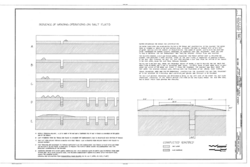
One of the most striking examples of ecological imbalance is the Lucin Cutoff across the Great Salt Lake in Utah. This structure created a mineral imbalance, resulting in the northern portion of the lake becoming significantly saltier than the southern portion.
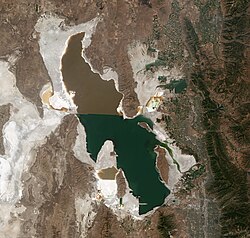
This salinity gap has created a visible color difference in the water and has made it impossible for native brine shrimp to survive in large portions of the lake, as the north is too salty and the south is insufficiently salty.
Frequently Asked Questions
What is the difference between a causeway and a bridge?
A causeway is primarily a roadway supported by an embankment of earth or stone, whereas a bridge supports a roadway using piers that may be embedded in embankments.
How does a causeway affect local wildlife?
Causeways can act as physical barriers that separate wildlife populations, which can increase the vulnerability of endangered species by restricting their movement.
Can ships pass through a causeway?
Generally, causeways block shipping because they are solid embankments. However, some are engineered with gates or specific openings to allow vessels to pass.
What is a cofferdam in causeway construction?
A cofferdam is a temporary enclosure created by parallel retaining walls that allows engineers to remove water and build the causeway's foundation in a dry environment.
Why are causeways dangerous during hurricanes?
Due to their low elevation, causeways are susceptible to storm surges, heavy rains, and high waves, making them impassable and dangerous during severe tropical storms.