Hans Albert Einstein: The Pioneering Engineer of Sediment Transport
While the name Einstein is synonymous with theoretical physics, Hans Albert Einstein carved his own distinguished path in the realm of practical science. A Swiss-American engineer, Hans Albert dedicated his life to understanding the movement of earth and water, becoming a global authority on hydraulic engineering.
His career spanned continents and institutions, moving from the rigorous academic environment of Switzerland to the cutting-edge research facilities of the United States. Through his work, he transformed how engineers approach the problem of sediment transport—the process by which solid particles are moved by flowing water.
Key Facts
- Primary Expertise: Hydraulic engineering and sediment transport.
- Academic Legacy: Professor at the University of California, Berkeley (1947–1971).
- Major Contribution: Authored the definitive work on bed load transport as a probability problem.
- Honors: Recipient of a Guggenheim Fellowship and the namesake of the ASCE Hans Albert Einstein Award.
- Family: Son of physicists Albert Einstein and Mileva Marić.
Early Life and Education
Hans Albert Einstein was born on May 14, 1904, in Bern, Switzerland. He was the first son of Albert Einstein and Mileva Marić. Growing up in a household of intellectual rigor, Hans eventually pursued his own scientific interests in civil engineering.
In 1922, he enrolled at ETH Zurich (the Swiss Federal Institute of Technology), graduating in 1926. Following his graduation, he gained practical experience working at the steel design company Klönne in Dortmund, Germany, from 1926 to 1930.
Academic Specialization
Between 1931 and 1938, Hans worked as a research engineer at the Laboratory of Hydraulics and Soil Mechanics (VAWE) at ETH Zurich. It was here that he earned his doctorate in technical science in 1936. His doctoral thesis, "Bed Load Transport as a Probability Problem", established him as a leader in the field, providing a mathematical framework for how sediments move along riverbeds.
Professional Career and Migration
The political climate of the 1930s forced a significant shift in Hans' life. Following the advice of his father, who had left Germany in 1933 to escape Nazi persecution, Hans emigrated from Switzerland to the United States in 1938.
He began his American career in Greenville, South Carolina, working for the U.S. Department of Agriculture (USDA) to study sediment transport. By 1943, he continued his USDA research at the California Institute of Technology.
In 1947, Hans Albert joined the faculty of the University of California, Berkeley as an associate professor of hydraulic engineering. He eventually rose to the rank of full professor and later professor emeritus, spending over two decades shaping the next generation of engineers.
Awards and Recognition
Throughout his career, Hans Albert's contributions were recognized by the highest bodies in his field. His accolades include:
- Guggenheim Fellowship (1953)
- American Society of Civil Engineers (ASCE) research awards (1959 and 1960)
- Berkeley Citation from the University of California (1971)
- USDA Certificate of Merit (1971)
- ASME Certificate of Recognition (1972) for his service to Applied Mechanics Reviews
In 1988, the ASCE established the Hans Albert Einstein Award to honor individuals who make significant contributions to hydraulic engineering.
Personal Life and Interests
Beyond the laboratory and classroom, Hans Albert was a man of diverse passions. He was an avid sailor who enjoyed excursions on the San Francisco Bay and a dedicated photographer who documented his academic travels through thousands of self-developed slides.
He was also deeply connected to the arts, playing both the piano and the flute. His personal life included two marriages: first to Frieda Knecht in 1927, with whom he had four children (Bernhard, Klaus, David, and adopted daughter Evelyn), and later to neurochemist Elizabeth Roboz in 1959.
Hans Albert Einstein passed away from heart failure on July 26, 1973, while attending a symposium in Woods Hole, Massachusetts.
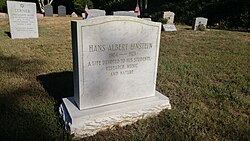
Summary of Hans Albert Einstein's Life
| Category | Details |
|---|---|
| Lifespan | May 14, 1904 – July 26, 1973 |
| Education | ETH Zurich (Civil Engineering & Doctorate) |
| Key Employer | University of California, Berkeley |
| Specialization | Hydraulic Engineering / Sediment Transport |
| Citizenship | Switzerland, United States |
Frequently Asked Questions
Who was Hans Albert Einstein?
Hans Albert Einstein was a Swiss-American engineer and professor at the University of California, Berkeley, renowned for his pioneering research on sediment transport in hydraulic engineering.
What was his most significant scientific contribution?
He is best known for his doctoral thesis, "Bed Load Transport as a Probability Problem," which is considered the definitive work on how sediments are transported in open channel flows.
How is he remembered by the engineering community?
The American Society of Civil Engineers (ASCE) honors his legacy through the annual Hans Albert Einstein Award, given to those who make significant contributions to hydraulic engineering.
What were his interests outside of engineering?
Hans Albert was a talented musician who played the flute and piano, an avid sailor on the San Francisco Bay, and a passionate photographer.
Where are his professional papers archived?
His papers are preserved at the Water Resources Collections and Archives in the University of California, Riverside Libraries, as well as the University of Iowa Libraries Special Collections and Archives.