ETH Zurich: A Global Leader in Science and Technology
The Eidgenössische Technische Hochschule Zürich, commonly known as ETH Zurich or the Swiss Federal Institute of Technology in Zurich, stands as one of the world's most prestigious institutions for science, technology, engineering, and mathematics (STEM). As a public research university located in Zurich, Switzerland, it operates as part of the Swiss Federal Institutes of Technology Domain, a consortium under the Swiss Federal Department of Economic Affairs, Education and Research.
With a legacy spanning over 170 years, ETH Zurich has evolved from a polytechnic institute into a global powerhouse of innovation, consistently ranking among the top universities worldwide for its contributions to research and education.
Key Facts
- Established: February 7, 1854.
- Student Population: 26,942 students (2025), including 4,266 doctoral candidates.
- Global Standing: Ranked 8th worldwide by QS World University Rankings 2026.
- Budget: CHF 2.051 billion (2025).
- Campuses: Two primary campuses in Zurich (Zentrum and Hönggerberg) and a location in Basel.
- Academic Reach: 16 specialized departments across various scientific and technical disciplines.
History and Evolution
Founded by the Swiss Confederation in 1854, the institution began delivering lectures in 1855 as the Eidgenössische polytechnische Schule (Federal polytechnic school). At its inception, it focused on six core faculties: architecture, civil engineering, mechanical engineering, chemistry, forestry, and an integrated department for mathematics, natural sciences, and social sciences.
A pivotal shift occurred between 1905 and 1908 under President Jérôme Franel, when the school restructured its programs to match university standards, gaining the authority to award doctorates starting in 1909. In 1911, it adopted its current name, Eidgenössische Technische Hochschule. Over the following century, the university expanded its organizational structure from 12 departments in 1924 to the 16 departments it maintains today.
Campus Infrastructure
ETH Zurich operates across three primary locations, each serving distinct academic and research purposes.
Zentrum Campus
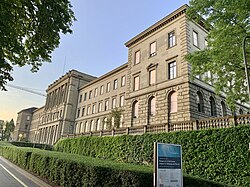
The Zentrum campus is centered around the historic main building, constructed between 1858 and 1864. Designed by the renowned architect and theorist Gottfried Semper, the building is a masterpiece of neoclassical style, featuring bold massings and a rusticated ground level inspired by Palladio and Bramante. The building was later enlarged to include its iconic cupola.

This campus houses departments focused on Mathematics, Computer Science, Humanities, Social and Political Sciences, Information Technology and Electrical Engineering, Mechanical and Process Engineering, Environmental Systems Science, Earth and Planetary Sciences, and Management, Technology, and Economics.
Hönggerberg Campus
The Hönggerberg campus is the hub for natural sciences and architecture, hosting the departments of Architecture, Civil, Environmental and Geomatic Engineering, Materials, Biology, Chemistry and Applied Biosciences, and Physics. In 2005, the university launched the "Science City" project to transform this campus into a sustainable, attractive district.
Students and faculty at Hönggerberg also have access to the ASVZ sports center, which provides comprehensive facilities including a gym, football field, and martial arts rooms.
Basel Location
Since 2007, ETH Zurich has extended its presence to Basel, where it operates one of its specialized departments.
Cutting-Edge Research and Innovation
ETH Zurich is at the forefront of the digital revolution and high-performance computing through several key initiatives:
- ETH AI Center: This center leads national projects such as the Swiss AI Initiative (launched 2023) and developed Apertus, a multilingual language model trained on 15 trillion tokens across more than 1,000 languages.
- Swiss National Supercomputing Center: Based in Lugano-Cornaredo, this facility deployed the Alps Supercomputer in 2024. With over 10,000 Nvidia H100 GPUs, it is one of the largest academic supercomputers globally.
- Entrepreneurial Ecosystem: The university actively fosters technology transfer. As of 2022, this ecosystem has resulted in the creation of 527 spin-off companies.
- Singapore-ETH Centre: Established in 2010, this hub employs over 250 researchers to solve urban sustainability and health challenges.
Academic Excellence and Rankings
The institution's commitment to rigor is reflected in its global standing. It is consistently ranked as the top university in Switzerland and one of the best in Europe.
| Ranking Body | Global Rank | Regional Rank (Europe) |
|---|---|---|
| QS World University Rankings | 8th | 2nd |
| Times Higher Education (THE) | 11th | 4th |
| ARWU World | 22nd | N/A |
Beyond overall rankings, ETH Zurich excels in specific fields, ranking 1st worldwide in earth and marine sciences, geology, and geophysics (2024), and 3rd worldwide in engineering and technology (2026).
Student Life and Tuition
As a public institution subsidized by Swiss federal taxes, ETH Zurich offers accessible tuition. The standard fee is CHF 730 per semester. However, starting in the autumn semester of 2025, tuition for foreign students will increase to CHF 2,190 per semester. To support students, the university provides both merit-based and need-based scholarships.
Student life is enriched by the Academic Sports Association of Zurich (ASVZ), which offers over 120 sports, and the annual SOLA-Stafette, a massive 140-kilometer relay race. Students also utilize the Student Project House to develop independent engineering projects and compete in global competitions.
Notable Figures and Affiliations
The university has been home to some of the most influential minds in science, including John von Neumann (computing and game theory), Wolfgang Pauli (Nobel Prize in Physics), and Niklaus Wirth (Turing Award winner and creator of Pascal).
Additionally, the Collegium Helveticum serves as a transdisciplinary think tank and Institute for Advanced Study, jointly operated with the University of Zurich and the Zurich University of the Arts.
Frequently Asked Questions
What are the tuition fees at ETH Zurich?
Tuition is currently CHF 730 per semester for all students. However, from autumn 2025, fees for international students will increase to CHF 2,190 per semester.
Which campuses does ETH Zurich have?
The university has two main campuses in Zurich—Zentrum and Hönggerberg—as well as a departmental location in Basel.
What is the Alps Supercomputer?
The Alps Supercomputer is a high-performance computing facility located at the Swiss National Supercomputing Center in Lugano, featuring over 10,000 Nvidia H100 GPUs.
How does ETH Zurich support startups?
The university promotes an entrepreneurial ecosystem for technology and knowledge transfer, which has helped launch 527 spin-off companies as of 2022.
What languages are used for instruction?
Instruction is primarily in German, though English is used for Master's degrees and above, as well as in some Bachelor's programs.