Carl Perkins: The Pioneer of Rockabilly and Rock and Roll
Carl Lee Perkins was more than just a musician; he was a foundational architect of the sound that defined a generation. As a guitarist, singer, and songwriter, Perkins blended country music with rhythm and blues to help create rockabilly—a high-energy fusion that served as a precursor to modern rock and roll. From his early days at the legendary Sun Studio in Memphis to his induction into the Rock and Roll Hall of Fame, Perkins' influence remains etched into the DNA of American music.
Throughout his career, which spanned from 1946 to 1997, Perkins produced timeless classics such as "Blue Suede Shoes," "Honey Don't," and "Matchbox." His technical skill on the guitar and his ability to write infectious hooks made him a favorite of both critics and fans alike.

Key Facts
- Full Name: Carl Lee Perkins (1932–1998).
- Primary Genres: Rockabilly, Rock and Roll, and Country.
- Signature Song: "Blue Suede Shoes," which hit number one on the Billboard country chart in 1956.
- Career Launchpad: Sun Studio in Memphis, Tennessee, under producer Sam Phillips.
- Major Honors: Inductee of the Rock and Roll Hall of Fame (1987), Nashville Songwriters Hall of Fame (1985), and the Rockabilly Hall of Fame.
The Sun Records Era and the Birth of a Hit
Perkins began his recording career at Sun Studio in 1954. It was here that he caught the attention of Sam Phillips, the visionary producer who sought to capture a raw, crossover sound. In the autumn of 1955, Perkins wrote "Blue Suede Shoes" after witnessing a dancer become angry with a date for scuffing his footwear.
Recorded on December 19, 1955, the song underwent slight lyrical adjustments suggested by Phillips and concluded with a boogie vamp—a repetitive, driving chord progression common in early rock and roll. Following Elvis Presley's departure to RCA in November 1955, Phillips famously told Perkins, "You're my rockabilly cat now."
Released on January 1, 1956, "Blue Suede Shoes" became a massive success. It reached number one on the Billboard country chart and number two on the Best Sellers popular music chart. Notably, Perkins became the first country artist to reach number three on the rhythm and blues chart on March 17, 1956.
Expanding the Rockabilly Catalog
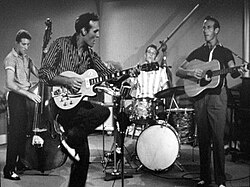
Perkins continued his momentum with several other influential releases. In 1956, he released "Boppin' the Blues," co-written with Johnny Cash, and "Dixie Fried." By February 1957, he released "Matchbox," which would eventually become a rockabilly classic. His visibility grew through appearances on television programs like Ozark Jubilee and Town Hall Party.
Collaborations and Later Career
After his tenure at Sun, Perkins remained a prolific performer and songwriter. He spent a decade touring in Johnny Cash's revue, often opening for Cash at high-profile events, including the Folsom and San Quentin prison concerts. His songwriting talent was also recognized by other stars; Patsy Cline took his co-written song "So Wrong" to number 14 on the country charts in 1962.
In 1969, Perkins collaborated with Bob Dylan on the song "Champaign, Illinois." While Dylan was recording Nashville Skyline, he struggled with writer's block; Perkins provided the rhythm and lyrics to help complete the track, which was later featured on Perkins' album On Top.
In his later years, Perkins reunited with his peers. In 1985, he joined Johnny Cash, Jerry Lee Lewis, and Roy Orbison for the album Class of '55: Memphis Rock & Roll Homecoming, a tribute to their early days and the famous 1956 Million Dollar Quartet jam session.
Final Tributes and Legacy
One of the highlights of his later career was the 1985 television special Blue Suede Shoes: A Rockabilly Session in London, where he performed alongside George Harrison, Eric Clapton, and Ringo Starr. In 1990, he returned to Sun Studio to record 706 ReUNION with Scotty Moore and D.J. Fontana.
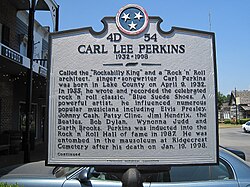
Perkins' legacy was cemented through his autobiography, Go, Cat, Go (1996), and his various Hall of Fame inductions. He passed away on January 19, 1998, at the age of 65.
Career Summary
| Category | Details |
|---|---|
| Active Years | 1946–1997 |
| Key Labels | Sun, London, Columbia, Mercury |
| Major Hits | "Blue Suede Shoes", "Honey Don't", "Matchbox" |
| Notable Collaborators | Johnny Cash, Bob Dylan, Elvis Presley, Jerry Lee Lewis |
| Key Awards | Grammy Hall of Fame, Rock and Roll Hall of Fame |
Frequently Asked Questions
What is rockabilly music?
Rockabilly is a genre that emerged in the 1950s, blending elements of country music (hillbilly) with rhythm and blues. Carl Perkins was one of the primary pioneers of this high-energy sound.
How did the song "Blue Suede Shoes" come to be?
Perkins wrote the song after seeing a dancer get angry with his date for scuffing up his shoes. It was recorded at Sun Studio in December 1955 and became a chart-topping hit in 1956.
Who was the Million Dollar Quartet?
The Million Dollar Quartet was a legendary 1956 jam session featuring Carl Perkins, Elvis Presley, Johnny Cash, and Jerry Lee Lewis, all of whom launched their careers at Sun Records.
Did Carl Perkins work with Bob Dylan?
Yes, in 1969, Perkins and Bob Dylan co-wrote "Champaign, Illinois." Perkins contributed the rhythm and lyrics to help Dylan overcome writer's block during the Nashville Skyline sessions.
Which Hall of Fame honors did Carl Perkins receive?
Perkins was inducted into the Nashville Songwriters Hall of Fame (1985), the Rock and Roll Hall of Fame (1987), and the Rockabilly Hall of Fame.