Rockabilly: The High-Energy Fusion That Birthed Rock and Roll
Rockabilly is one of the earliest and most influential styles of rock and roll. Emerging in the early 1950s, primarily in the Southern United States, it represents a high-energy collision of musical worlds. The genre is a portmanteau of "rock" (from rock 'n' roll) and "hillbilly," a term commonly used in the 1940s and 50s to describe country music.
At its core, rockabilly blends the twang of Western musical styles, such as country and bluegrass, with the driving beat of rhythm and blues. This fusion created the "classic" rock and roll sound, further enriched by influences from Western swing, boogie-woogie, jump blues, and electric blues.
Key Facts
- Origins: Early to mid-1950s in the Southern United States.
- Core Blend: A mix of country (hillbilly) music and rhythm and blues.
- Essential Instruments: Hollow-body electric guitar, upright bass, and a minimal drum kit.
- Pioneers: Elvis Presley, Bill Haley, Johnny Cash, and Carl Perkins.
- Legacy: Influenced the British Invasion, the Beatles, and led to subgenres like psychobilly.
The Sound and Instrumentation
The characteristic rockabilly sound is defined by its stripped-down arrangement. The standard ensemble consists of a hollow-body electric guitar, an upright bass, and a pared-down drum kit. While drums were uncommon in traditional country music of the era, their integration into rockabilly helped distinguish the genre and provide the driving energy essential to the style.
The Birthplace: Tennessee and the Memphis Scene
In the early 1950s, Memphis, Tennessee, became a hotbed for musical experimentation. Local bands competed by playing a mix of original songs and "hillbilly flavored" blues. Influential figures like producer Sam Phillips and disc jockey Dewey Phillips helped shape the scene. The Saturday Night Jamboree, held at the Goodwyn Institute Auditorium from 1953 to 1954, served as a vital stage where future stars, including Elvis Presley, performed and experimented with new sounds.
Other early innovators included the Burnette brothers (Johnny and Dorsey) and Paul Burlison. Their 1956 recording of "Train Kept A-Rollin'" is historically significant; it is widely considered one of the first intentional uses of a distortion effect on a rock song, courtesy of lead guitarist Paul Burlison.
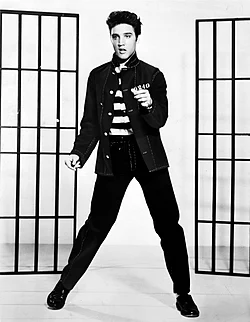
The Rise of Elvis Presley
Elvis Presley became a central figure in the genre's evolution. In 1955, he recruited drummer D.J. Fontana, further cementing the role of drums in the rockabilly sound. Following his move from Sun Records to RCA Victor in 1956, Presley's sound expanded to include pianist Floyd Cramer and vocal backup from the Jordanaires.
Expanding North: Bill Haley and the National Stage
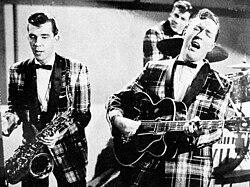
While the South was a primary hub, rockabilly also took root north of the Mason-Dixon Line. Bill Haley, a Western swing bandleader, recorded "Rocket 88" in 1951 with his group, the Saddlemen, which is recognized as one of the earliest rockabilly recordings.
Haley's most enduring contribution came on April 12, 1954, when he and His Comets recorded "Rock Around the Clock." Though it initially charted modestly, the song exploded in popularity after being featured in the 1955 film Blackboard Jungle. It held the No. 1 spot for eight weeks and was once cited by Guinness World Records as the highest-selling pop vinyl recording, with an unaudited claim of 25 million copies.
The Sun Records Era: Cash and Perkins
Sam Phillips's Sun Records studio was instrumental in launching other rockabilly icons. In 1954, Carl Perkins recorded "Movie Magg," released in 1955. Johnny Cash, who originally hoped to record gospel, eventually found success at Sun in 1955 with "Hey, Porter" and "Cry! Cry! Cry!," the latter of which reached No. 14 on the Billboard charts.
Global Influence and the British Invasion
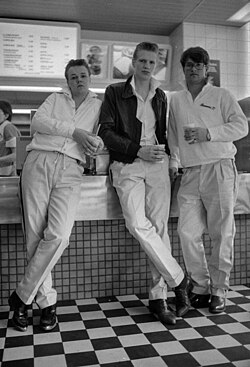
Rockabilly's influence crossed the Atlantic, sparking distinct youth cultures in the United Kingdom. The "Teddy Boys" adopted Edwardian-style frock coats and drainpipe trousers, while the "Ton-Up boys" (later known as rockers) paired leather jackets and T-shirts with slicked pompadour haircuts.
This passion for 1950s rock and roll deeply influenced the Beatles. Even after their global superstardom, the members maintained their love for the genre. John Lennon recorded the album Rock 'n' Roll in 1975, Ringo Starr had a hit with "You're Sixteen," and Paul McCartney released a collection of rockabilly covers titled Run Devil Run in 1999.
Evolution and Modern Revivals
Though the initial craze declined in the late 1950s, the genre never truly disappeared. It evolved into derivative forms like garage rock and fusion genres such as psychobilly and gothabilly. In the modern era, the "neo-rockabilly" movement continues, exemplified by artists like Brian Setzer of The Stray Cats and more recent projects like Drake Bell's 2014 album Ready Steady Go!

| Category | Details |
|---|---|
| Primary Influences | Country, Rhythm and Blues, Bluegrass, Western Swing |
| Key Instruments | Hollow-body electric guitar, Upright bass, Minimal drums |
| Defining Era | Early to mid-1950s |
| Notable Artists | Elvis Presley, Bill Haley, Johnny Cash, Carl Perkins, Gene Summers |
| Fusion Genres | Psychobilly, Gothabilly |
Frequently Asked Questions
What does the word "rockabilly" actually mean?
The term is a portmanteau combining "rock" (from rock 'n' roll) and "hillbilly," which was a common term for country music in the 1940s and 1950s.
Who are the most important artists in the rockabilly genre?
Key pioneers include Elvis Presley, Bill Haley, Johnny Cash, and Carl Perkins, as well as early innovators like the Burnette brothers.
How did rockabilly influence the Beatles?
The Beatles were heavily influenced by 1950s rock and roll. This is evident in their early work and later solo projects, such as John Lennon's 1975 Rock 'n' Roll album and Paul McCartney's Run Devil Run.
What is the difference between rockabilly and standard rock and roll?
Rockabilly is a specific early style of rock and roll that leans more heavily on country and bluegrass influences, typically featuring a distinct instrumentation of upright bass and hollow-body electric guitar.
What are psychobilly and gothabilly?
These are fusion genres that evolved from rockabilly, blending the original sound with elements of punk rock (psychobilly) or gothic subculture (gothabilly).