Bill Haley: The Pioneer Who Popularized Rock and Roll
Before the global phenomenon of Elvis Presley, there was Bill Haley, a musician whose energy and sound helped transition the music industry from the era of jazz and pop standards into the age of rock and roll. With over 60 million records sold worldwide, Haley and his band, The Comets, provided the spark that ignited a cultural revolution in the early 1950s.
Key Facts
- Major Hits: "Rock Around the Clock," "Shake, Rattle and Roll," and "See You Later, Alligator."
- Global Impact: Sold over 60 million records and was the first major American rock singer to tour Europe.
- Legacy: Posthumously inducted into the Rock and Roll Hall of Fame in 1987.
- Musical Style: Blended rhythm and blues with Western swing (a dance-band style of country music) and rockabilly.
- Cultural Milestone: "Rock Around the Clock" is often cited as the demarcation line between the pre-rock era and the modern music industry.
Early Life and Musical Roots
Born William John Clifton Haley on July 6, 1925, in Highland Park, Michigan, Haley's early life was marked by a significant medical accident. At age four, an inner-ear mastoid operation accidentally severed his optic nerve, leaving him blind in his left eye. To divert attention from this, Haley adopted his signature "kiss curl" hairstyle over his right eye, which eventually became a popular trademark.
Music was ingrained in his upbringing. His father played the banjo and mandolin, while his mother, a British immigrant, was a classically trained keyboardist. By age 13, Haley was already performing guitar and songs at local events. After leaving home at fifteen, he spent several years in poverty before joining a group called the Down Homers in Hartford, Connecticut.
In 1947, he formed the Four Aces of Western Swing, later renamed the Saddlemen. It was with this group that he recorded a cover of "Rocket 88" on June 14, 1951, signaling his move toward the high-energy sound that would soon define a generation.
The Rise of Bill Haley and His Comets
In 1952, the Saddlemen were renamed Bill Haley and His Comets, a name suggested by radio program director Bob Johnson. The group began gaining traction with "Crazy Man, Crazy" in 1953, which some historians consider one of the first rock and roll records, though it leans heavily toward rockabilly (a blend of rock and country music).
The turning point came with "Rock Around the Clock." While initially a moderate success in 1954, the song skyrocketed to number one in July 1955 after being featured as the theme for the film Blackboard Jungle. The track spent eight weeks at the top of the Billboard chart and became the first record to sell over a million copies in both Germany and Britain.
Another massive hit, "Shake, Rattle and Roll," further cemented his status. By speeding up a rhythm and blues cover and adding Western swing elements, Haley helped move rock and roll from an underground genre to a mainstream sensation.
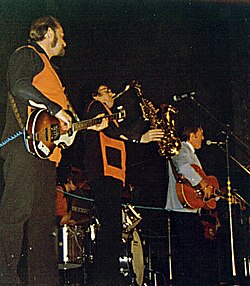
Television and Global Reach
Haley was a pioneer in bringing rock and roll to the television screen. He performed on the Texaco Star Theater with Milton Berle in May 1955 and became the first rock and roll act to appear on The Ed Sullivan Show in August 1955. These appearances exposed the genre to a massive national audience.
By 1957, Haley became the first major American rock singer to tour Europe. Although his popularity in the U.S. was eventually eclipsed by the younger Elvis Presley, he remained a superstar in Europe, Australia, and Latin America throughout the 1960s.
Personal Life and Later Years
Haley's personal life was complex. He was married three times—to Dorothy Crowe, Barbara Joan Cupchak, and Martha Velasco—and fathered at least ten children. Among them, Bill Haley Jr. continues his father's legacy through a tribute band.
Despite his fame, Haley struggled with chronic alcoholism, a battle he admitted to in a 1974 BBC interview. However, he experienced a career resurgence in the late 1960s due to a nostalgia movement and a lucrative deal with the European label Sonet. One of his final high-profile achievements was performing for Queen Elizabeth II at the Royal Variety Performance in 1979.
In 1980, it was reported that Haley had an inoperable brain tumor. He passed away at his home in Harlingen, Texas, on February 9, 1981, at the age of 55. His death certificate cited natural causes, most likely a heart attack.
Legacy and Honors
Bill Haley's contribution to music is recognized through numerous prestigious honors. He received a star on the Hollywood Walk of Fame in 1960, and "Rock Around the Clock" was inducted into the Grammy Hall of Fame in 1982 and the National Recording Registry in 2018.
In addition to his 1987 induction into the Rock and Roll Hall of Fame, the Comets were inducted as a group in 2012. His influence even extends to the stars; in 2006, the International Astronomical Union named asteroid 79896 "Billhaley" in his honor.
| Category | Details |
|---|---|
| Active Years | 1946–1980 |
| Primary Genres | Rock and Roll, Rockabilly, Western Swing |
| Total Record Sales | Over 60 Million |
| Key Labels | Decca, London, Brunswick |
| Instruments | Vocals, Guitar, Double Bass |
Frequently Asked Questions
Was Bill Haley the first rock and roll star?
While many artists contributed to the genre, Bill Haley is credited by many with first popularizing rock and roll in the early 1950s, helping it move from an underground style to a mainstream global phenomenon.
What is the significance of "Rock Around the Clock"?
The song is often viewed as the dividing line between the previous era of pop/jazz and the "rock era." It was a massive commercial success and the first record to sell over a million copies in both Britain and Germany.
Why did Bill Haley wear a "kiss curl"?
Haley adopted the trademark curl over his right eye to draw attention away from his left eye, which was blind due to a medical accident during childhood.
When was Bill Haley inducted into the Rock and Roll Hall of Fame?
Bill Haley was posthumously inducted in 1987. His backing band, The Comets, were later inducted as a group in 2012.
How did Bill Haley influence the music of the 1950s?
He blended rhythm and blues with Western swing and rockabilly, creating a high-energy sound that appealed to a wide audience and paved the way for future artists like Elvis Presley.