Canal Streetcar Line: A Historic Journey Through New Orleans
The Canal Streetcar Line is a cornerstone of the New Orleans transit landscape, blending historic charm with modern urban mobility. Operated by the New Orleans Regional Transit Authority (RTA), this heritage streetcar system serves as a vital link between the bustling Central Business District and the scenic neighborhoods of Mid-City.
While the current iteration of the line is a modern revival, its roots stretch back to the mid-19th century, reflecting the city's evolving relationship with public transportation. Today, the line provides a scenic and efficient way for residents and tourists alike to navigate the heart of the Crescent City.
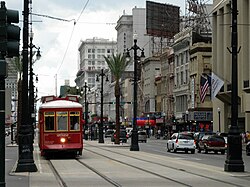
Key Facts
- Operator: New Orleans Regional Transit Authority (RTA).
- Total Length: Approximately 5.5 miles (8.9 km).
- Routes: Route 47 (Cemeteries) and Route 48 (City Park).
- Rolling Stock: 2000 series streetcars.
- Power: 600 V DC overhead line electrification.
- Track Gauge: 5 ft 2.5 in (1,588 mm).
Route Overview and Branches
The system operates as a trunk line along Canal Street, starting at the Canal Street Ferry Terminal near the Mississippi River. From there, it travels through the central business district before splitting into two distinct branches.
Route 47: The Cemeteries Branch
The Canal/Cemeteries branch runs the full length of Canal Street. It terminates at the Cemeteries Transit Center, located at the intersection of Canal Street and City Park Avenue. This area is historically significant for its high density of Catholic, Protestant, and Jewish cemeteries, which once marked the lakeside boundary of the city. In 2018, a new loop terminal was opened on Canal Boulevard to improve passenger safety and facilitate easier transfers to RTA bus lines.
Route 48: The City Park Branch
The Canal/City Park branch follows the main trunk until it reaches North Carrollton Avenue. At this point, the streetcar diverges from the neutral ground (the median strip) and runs in the inside lanes of the street. The line concludes at Beauregard Circle, near the New Orleans Museum of Art in City Park and within walking distance of the New Orleans Fairgrounds.
A History of Resilience
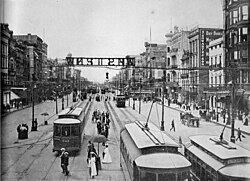
The story of the Canal Streetcar is one of disappearance and rebirth. The first incarnation began in June 1861 as part of the New Orleans City RR Co., utilizing horse-drawn cars. By July 28, 1894, the Canal Line became the first in the city to be electrified.
Throughout the early 20th century, the line underwent various configurations, including a "Belt Line" arrangement with the Esplanade line and service to the West End amusement area. However, by the 1960s, the trend shifted toward motorized transport. Despite protests from preservationists, the original Canal line was closed on May 31, 1964, and replaced by buses.
After a 40-year hiatus, the city began rebuilding the infrastructure in 2000. The modern Canal Streetcar Line officially resumed service on April 18, 2004. Even in its new form, the line has faced challenges; Hurricane Katrina in 2005 damaged the red 2000 series cars, forcing the RTA to temporarily use green cars borrowed from the St. Charles line during repairs.
Technical Specifications and Operations
The line utilizes a specialized track gauge of 5 ft 2.5 in and is powered by a 600 V DC overhead system. The infrastructure is designed to handle high capacity, with the trunk segment featuring two tracks running in the neutral ground.
| Feature | Route 47 (Cemeteries) | Route 48 (City Park) |
|---|---|---|
| Color Designation | Light Yellow | Red |
| Terminus | Cemeteries Transit Center | New Orleans Museum of Art |
| Service Hours | 24 Hours | 5:00 a.m. – Midnight |
| Primary Path | Canal Street | Canal St & N. Carrollton Ave |
In terms of frequency, streetcars run approximately every 11 minutes along the shared Canal Street segment. Because the service alternates between the two branches, the headway for a specific branch is roughly 22 minutes. The Cemeteries branch provides 24-hour service, though frequency is reduced to every 40 minutes between midnight and 5:00 a.m.
Frequently Asked Questions
What is the difference between Route 47 and Route 48?
Route 47 (Cemeteries) runs straight along Canal Street to the Cemeteries Transit Center, while Route 48 (City Park) turns onto North Carrollton Avenue to end near the New Orleans Museum of Art.
When did the modern Canal Streetcar line open?
After being closed since 1964, the rebuilt Canal Streetcar line resumed service on April 18, 2004.
What is the "neutral ground" mentioned in the route description?
The neutral ground is the local term for the median strip that separates opposing lanes of traffic, where the streetcar tracks are primarily located on Canal Street.
Does the streetcar run 24 hours a day?
Only the Canal/Cemeteries branch (Route 47) operates 24 hours a day, albeit with reduced frequency during overnight hours. The City Park branch operates from 5:00 a.m. to midnight.
How was the line affected by Hurricane Katrina?
Hurricane Katrina damaged the red 2000 series streetcars stored at the car barn, requiring the RTA to use borrowed green cars from the St. Charles line until the red cars were rebuilt.