Understanding the California Tiger Salamander: A Guide to This Vulnerable Amphibian
The California tiger salamander (*Ambystoma californiense*) is a striking and secretive amphibian native to the state of California. A member of the mole salamander family, this species plays a vital role in its ecosystem, though it currently faces significant conservation challenges. Once considered a subspecies of the tiger salamander, recent scientific designations have recognized it as a distinct species.
Historically, these salamanders were widespread throughout the San Joaquin and Sacramento river valleys. Today, however, their range has contracted into three geographically isolated and genetically distinct population segments (DPS). Because these groups are separated, they have evolved independently for over a million years, dating back to the Pleistocene epoch.
Key Facts
- Scientific Name: Ambystoma californiense
- Conservation Status: Vulnerable (IUCN 3.1)
- Adult Size: Approximately 7–8 inches in length
- Lifespan: Up to 15 years
- Primary Habitat: Vernal pools, seasonal ponds, and fishless perennial water bodies
- Diet: Earthworms, snails, insects, fish, and small mammals
Physical Description and Appearance
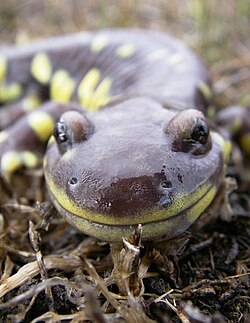
The California tiger salamander is a relatively large amphibian characterized by a stocky body and a broad, rounded snout. Adults typically feature a black base color accented by yellow or cream-colored spots. Their eyes are brown and protruding, featuring black irises.
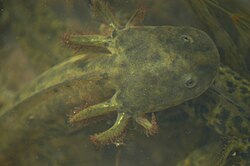
The appearance of the species changes significantly during its development. While adults are dark and spotted, the larvae are a distinct greenish-grey color.
Habitat and Range
This species is endemic to California, meaning it is found nowhere else in the world. Its habitat is specialized; it relies on vernal pools (seasonal wetlands that fill with rain and then dry up) and other seasonal or stock ponds for reproduction. Crucially, these water bodies must be largely fishless to ensure the survival of the larvae.
The salamander's range extends from Sonoma County in the north, through the Central Valley (from Colusa to Kern County), down to Santa Barbara County in the south. They can be found at elevations up to 1,000 meters (3,200 feet).
Conservation Status and Threats
The California tiger salamander is protected under various federal listings due to its declining numbers. The current status of its population segments is as follows:
- Sonoma County DPS: Federally Endangered
- Santa Barbara County DPS: Federally Endangered
- Central California DPS: Federally Threatened
Several factors contribute to their decline. Human development has led to habitat destruction and increased road mortality during their nocturnal migrations. Additionally, invasive species like the American bullfrog act as predators. A complex challenge also exists in the form of hybridization—the interbreeding of different species. For the last 50–60 years, the native California tiger salamander has been hybridizing with the introduced barred tiger salamander, which complicates conservation and protection efforts.
Life Cycle and Reproduction
The life of a California tiger salamander is defined by a "boom and bust" cycle, driven by the unpredictable California climate. Their survival depends heavily on precipitation levels.
The Underground Phase
Adults spend the majority of their lives underground in burrows created by other animals, such as gophers or ground squirrels. While it was once thought they underwent estivation (a state of dormancy similar to hibernation used to survive heat or drought), researchers using fiber optic cameras have observed them actively foraging underground.
Breeding and Metamorphosis
Breeding begins with the first major rains of fall or winter. Adults migrate at night from upland habitats to breeding pools, sometimes traveling up to 1.3 miles. This migration is a high-risk period for the animals.
The reproductive process follows these stages:
- Egg Laying: Females lay eggs in small clusters or singly.
- Hatching: Eggs typically hatch within 10 to 14 days.
- Larval Stage: Larvae feed on small invertebrates and tadpoles. This stage usually lasts three to six months, but some larvae may "overwinter," extending the period to 13 months or more.
- Metamorphosis: As ponds dry, larvae undergo a rapid transformation. They resorb their gills, develop lungs, and emerge as "metamorphs." This process can happen in as little as four days, an evolutionary adaptation to ensure they leave ephemeral ponds before they disappear completely.
The Importance of Perennial Pools
While vernal pools are traditional breeding sites, recent research shows that these salamanders can also utilize perennial water bodies (pools that hold water year-round), such as stock ponds or fishless creeks. Using perennial pools may allow larvae to stay in the water longer, reaching a larger body size before metamorphosis. A larger size at metamorphosis is linked to higher individual fitness, which improves survival rates once they return to terrestrial life.
Summary of Population Segments
| Population Segment (DPS) | Federal Listing Status | Geographic Area |
|---|---|---|
| Sonoma County | Endangered | Northern California (e.g., Laguna de Santa Rosa) |
| Santa Barbara County | Endangered | Southern Coastal Range |
| Central California | Threatened | Central Valley (Colusa to Kern County) |
Frequently Asked Questions
How long do California tiger salamanders live?
In the wild, these salamanders can live for up to 15 years.
What do adult California tiger salamanders eat?
Adults have a varied diet that includes earthworms, snails, insects, fish, and occasionally small mammals, though they are known to eat relatively little.
Why is hybridization a problem for this species?
The California tiger salamander has been hybridizing with the invasive barred tiger salamander for approximately 50–60 years. This genetic mixing makes it difficult for conservationists to provide specific protections for the native species.
What is the difference between a vernal pool and a perennial pool?
A vernal pool is a seasonal wetland that fills with rain and eventually dries up, whereas a perennial pool holds water year-round. While the salamander traditionally uses vernal pools, they have recently been observed using perennial pools to potentially increase their size before metamorphosis.
Why are these salamanders vulnerable during migration?
Because they migrate at night from upland habitats to breeding ponds following the first rains, they are highly susceptible to road mortality caused by human development and vehicle traffic.