Barred Tiger Salamander: Nature's Striking North American Amphibian
The barred tiger salamander (Ambystoma mavortium), also known as the western tiger salamander, is one of the most impressive amphibian species in North America. A member of the mole salamander family, this resilient creature is found across a vast range stretching from lower western Canada through the western United States and into northern Mexico.
Known for its distinctive markings and varied physical forms, the barred tiger salamander plays a vital role in its ecosystem, transitioning from an aquatic larval stage to a primarily terrestrial adult life.
Key Facts
- Scientific Name: Ambystoma mavortium
- Size Range: Typically 7.6 to 16.5 cm; neotenic forms can reach up to 38.1 cm.
- Diet: Opportunistic feeders including insects, slugs, and earthworms.
- Habitat: Forests, grasslands, deserts, and meadows.
- Status: The Sonoran subspecies is classified as endangered.
Physical Characteristics and Appearance
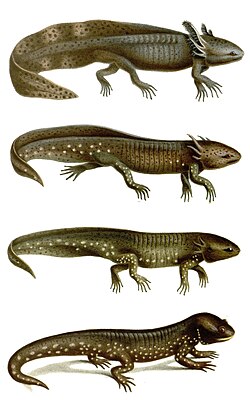
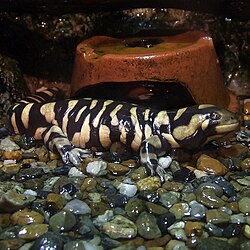
The barred tiger salamander is characterized by a sturdy body and a broad head. Its coloration is highly variable depending on its specific range. Most commonly, the dorsal (top) surface features a grey, dark brown, or black base decorated with muddy yellow bars and spots, giving it a "tiger-like" appearance. The ventral (bottom) surface can range from light to dark shades.
Size variation is significant within the species. While most adults grow between 7.6 and 16.5 cm, some individuals exhibit neoteny—a biological phenomenon where an organism retains juvenile features, such as external gills, into adulthood. These neotenic forms can grow remarkably large, reaching lengths of up to 38.1 cm.
Larval Development
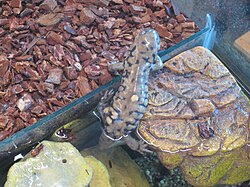
The life cycle of the salamander begins in the water. Larvae are entirely aquatic and possess external gills to breathe. During this stage, they display a different pattern than adults, featuring alternating dark and light blotches on the center of their backs and pale stripes along their sides.
Behavior and Feeding Morphologies
As nocturnal animals, barred tiger salamanders are most active during the night. They are opportunistic predators, meaning they will consume almost any prey they can successfully catch, such as earthworms, slugs, and various insects.
Interestingly, the species exhibits two distinct feeding morphologies: typical and cannibalistic. The cannibalistic form is physically distinct, possessing a wider head and a slimmer body. They also feature large vomerine teeth (teeth located on the roof of the mouth) which provide a superior grip on larger prey, such as fathead minnows. This morphology is often an evolutionary advantage in drier or more competitive environments, as eating competitors reduces the demand for shared food resources. Cannibalistic forms also tend to undergo metamorphosis earlier than typical forms.
Subspecies and Distribution
The Ambystoma mavortium species is divided into five recognized subspecies:
- Gray barred tiger salamander (A. m. diaboli)
- Barred tiger salamander (A. m. mavortium)
- Blotched tiger salamander (A. m. melanostictum)
- Arizona tiger salamander (A. m. nebulosum)
- Sonoran tiger salamander (A. m. stebbinsi)
Geographically, their range is expansive. In Canada, they inhabit British Columbia, Alberta, Saskatchewan, and Manitoba. In the United States, they extend from the Dakotas and Oklahoma down to the southern tip of Texas, with infrequent sightings in California and Nevada. Their habitats are diverse, ranging from lowland deciduous and coniferous forests to open grasslands, deserts, and semideserts.
| Subspecies Name | Scientific Name |
|---|---|
| Gray barred tiger salamander | A. m. diaboli |
| Barred tiger salamander | A. m. mavortium |
| Blotched tiger salamander | A. m. melanostictum |
| Arizona tiger salamander | A. m. nebulosum |
| Sonoran tiger salamander | A. m. stebbinsi |
Conservation and Human Interaction
While many tiger salamanders are hardy, certain subspecies face significant threats. The Sonoran tiger salamander was classified as endangered in 1997. This decline is driven by habitat fragmentation and degradation caused by human activity, as well as disease outbreaks from non-native species and predation by introduced animals like crayfish.
In human settings, these salamanders are frequently kept in captivity due to their hardy nature and ease of feeding. However, regulations vary; in most parts of the United States, it is illegal to sell adult specimens. Interestingly, their larval stage is often used commercially as fishing bait, where they are commonly referred to as "mud puppies" or "water dogs."
Cultural Significance
The tiger salamander holds special status in several U.S. states. It is the official state amphibian of Kansas, a designation that originated from a petition by a second-grade class in Wichita. Colorado also recognizes it as their state amphibian, and the blotched tiger salamander serves as the official state amphibian for Wyoming.
Frequently Asked Questions
What is the difference between typical and cannibalistic tiger salamanders?
Cannibalistic forms have wider heads and larger vomerine teeth to help them capture larger prey and competitors. They also tend to undergo metamorphosis earlier than typical forms.
Are tiger salamanders dangerous to humans?
The source does not indicate that they are dangerous to humans; they are primarily known as opportunistic feeders of insects and small invertebrates.
Why is the Sonoran tiger salamander endangered?
The Sonoran subspecies faces threats from habitat degradation and fragmentation caused by human activity, disease outbreaks from non-native species, and predation by introduced animals like crayfish.
What are "mud puppies"?
"Mud puppies" or "water dogs" are common names used to market tiger salamander larvae when they are sold as fishing bait.
Can tiger salamanders live in the desert?
Yes, their habitat range includes deserts and semideserts, as well as forests, grasslands, and meadows.