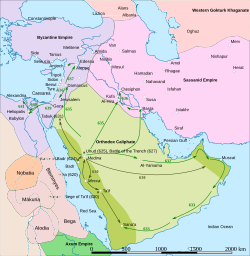
Byzantine–Sasanian War of 602–628
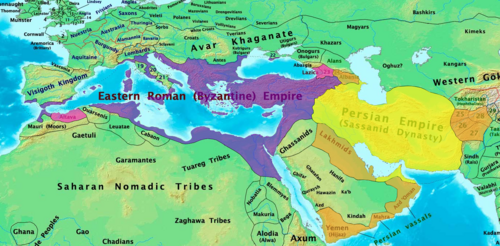
The Byzantine–Sasanian War of 602–628, often referred to as the Last Great War of Antiquity, represented the final and most destructive chapter of the centuries-long Roman–Persian conflicts. This grueling struggle pitted the Byzantine Empire against the Sasanian Empire in a war of attrition that spanned the Middle East, the Balkans, and the Aegean Sea, ultimately leaving both superpowers exhausted on the eve of the Arab conquests.
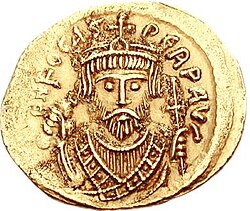
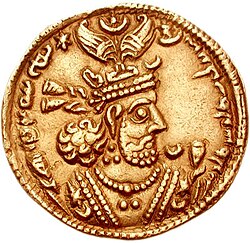
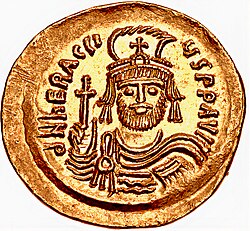
The conflict was sparked by political instability within the Byzantine Empire. In 602, Emperor Maurice was murdered by his rival, Phocas. The Sasanian King Khosrow II, who had previously been aided by Maurice in regaining his own throne, used the murder as a casus belli (justification for war), declaring his intent to avenge the fallen emperor.
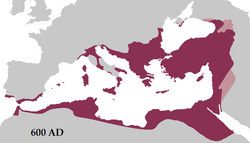
Key Facts
- Duration: Approximately 602–628 AD.
- Primary Belligerents: The Byzantine Empire and the Sasanian Empire.
- Outcome: Byzantine victory, resulting in a status quo ante bellum (return to pre-war borders).
- Casualties: Estimated at over 200,000 dead.
- Decisive Engagement: The Battle of Nineveh in 627.
The Era of Persian Dominance (602–622)
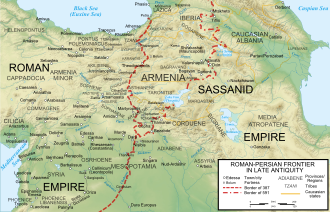
For the first two decades of the war, the Sasanian Empire held a commanding advantage. Under the leadership of Khosrow II and his generals, the Persians systematically dismantled Byzantine control across the East.
The Fall of the Levant and Egypt
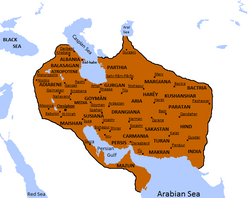
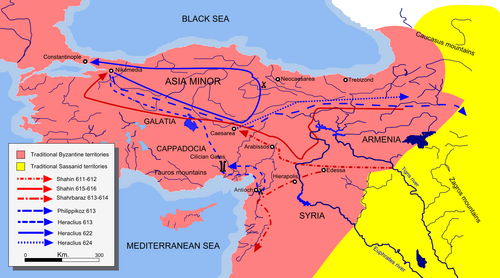
The Sassanians gradually conquered the Levant and parts of Anatolia. In 618, the Persian general Shahrbaraz invaded Egypt, a region that had remained largely peaceful for three centuries. The local Monophysite population, alienated by the Chalcedonian orthodoxy of the Byzantine state, offered little resistance. After a year-long siege of Alexandria, the city fell, depriving Constantinople of its vital grain shipments and forcing the abolition of the free grain ration in the capital.
The Threat to Constantinople
By 615, Persian forces reached Chalcedon. The situation became so dire that Emperor Heraclius reportedly considered moving the imperial government to Carthage in Africa. By 617, the Persians were within sight of Constantinople, and by 622, they had captured Rhodes and several Aegean islands, threatening a direct naval assault on the capital.
The Byzantine Resurgence
The tide began to turn as Heraclius reorganized the Byzantine military and financial structures. He faced a dual threat: the Persians in the East and the Avars and Slavs in the Balkans.
The Avar Threat and the Siege of 626
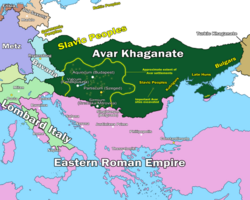
In 626, the Persians allied with the Avars and Slavs to launch a coordinated assault on Constantinople. Despite a month of continuous bombardment, the city's walls held. Morale was bolstered by Patriarch Sergius, who led religious processions with the icon of the Virgin Mary, convincing the defenders they were under divine protection. The assault failed, marking a critical turning point in the war.
The Counter-Offensive in the Persian Heartland
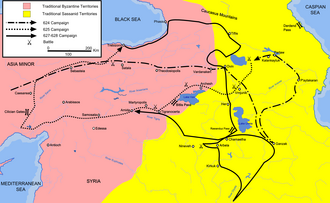
Rather than focusing on reclaiming lost provinces, Heraclius adopted a high-risk strategy. In 624, he marched his army—estimated between 20,000 and 40,000 men—directly into the Persian heartland through Armenia. This bold maneuver bypassed Persian strongholds to strike at the core of the Sasanian Empire.
The Climax and Conclusion
The Byzantine–Turkic Alliance
To secure his flank and increase his pressure on the Sassanians, Heraclius formed an alliance with the Western Turkic Khaganate. This partnership led to joint operations in the Caucasus, including the siege of Tbilisi, where the Byzantines utilized traction trebuchets (large gravity-powered catapults) to breach the city walls.
![Western Turk officers during an audience with King Varkhuman of Samarkand. 648–651, Afrasiyab murals, Samarkand[129][130][131]](/images/b5/ec/b5ec5a46f7af3d43c318889d23de7d1554f072ef1dd2cdf702c16d7bb072415b.jpg)
The Battle of Nineveh and Peace
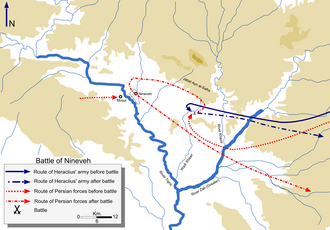
The conflict reached its zenith at the Battle of Nineveh in 627. The Byzantine victory here broke the back of the Sasanian military. Combined with internal civil strife within Persia, Khosrow II was forced to sue for peace. The war ended in 628 with the restoration of the borders as they existed before the conflict began.
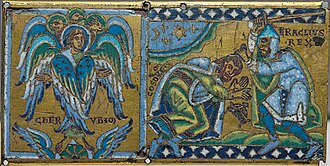
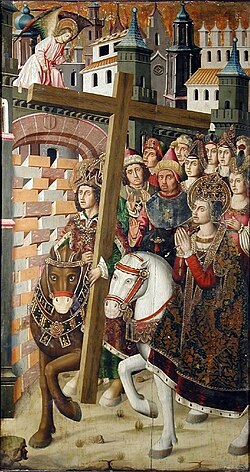
Following the peace treaty, Heraclius returned the True Cross—a sacred relic captured by the Persians during the fall of Jerusalem—to the city of Jerusalem, symbolizing the restoration of Christian authority in the region.
![Silver plate showing the arming of David, made after the conclusion of the war in 629–630. The plate, using the costumes of the early Byzantine court, suggests that, like Saul and David, the Byzantine emperor was a ruler chosen by God.[197]](/images/d5/89/d589c1da38e91bd6f978150bb4b22d769addd00aaf32b0f87a802a5ce00e6fe1.jpg)
Summary of the Conflict
| Feature | Byzantine Empire | Sasanian Empire |
|---|---|---|
| Primary Leader | Heraclius | Khosrow II |
| Key Allies | Western Turks, Ghassanids | Avars, Lakhmids |
| Strategic Peak | Battle of Nineveh (627) | Capture of Egypt & Levant (618-621) |
| Final Result | Victory / Status Quo | Defeat / Status Quo |
Frequently Asked Questions
What caused the start of the war in 602?
The war began after the murder of Byzantine Emperor Maurice by Phocas. King Khosrow II of Persia used this event as a pretext to invade, claiming he was avenging Maurice, who had previously helped him secure the Sasanian throne.
Why was the loss of Egypt so significant for the Byzantines?
Egypt was the primary source of grain for Constantinople. Its capture by the Persians in 618 led to severe food shortages in the capital and forced the government to end the free grain ration.
How did the Byzantine-Turkic alliance help Heraclius?
The alliance provided Heraclius with 40,000 Turkic warriors who ravaged Sasanian territories in the Caucasus, forcing the Persians to divert resources and weakening their defenses before the final Byzantine push.
What was the result of the Siege of Constantinople in 626?
The siege was a failure for the Persians and their Avar and Slav allies. The city's formidable walls and the high morale of the defenders, inspired by religious fervor, prevented the capital from falling.
What were the long-term consequences of this war?
Although the Byzantines won, both empires were left militarily and economically exhausted. This vulnerability made them easy targets for the Arab Muslim invasions that began shortly after the war's conclusion.