Brown-headed Cowbird: The Master of Brood Parasitism
The brown-headed cowbird (Molothrus ater) is a small, fascinating member of the icterid family native to temperate and subtropical North America. Unlike most birds, the cowbird is an obligate brood parasite, meaning it relies entirely on other bird species to raise its young. While some populations are permanent residents in the southern parts of their range, northern birds migrate to Mexico and the southern United States during the winter, returning north around March or April.
Key Facts
- Scientific Name: Molothrus ater
- Behavior: Obligate brood parasite (lays eggs in other birds' nests).
- Diet: Primarily seeds and insects; occasionally berries.
- Range: North America, from Canada to Mexico.
- Conservation Status: Least Concern (IUCN 3.1).
- Host Range: Has used at least 220 different host species.
Taxonomy and Origins
The brown-headed cowbird was first described in 1775 by the French polymath Georges-Louis Leclerc, Comte de Buffon. However, the binomial name Oriolus ater was not coined until 1783 by Dutch naturalist Pieter Boddaert. By 1832, English naturalist William Swainson placed the species in the genus Molothrus, which serves as the type species for the genus. The name Molothrus is derived from the Ancient Greek words mōlos ("struggle" or "battle") and thrōskō ("to sire"). The specific name ater is Latin for "dull black." The common name "cowbird" appeared in 1839, reflecting the bird's habit of foraging near cattle.
Scientists recognize three distinct subspecies:
- M. a. artemisiae: Found in the interior west of Canada and the USA.
- M. a. obscurus: Found in coastal Alaska, Canada, the USA, and northwest Mexico.
- M. a. ater: Found in southeast Canada, the east and central USA, and northeast Mexico.
Physical Description
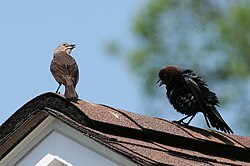
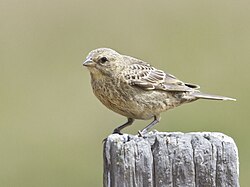
While the brown-headed cowbird shares the general shape of other icterids, it is smaller and possesses a finch-like head and beak. Adult males are characterized by iridescent black plumage with a distinct brown head. Adult females are slightly smaller and duller, featuring grey plumage with a pale throat and fine streaking on their underparts.
In terms of size, they range from 16 to 22 cm (6.3 to 8.7 in) in length, with an average wingspan of 36 cm (14 in). Males typically average 49 g (1.7 oz), while females average 38 g (1.37 oz).
Distribution and Habitat
These birds prefer open or semi-open country and are frequently seen in flocks. They often associate with other species, such as red-winged blackbirds in the spring and bobolinks in the fall, as well as European starlings and common grackles. Their foraging strategy involves following grazing animals—historically bison on the prairies, and now horses and cattle—to catch insects stirred up by the livestock.
The expansion of the cowbird's population is closely linked to human activity. The clearing of forests and the introduction of domestic grazing animals provided more of the open habitats they prefer. Today, they are also common visitors to suburban birdfeeders. Notably, in 2012, some cowbirds in northwest Riverside County, California, tested positive for West Nile Virus.
The Mechanics of Brood Parasitism
The most striking aspect of the brown-headed cowbird's ecology is its parasitic breeding strategy. Females do not build their own nests; instead, they lay their eggs in the nests of other small passerines (perching birds), particularly those with cup-shaped nests. A single female can lay up to 40 eggs in one season.
This strategy is incredibly widespread, with eggs documented in at least 220 host species—ranging from raptors to hummingbirds—and over 140 species known to have successfully raised cowbird young. The host parents feed the cowbird chick, often at the expense of their own biological offspring.
Host Responses and Survival
Not all hosts are equally susceptible. Some species, like the house finch, provide an herbivorous diet that is unsuitable for cowbird chicks, leading to low survival rates. Other hosts have developed active defenses:
- Abandonment: The blue-grey gnatcatcher may abandon the nest entirely.
- Burial: The American yellow warbler may bury the foreign egg under nesting material.
- Ejection: The brown thrasher and grey catbird physically remove the egg from the nest.
In some cases, host nestlings adapt. Song sparrow nestlings in parasitized nests have been observed altering their vocalizations to mimic the cowbird, ensuring they are fed just as often as the parasite.
Parasite Strategies: Mafia and Farming Behavior
Cowbirds do not simply "drop and forget" their eggs. They periodically monitor their nests. If a host removes a cowbird egg, the adult cowbird may engage in mafia behavior, returning to ransack the nest. Research shows this occurs in about 56% of cases where eggs are removed. Additionally, they exhibit farming behavior, destroying nests to force hosts to build new ones, which the cowbirds then parasitize 85% of the time.
Development and Social Behavior
Because they are raised by other species, young cowbirds never receive species-specific visual or auditory cues from their parents. To compensate, their brains are biologically wired to respond to the vocalizations of other cowbirds. These sounds act as a "species-recognition password." If a juvenile does not encounter these sounds by a certain age, it may mistakenly imprint on the host species.
Adult males engage in competitive singing bouts and form monogamous pair bonds with females. Studies suggest that males exposed to more complex social environments tend to achieve greater reproductive success.
Human Interaction and Conservation
Due to their impact on other songbirds, brown-headed cowbirds are often viewed as pests. This has led to various control programs. However, these programs can have unintended consequences. For example, in studies of Bell's vireo, removing cowbirds actually increased cowbird productivity on-site because fewer parasitized nests were deserted, leading to a higher success rate for the remaining cowbird eggs.
| Feature | Details |
|---|---|
| Scientific Name | Molothrus ater |
| Body Mass | 30–60 g |
| Diet | Seeds, insects, and occasionally berries |
| Breeding Strategy | Obligate Brood Parasitism |
| Key Behaviors | Mafia behavior, farming behavior, password-based recognition |
| Conservation Status | Least Concern |
Frequently Asked Questions
What does "obligate brood parasite" mean?
It means the species is biologically dependent on other species to raise its young. The brown-headed cowbird does not build its own nest or provide parental care, instead laying its eggs in the nests of other birds.
How do cowbird chicks know they are cowbirds if they are raised by other species?
They possess an innate neural wiring that allows them to recognize and respond to the specific vocalizations of other brown-headed cowbirds, which serve as a species-recognition "password."
What is "mafia behavior" in cowbirds?
Mafia behavior occurs when a cowbird returns to a host's nest and destroys it as retaliation for the host having removed the cowbird's parasitic egg.
Why are they called "cowbirds"?
The name comes from their habit of foraging on the ground near grazing livestock, such as cattle and horses, to eat the insects that the animals stir up.
Do all birds accept cowbird eggs?
No. Many species have evolved defenses, such as burying the egg, ejecting it from the nest, or abandoning the nest entirely. Some, like the house finch, provide a diet that the cowbird chicks cannot survive on.