Boxer Protocol: The Terms and Consequences of the 1901 Agreement
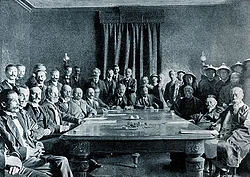
The Boxer Protocol was a formal agreement signed in 1901 that concluded the conflict between the Qing Empire and the Eight-Nation Alliance. This treaty imposed severe financial penalties and restrictive political conditions on China, fundamentally altering its sovereignty and administrative structure during the early 20th century.
The protocol served as a punitive measure following the Boxer Rebellion, ensuring that the foreign powers involved in the intervention were compensated and their diplomatic presence in China was secured through military and legal guarantees.
Key Facts
- Financial Indemnity: China was ordered to pay 450 million taels of fine silver.
- Total Cost: Due to 4% interest, the final payment reached nearly 1 billion taels by 1940.
- Military Restrictions: The Taku Forts were destroyed, and arms imports were banned for up to four years.
- Diplomatic Shifts: The Zongli Yamen was replaced by a higher-ranking Foreign Office.
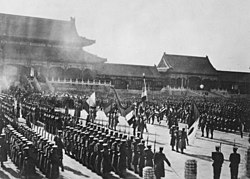
- Foreign Presence: Foreign powers gained the right to station troops in specific strategic locations.
The Financial Burden: The Boxer Indemnity
One of the most grueling aspects of the protocol was the indemnity—a massive sum of money paid as compensation. The initial requirement was 450 million taels of fine silver, which amounted to approximately 18,000 tonnes of silver, valued at roughly US$ 333 million or £ 67 million at the time.
This debt was structured to be paid over 39 years. However, because the payments were made in gold on a rising scale with a 4% interest charge, the total cost escalated significantly. By the time the debt was fully amortized on December 31, 1940, China had paid 982,238,150 taels (approximately 1.18 billion troy ounces or 37,000 tonnes of silver).
The distribution of these funds among the participating nations was uneven, with Russia and Germany receiving the largest shares.
| Nation | Percentage Share |
|---|---|
| Russia | 28.97% |
| Germany | 20.02% |
| France | 15.75% |
| Britain | 11.25% |
| Japan | 7.73% |
| United States | 7.32% |
| Italy | 7.32% |
| Belgium | 1.89% |
| Austria-Hungary | 0.89% |
| Netherlands | 0.17% |
| Spain | 0.03% |
| Portugal | 0.02% |
| Sweden and Norway | 0.01% |
Political and Military Restrictions
Beyond the financial penalties, the protocol imposed strict limitations on China's military capabilities and internal governance. To prevent future uprisings, the importation of arms, ammunition, and materials for their production was prohibited for two years, with a possible two-year extension.
Military and Territorial Concessions
The treaty mandated the destruction of the Taku Forts and granted foreign powers the right to station troops in several strategic locations, including:
- Huangcun, Langfang, and Yangcun
- Tianjin, Junliangcheng, and Tanggu
- Lutai, Tangshan, and Luanzhou
- Changli, Qinhuangdao, and Shanhaiguan
Diplomatic and Administrative Changes
The Zongli Yamen (the Office in Charge of Affairs of All Nations) was abolished and replaced by a new Foreign Office, which was granted a higher rank than the other six government boards. Additionally, the Legation Quarters—areas where foreign diplomats resided—were designated as special reserved areas under exclusive foreign control. Chinese citizens were forbidden from residing there, and the foreign powers were permitted to maintain permanent guards for defense.
Punishments and Symbolic Reparations
The protocol demanded severe retribution for those involved in the rebellion. Boxers and government officials accused of crimes against foreign nationals were subjected to execution, life imprisonment, deportation to Xinjiang, or forced suicide. Some suffered posthumous degradation.
The Chinese government was further required to prohibit membership in any anti-foreign society under penalty of death. In regions where foreigners had been massacred or mistreated, civil service examinations were suspended for five years, and local officials were held personally responsible for any new anti-foreign incidents.
Symbolic gestures of apology were also mandated. The Emperor of China was required to convey official regrets to the German Emperor for the assassination of Baron von Ketteler and to the Emperor of Japan for the assassination of Mr. Sugiyama. Furthermore, a commemorative arch inscribed in Latin, German, and Chinese had to be erected at the site of Baron von Ketteler's assassination.
Frequently Asked Questions
How much did China eventually pay for the Boxer Indemnity?
While the initial sum was 450 million taels, the addition of a 4% interest charge meant that by the time the debt was paid off on December 31, 1940, the total amount reached 982,238,150 taels.
What happened to the Zongli Yamen?
The Zongli Yamen, which previously handled foreign affairs, was replaced by a dedicated Foreign Office that held a higher administrative rank than the other six boards of the Chinese government.
Which nations received the largest portion of the indemnity?
Russia received the largest share at 28.97%, followed by Germany at 20.02% and France at 15.75%.
What were the restrictions on the Legation Quarters?
The Legation Quarters became special areas under the exclusive control of the foreign powers. Chinese citizens were prohibited from living there, and the powers were allowed to maintain permanent military guards for defense.
What military restrictions were placed on China?
China was forced to destroy the Taku Forts, ban the import of arms and ammunition for up to four years, and allow foreign troops to be stationed in various locations such as Tianjin and Shanhaiguan.