Battle of Peking: The Relief of the Legations
The Battle of Peking, fought on August 14–15, 1900, was a pivotal military engagement during the Boxer Rebellion. Known historically as the Relief of Peking, the battle saw a multinational coalition known as the Eight-Nation Alliance fight to break a brutal siege of foreign diplomats and citizens in the Peking Legation Quarter.
Since June 20, 1900, the Boxers—a secret society opposed to foreign influence—and the Imperial Chinese Army had trapped foreign nationals from eleven different countries within the legations. The rescue operation was not merely a military necessity but became a competitive race among the alliance powers to be the first to reach the besieged survivors.
Key Facts
- Date: August 14–15, 1900.
- Outcome: Decisive victory for the Eight-Nation Alliance.
- Primary Objective: Rescue 900 foreigners and 2,800 Chinese Christians besieged in the Legation Quarter.
- Alliance Strength: Approximately 22,000 troops from Japan, Russia, Britain, USA, France, Germany, Austria, and Italy.
- Chinese Defense: Roughly 20,000 troops, including the fanatical Gansu Muslim forces.
- Financial Aftermath: China was forced to pay an indemnity of $335 million.
The Road to Beijing
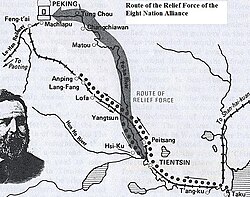
The relief effort began after an initial attempt by 2,000 sailors and marines under British Admiral Edward Seymour was repelled on June 26. A second, significantly larger force was organized, marching from Tientsin (Tianjin) starting August 4.
This coalition, the Eight-Nation Alliance, consisted of a diverse array of forces, dominated by Japanese and Russian contingents. After defeating Chinese forces at the battles of Beicang and Yangcun, the alliance reached Tongzhou, just 14 miles from the capital, on August 12. Despite a desire by British, American, and Japanese commanders to attack immediately, the force paused for one day of reconnaissance at the request of the Russian commander.
The Assault on the City Walls
Beijing was a fortress, protected by walls 21 miles long and 30 to 40 feet high, punctuated by 16 gates. The alliance forces faced a desperate situation; as they approached on the night of August 13, the sound of heavy artillery from within the city suggested the Legation Quarter might already have fallen.
The assault on August 14 was marked by varying degrees of success across different national sectors:
- The Russians: Attempted to storm the Dongbien gate at 3:00 a.m. but were caught in a deadly crossfire, suffering heavy casualties and becoming pinned down.
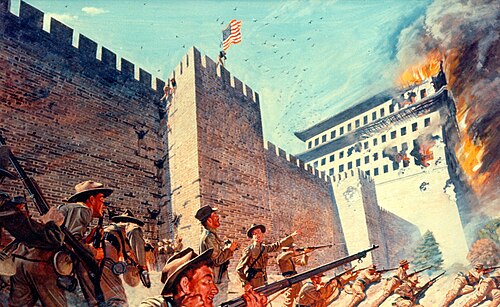
- The Americans: Finding the Russians blocking their assigned gate, American troops moved south. Trumpeter Calvin P. Titus volunteered to scale the 30-foot wall, allowing other soldiers to follow. By 11:03 a.m., the American flag was raised over the Outer city.
- The British: Encountered minimal resistance at the Shawo (Guangqui) gate. They utilized a drainage canal known as the Water Gate to enter the Legation Quarter, arriving to cheers at 2:30 p.m.
- The Japanese: Faced stiff resistance and relied on heavy artillery barrages to breach their assigned sector.
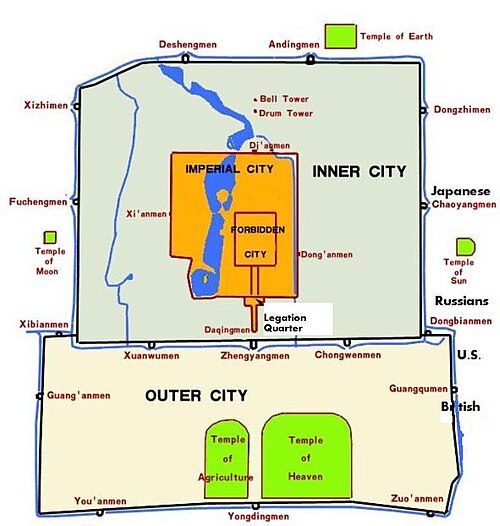
The Americans arrived at the Legation Quarter around 4:30 p.m., suffering one death and nine wounded, including future general Smedley Butler. By that evening, the siege of the legations was officially over.
![American flag raised by the survivors to show the Allies that they were still alive[6]](/images/a7/9d/a79d980f4e71957121d56ae68ed0932664f60ecdc74cb5e06082c7986490ce81.png)
The Fall of the Imperial City
On August 15, the alliance turned its attention to the Inner City. American forces, supported by Russian and French artillery, blasted through walls and gates to occupy the Imperial City. This advance stopped only at the gates of the Forbidden City.
Hours before the Americans reached the Forbidden City, the Dowager Empress Cixi and the Emperor fled the capital in wooden carts, disguised as peasants. While the court fled to Shanxi province, the defense of the city was left to trusted aides and the Gansu Muslim troops, described as the most fanatical of defenders. In a fierce battle at the Zhengyang Gate, General Ma Fulu and several relatives were killed while charging the British forces.
A secondary rescue took place on August 16 at the Peitang (Beitang) cathedral, where French troops finally relieved 28 foreign priests and nuns and 3,400 Chinese Catholics who had been besieged since June 15.
Occupation and the Boxer Protocol
Following the victory, the alliance divided Beijing into administrative districts. The city was in ruins, with many Christian churches destroyed and streets littered with unburied bodies. On August 28, the foreign armies marched through the Forbidden City as a symbolic demonstration of total control.
The conflict concluded with a peace agreement on September 7, 1901. The resulting treaty imposed severe penalties on the Qing dynasty, including the execution or exile of Boxer supporters and a massive financial indemnity.
| Country | Troop Strength | Notes |
|---|---|---|
| Japan | 10,000 | Largest contingent |
| Russia | 4,000 | Infantry, Cossacks, and artillery |
| Britain | 3,000 | Primarily Indian infantry and cavalry |
| United States | 2,000 | Soldiers and marines |
| France | 800 | Indochinese brigade |
| Germany | 200 | Support forces |
| Austria | 100 | Support forces |
| Italy | 100 | Support forces |
Frequently Asked Questions
Who were the Boxers?
The Boxers were members of a secret society in China who launched a violent uprising against foreign influence, Christian missionaries, and Chinese converts to Christianity.
What was the Legation Quarter?
The Legation Quarter was the area in Beijing where the diplomatic residences (legations) of foreign powers were located. It became a fortress during the siege from June to August 1900.
How did the Americans enter the city?
After finding their assigned gate blocked by Russian forces, American troops scaled the 30-foot-tall city walls, led by Trumpeter Calvin P. Titus.
What happened to the Empress Dowager Cixi?
She fled Beijing in disguise on August 15, 1900, just before the alliance forces reached the Forbidden City, claiming her flight to Shanxi was a "tour of inspection."
What were the long-term consequences of the battle?
China was forced to pay a $335 million indemnity and dismantle its northern defenses. The defeat significantly weakened the Qing dynasty, which eventually collapsed in 1911.