Bowling Green Tornadoes: Analysis of the December 11 Outbreak
On December 11, a powerful supercell—a highly organized thunderstorm with a rotating updraft—spawned two distinct tornadoes that tore through Bowling Green, Kentucky, and surrounding communities. The primary tornado, a devastating EF3, carved a nearly 30-mile path of destruction, while a secondary EF2 tornado caused significant structural damage to the southeast. Together, these events highlighted the extreme volatility of winter storm systems in the region.
Key Facts
- Primary Tornado: Rated EF3 with peak winds of 165 mph.
- Secondary Tornado: Rated EF2 with peak winds of 125 mph.
- Human Impact: 17 total fatalities (16 direct, 1 indirect) and 63 injuries.
- Maximum Path Length: 29.26 miles for the primary tornado.
- Critical Areas Hit: Creekwood subdivision, TMS Automotive, and the GM Corvette Assembly Plant.
The Primary EF3 Tornado: A Path of Destruction
The first and most powerful tornado touched down at 1:09 a.m. CST south of the intersection of Wimpee Smith Road and Petros Browning Road. Initially an EF0, it rapidly intensified to EF2 strength near Rockfield, where it destroyed barns and threw a 1,700-pound horse trailer 300 feet into a ravine.
Surveyors noted a peculiar internal structure during the early stages of the storm: a smaller, intense circulation embedded within a broader, weaker one, creating narrow strips of extreme damage surrounded by less severe impact.
Devastation in Bowling Green
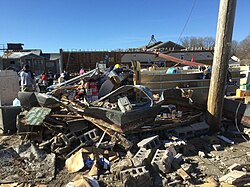
As the tornado entered the western fringes of Bowling Green, it intensified to EF3 strength. The Creekwood subdivision suffered the most catastrophic losses. Along Moss Creek Avenue, dozens of homes were swept from their foundations. Many of these structures were built on poorly constructed cinder block foundations, which contributed to the total collapse. This area saw numerous fatalities, including an entire family of seven.
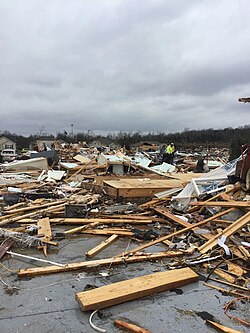
The storm continued eastward, damaging businesses along Russellville Road and striking the south edge of the Western Kentucky University campus. While campus buildings were not hit directly by the winds, debris was found speared into exterior walls.
Industrial Impact and Peak Intensity
The tornado caused significant damage to the GM Corvette Assembly Plant, where rooftop HVAC units were torn off and a security checkpoint building was completely destroyed. However, the storm reached its peak intensity in the Sunnyside community. At an industrial park near US 68, the well-built TMS Automotive warehouse was leveled, with metal structural supports torn from their anchor plates.
The tornado eventually weakened to EF1 strength as it moved through Tuckertown and Edmonson County, finally dissipating near Cedar Spring at 1:38 a.m. CST.
The Secondary EF2 Tornado
While the primary EF3 tornado was moving south of downtown, a second, smaller circulation within the same supercell produced a separate tornado at 1:19 a.m. CST. This tornado touched down near the Bowling Green–Warren County Regional Airport.
This second storm tracked northeast, reaching EF2 intensity as it struck the NCM Motorsports Park. The facility's automobile repair garages and storage buildings suffered extensive damage, with roofing and walls ripped away and debris scattered over a half-mile. The tornado dissipated near mile marker 29.2 along I-65 at 1:24 a.m. CST, after a 6.1-mile journey.
Storm Summary Comparison
| Feature | Primary Tornado | Secondary Tornado |
|---|---|---|
| Peak Rating | EF3 | EF2 |
| Max Wind Speed | 165 mph | 125 mph |
| Duration | 29 minutes | 5 minutes |
| Path Length | 29.26 miles | 6.1 miles |
| Fatalities | 17 | 0 |
| Injuries | 63 | 0 |
Frequently Asked Questions
What is the Enhanced Fujita (EF) scale?
The Enhanced Fujita scale is a set of wind speed estimates based on related damage to various structures, used to assign a tornado a rating from EF0 (weakest) to EF5 (strongest).
Why was the damage in the Creekwood subdivision so severe?
The damage was rated high-end EF3, exacerbated by the fact that many homes were built on poorly constructed cinder block foundations, making them more susceptible to being swept away.
Did the tornadoes hit any major landmarks?
Yes, the primary tornado impacted the GM Corvette Assembly Plant and the south edge of the Western Kentucky University campus, while the secondary tornado struck the NCM Motorsports Park.
How did the two tornadoes relate to one another?
Both tornadoes were produced by the same parent supercell, with the second tornado forming from a separate, smaller circulation while the first was still active.
What was the most intense point of the primary tornado?
The peak intensity occurred in the Sunnyside community at an industrial park near US 68, where a well-built warehouse was completely leveled.