Boston Athenæum: A History of Literary and Artistic Excellence
Founded on a passion for polite literature and intellectual growth, the Boston Athenæum stands as one of the most prestigious private libraries in the United States. What began as a small gathering of young intellectuals has evolved over two centuries into a National Historic Landmark, blending a vast library with a rich gallery of art and sculpture.
The 19th Century Origins
The roots of the Athenæum trace back to 1803, when Harvard graduate Phineas Adams launched The Monthly Anthology, or Magazine of Polite Literature. Although Adams departed in 1804 due to financial constraints, the printers Munroe and Francis encouraged other young men to sustain the publication as The Monthly Anthology and Boston Review. This group eventually formed the Anthology Society in 1805.
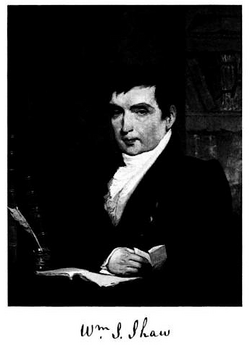
In 1807, members of the Anthology Society established the Boston Athenæum. Inspired by the Athenæum and Lyceum in Liverpool, England, the first librarian, William Smith Shaw, and the trustees envisioned a comprehensive institution. Their goal was to house books in multiple languages, a gallery of paintings and sculptures, collections of coins, natural curiosities, and even a laboratory.
The institution's guiding philosophy was solidified in 1814 with the adoption of its seal: Literarum fructus dulces, which translates to "Sweet are the Fruits of Letters." Early access was restricted to members who paid a ten-dollar annual subscription. Initially, the collections were non-circulating, meaning books could not be taken home. This policy changed in 1830, allowing members to check out up to four books at a time.
Early Locations and Growth
The Athenæum's physical presence grew alongside its collection. After renting rooms, the society purchased a small house near the King's Chapel Burying Ground in 1809. By 1822, they moved to a mansion on Pearl Street, adding a gallery and lecture hall by 1826. In 1823, the institution expanded its holdings by accepting the King's Chapel Library and the Theological Library of the Boston Association of Ministers.
10½ Beacon Street: A Purpose-Built Sanctuary
By the 1840s, the commercialization of Pearl Street made the original location impractical. The trustees sought a more accessible site, eventually acquiring land overlooking the Old Granary Burying Ground. In 1849, the Athenæum opened its doors at 10½ Beacon Street.
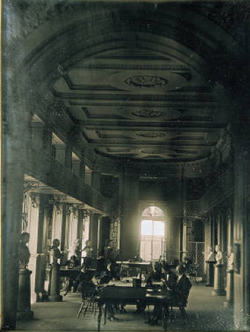
Designed by architect Edward Clarke Cabot, the building featured a unique neo-Palladian façade of Patterson sandstone. Cabot utilized an ingenious ground-level arch over the burial ground to maximize space on the upper floors. The original layout dedicated the first floor to sculpture, the second to the library, and the third to paintings.
The Legacy of Charles Ammi Cutter
In 1869, Charles Ammi Cutter became librarian. He inherited a catalog that had seen little progress and used the space vacated by the Museum of Fine Arts to reorganize the library. Cutter developed the Expansive Classification system to complete the library's five-volume catalog.
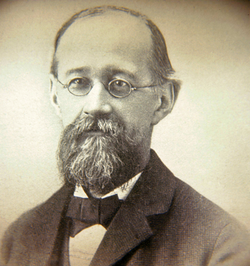
Cutter's work had a lasting impact on global librarianship; his system served as the foundation for the Library of Congress classification. To this day, the alphabetical sections used to designate authors' names in the Library of Congress system are referred to as "Cutter numbers."
Evolution into the Modern Era
The relationship between the Athenæum and the Museum of Fine Arts (MFA) was symbiotic. From 1872 to 1876, the MFA used the Athenæum's galleries while its own building was under construction. Once the MFA moved to Copley Square, the Athenæum converted its gallery spaces into additional library shelving.
Further expansions occurred between 1913 and 1914 via the firm Bigelow and Wadsworth. This project added a fourth-floor Trustees’ Room and a fifth-floor reading room, while introducing a "drum stack"—a ten-story Snead stack extending from the basement to the third floor. The building was designated a National Historic Landmark in 1966 and underwent significant climate control and gallery renovations between 1999 and 2002. In May 2020, Leah Rosovsky was appointed as the Stanford Calderwood Director.
The Gilbert Stuart Portrait Controversy
One of the most publicized episodes in the Athenæum's history involved two unfinished portraits of George and Martha Washington by Gilbert Stuart.
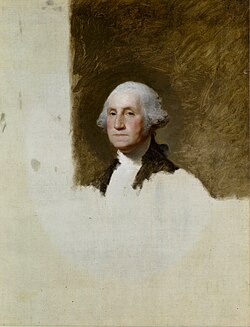
Though on loan to the MFA since 1876, the Athenæum sought to sell the portraits to the National Portrait Gallery for $5 million in 1979. This sparked intense public opposition in Boston. After a failed local fundraising campaign and a lawsuit by the City of Boston involving Attorney General Francis X. Bellotti, a compromise was reached in 1980. The National Portrait Gallery and the MFA jointly purchased the works, agreeing to rotate them between the two institutions every three years.
Key Facts
- Founded: 1807 by the Anthology Society.
- Motto: Literarum fructus dulces ("Sweet are the Fruits of Letters").
- Location: 10½ Beacon Street, Boston (since 1849).
- Architectural Style: Neo-Palladian façade of Patterson sandstone.
- Major Contribution: The development of the Expansive Classification system by Charles Ammi Cutter.
- Status: Declared a National Historic Landmark in 1966.
| Feature | Detail |
|---|---|
| First Librarian | William Smith Shaw |
| Current Director | Leah Rosovsky |
| Key Architectural Feature | Ten-story Snead drum stack |
| Notable Artworks | Gilbert Stuart portraits of George and Martha Washington |
| Original Membership Cost | $10 annual subscription |
Notable Members
The Athenæum has attracted some of the most influential figures in American history, including:
- Political Leaders: John Adams, John Quincy Adams, John Fitzgerald Kennedy, and Edward M. Kennedy.
- Literary Figures: Louisa May Alcott, Ralph Waldo Emerson, Nathaniel Hawthorne, and Amy Lowell.
- Intellectuals: Margaret Fuller, Oliver Wendell Holmes Sr., and Oliver Wendell Holmes Jr.
Frequently Asked Questions
What is the significance of the Cutter numbers?
Cutter numbers are alphabetical designations for authors' names, derived from the Expansive Classification system created by librarian Charles Ammi Cutter. This system became a foundational element of the Library of Congress classification system.
Why was the move to Beacon Street necessary?
By the early 1840s, the Athenæum's Pearl Street location was surrounded by warehouses in a crowded commercial district, making it difficult for members to access the institution.
What happened to the Gilbert Stuart portraits?
After a legal and public battle over their sale to the National Portrait Gallery, the portraits were jointly purchased by the National Portrait Gallery and the Boston Museum of Fine Arts. They now alternate between the two institutions in three-year terms.
Was the Boston Athenæum always a circulating library?
No. Initially, the collections were non-circulating. It was not until 1830 that measures were taken to allow members to check out books, with a limit of four books at a time.
What is a "drum stack"?
A drum stack is a semi-circular shelving system. The Athenæum installed a ten-story Snead stack between 1913 and 1914 that spans from the basement to the third floor.