American Philosophical Society Hall
Located in the heart of Philadelphia, the American Philosophical Society (APS) stands as a testament to the Enlightenment's pursuit of knowledge. Founded in 1743 by the polymath Benjamin Franklin and several associates, it is recognized as the first learned society established in what would become the United States. The society serves as a scholarly organization dedicated to promoting the humanities and natural sciences through rigorous research, professional publications, and community outreach.
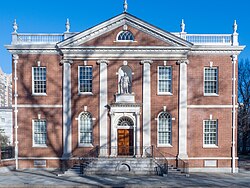
The society's headquarters, Philosophical Hall, is situated just east of Independence Hall within Independence National Historical Park. This historic site not only houses the society's administration but also serves as a museum, preserving a legacy of intellectual curiosity that has attracted some of the world's most influential thinkers.
Key Facts
- Founded: 1743 by Benjamin Franklin and others.
- Headquarters: Philosophical Hall, Philadelphia, Pennsylvania.
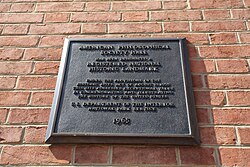
- Status: Designated as a U.S. National Historic Landmark on January 12, 1965.
- Membership: Approximately 1,000 elected members, with 5,890 inducted since its inception.
- Oldest Prize: The Magellanic Premium, established in 1786.
- Architectural Style: Georgian/Federal style.
History and Evolution
The APS began as the Philosophical Society, an offshoot of a club called the Junto. Its early membership included foundational figures of American history such as George Washington, Thomas Jefferson, John Adams, and Alexander Hamilton. The society's reach was global from the start, recruiting international intellectuals including Alexander von Humboldt and the Marquis de Lafayette.
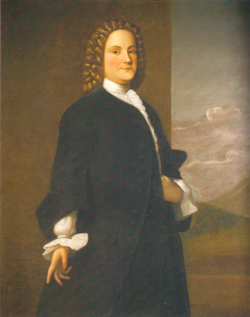
After a period of inactivity between 1746 and 1767, the society was revived and later merged on January 2, 1769, with the American Society for Promoting Useful Knowledge. Under the presidency of Benjamin Franklin, the society focused on practical improvements, including early studies for a canal connecting the Chesapeake Bay and the Delaware River—a project that eventually became the Chesapeake and Delaware Canal in the 1820s.
Following the Revolutionary War, the society flourished under the influence of Francis Hopkinson, a signatory of the Declaration of Independence. Through his efforts, the government of Pennsylvania provided the land that now hosts Philosophical Hall.
Membership and Academic Influence
Membership in the APS is an honor reserved for those who have achieved extraordinary accomplishments in their respective fields. The current membership consists of roughly 840 resident members (U.S. citizens or residents) and 160 international members. Over the centuries, the society has maintained strong ties with leading academic institutions.
| Institution | Number of Members |
|---|---|
| Harvard | 220 |
| Princeton | 117 |
| Stanford | 91 |
| Berkeley | 86 |
| Columbia | 76 |
| Chicago | 73 |
| Penn | 67 |
| Yale | 63 |
| MIT | 58 |
| NYU | 42 |
Awards and Scholarly Contributions
The APS is renowned for its prestigious awards. The Magellanic Premium, created in 1786 for achievements in navigation, astronomy, or natural philosophy, is the oldest scientific prize awarded by an American institution. Other notable honors include the Benjamin Franklin Medal for science, the Thomas Jefferson Medal for arts and humanities, and the Barzun Prize for cultural history.
The society's publishing arm has been active since 1771 with the Transactions of the American Philosophical Society. It also produces the Proceedings, which document papers from biannual meetings, and has published the collected papers of figures like William Penn and Meriwether Lewis.
Beyond publications, the APS maintains a vast archive. This includes the ACLS Collection, which preserves indigenous language documents and recordings from across the United States, as well as manuscripts regarding quantum physics, genetics, and the history of the British colonies.
The Campus and Architecture
Philosophical Hall
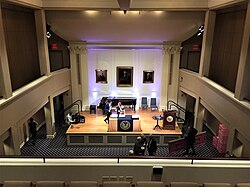
Built between 1785 and 1789 and designed by Samuel Vaughan, Philosophical Hall is a prime example of Georgian architecture. While a third floor was added in 1890, it was removed between 1948 and 1950 to restore the building to its original appearance. Today, it houses the American Philosophical Society Museum, which displays scientific instruments, rare books, and natural history specimens.
Library Hall
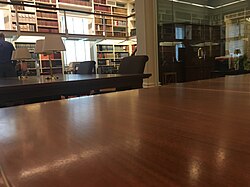
Originally built in 1789–90 by the Library Company of Philadelphia (LCP), the original Library Hall was demolished in the 1880s. In 1958, the APS constructed a new library building on the original site, recreating the historic façade of the LCP's former headquarters.
Benjamin Franklin Hall and Richardson Hall
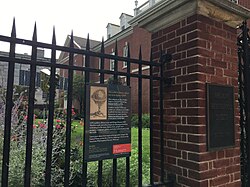
The society also operates Benjamin Franklin Hall, a restored Italianate-style building (formerly the Farmers' & Mechanics' Bank) used for lectures and major events. Adjacent to it is Richardson Hall, a former insurance building constructed in the 1870s, which now houses offices and the Consortium for History of Science, Technology and Medicine.
Frequently Asked Questions
Who founded the American Philosophical Society?
The society was founded in 1743 by Benjamin Franklin, James Alexander, Francis Hopkinson, John Bartram, Philip Syng Jr., and others as an offshoot of the Junto club.
What is the Magellanic Premium?
Established in 1786, the Magellanic Premium is the oldest scientific prize awarded by an American institution, recognizing achievements in navigation, astronomy, or natural philosophy.
Is Philosophical Hall open to the public?
Yes, Philosophical Hall opened to the public in 2001 as the American Philosophical Society Museum, featuring thematic exhibitions on history, art, and science.
Which universities have the most members in the APS?
Harvard University has the highest number of affiliated members (220), followed by Princeton (117) and Stanford (91).
What is the significance of the ACLS Collection?
The ACLS Collection is a critical archive of indigenous language documents and recordings from across the United States, including materials dating from 1553 to 2020.