Bob Dylan's 'It's All Over Now, Baby Blue'
Few songs in the Bob Dylan canon capture the bittersweet tension of transition as poignantly as "It's All Over Now, Baby Blue." Recorded during a pivotal era of musical evolution, the track serves as a stark, heartbreaking farewell that has sparked decades of debate among scholars and fans regarding its true subject.
Composition and Recording
Bob Dylan likely wrote the song in January 1965. The master take was recorded on January 15, 1965, produced by Tom Wilson for the album Bringing It All Back Home. Interestingly, while Dylan had spent significant time performing other tracks from the album's second side—such as "Mr. Tambourine Man" and "Gates of Eden"—live, he intentionally chose to record "It's All Over Now, Baby Blue" before he became too familiar with it.
The path to the final version involved several iterations. Dylan recorded a solo acoustic version on January 13 and a semi-electric version on January 14 before arriving at the sparsely arranged album track. The final recording features Dylan on acoustic guitar and harmonica, accompanied by William E. Lee on bass guitar.
Musically, the song is characterized by folk guitar chord changes and a somber melody. Lyrically, Dylan drew influence from Symbolist poets (a late 19th-century art movement focused on suggestive, metaphorical imagery), specifically Arthur Rimbaud. Additionally, the line "take what you have gathered from coincidence" reflects the I Ching philosophy, which posits that coincidence is more than mere chance.
Dylan later revealed that the title was inspired by a Gene Vincent song he sang in high school, though he clarified that he was singing about a "different Baby Blue."
Key Facts
- Recorded: January 15, 1965, for the album Bringing It All Back Home.
- Production: Produced by Tom Wilson; features William E. Lee on bass.
- Influences: Symbolist poet Arthur Rimbaud and I Ching philosophy.
- Live History: Performed live 588 times as of December 2024.
- Critical Standing: Ranked in the top 10 all-time best Dylan songs by Mojo readers and artists.
The Mystery of 'Baby Blue'
Because Dylan has remained silent on the song's inspiration, the identity of "Baby Blue" remains a subject of intense speculation. Scholars suggest the character may be an amalgam of several people in Dylan's social circle.
Potential Personal Subjects
- Joan Baez: The folk singer was in a relationship with Dylan at the time, and some believe the song signals his intention to leave.
- David Blue: A singer-songwriter and acquaintance from Greenwich Village.
- Paul Clayton: A folk singer and former friend whose intense devotion and use of amphetamines may have strained their relationship.
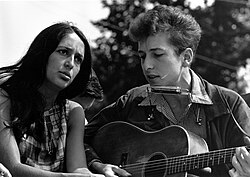
However, author Paul Williams suggests the song's natural structure may have allowed it to "finish writing itself" without a specific person in mind. The lyrics note that the subject's lover "has taken all his blankets," implying the subject was either female or gay.
Symbolic Interpretations
Beyond specific people, many interpret the song as a metaphor for Dylan's own career. Written as he transitioned away from the folk protest movement, the song can be seen as a farewell to his identity as an acoustic protest singer. This theory is supported by his decision to perform the song as his final acoustic piece at the 1965 Newport Folk Festival, following a controversial electric set.
Other interpretations suggest the song is a dialogue with himself—an imperative to leave the past behind and "start anew"—or a farewell to the political left and the illusions of his youth.
Legacy and Impact
The song's emotional weight extended beyond music into literature; author Joyce Carol Oates cited the song as a primary inspiration for her story Where Are You Going, Where Have You Been. Over the years, the track has appeared on numerous compilations, including The Essential Bob Dylan and The Bootleg Series.
| Version/Release | Date/Year | Key Characteristic |
|---|---|---|
| First Studio Take | January 13, 1965 | Solo acoustic (released in 2005) |
| Album Version | 1965 | Acoustic guitar, harmonica, and bass |
| Manchester Live | May 17, 1966 | Released on Biograph and Bootleg Series Vol. 4 |
| Rolling Thunder Revue | December 1975 | Live recording from the first tour |
Frequently Asked Questions
Who is the 'Baby Blue' mentioned in the song?
Dylan has not confirmed a specific subject, but theories include folk singers Joan Baez, David Blue, and Paul Clayton. Others believe it represents Dylan's own folk-singer persona or his audience.
What are the primary musical influences of the song?
The song blends folk guitar chord changes with a somber melody, while the lyrics are heavily influenced by Symbolist poets like Arthur Rimbaud and the philosophy of the I Ching.
Why is the Newport Folk Festival performance significant?
Dylan performed the song as his final acoustic number after his electric set was met with boos, leading many to view the song as a symbolic farewell to his days as a protest singer.
How many times has Bob Dylan performed this song live?
As of December 2024, Bob Dylan has performed "It's All Over Now, Baby Blue" live 588 times.
Which album first featured this song?
The song first appeared as the final track on the 1965 album Bringing It All Back Home.