BNSF Railway: Powering North American Freight Logistics
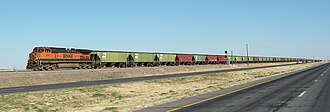
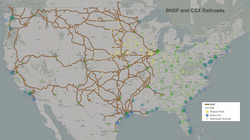
BNSF Railway is a titan of the North American transport industry and the largest freight railroad in the United States. As one of the six Class I railroads—a designation for the largest operating rail networks in North America—BNSF serves as a critical artery for commerce, connecting the Western, Midwestern, and Southern United States with Western Canada.
With a massive workforce of over 36,000 employees and a network spanning 33,400 miles of track across 28 states, BNSF operates three primary transcontinental routes. These routes facilitate the seamless movement of goods between the eastern and western halves of the U.S., making it a cornerstone of the continental supply chain.
Key Facts
- Parent Company: Berkshire Hathaway (acquired in February 2010).
- Network Scale: 33,400 miles of track and over 8,000 locomotives.
- Financial Strength: Reported 2022 revenue of US$ 25.888 billion.
- Operational Reach: Spans 28 U.S. states and Western Canada.
- Predecessors: Formed from the merger of Burlington Northern Railroad and Atchison, Topeka and Santa Fe Railway.
History and Evolution
The BN-ATSF Merger
The origins of BNSF date back to 1993 with the incorporation of the Burlington Northern Santa Fe Corporation. This entity was created to facilitate the merger of Burlington Northern, Incorporated and the Santa Fe Pacific Corporation. The corporate merger was finalized on September 22, 1995, and the two railroads were formally merged into the Burlington Northern and Santa Fe Railway on December 31, 1996.
In January 2005, the company simplified its identity, officially changing its name to BNSF Railway Company. A major turning point occurred in February 2010, when Warren Buffett's Berkshire Hathaway acquired all shares of the company, taking BNSF private.
Strategic Acquisitions
BNSF continues to expand its footprint through strategic moves. In January 2022, the company agreed to purchase Montana Rail Link for $2 billion via an early lease termination. Approved by the Surface Transportation Board on March 8, 2023, this acquisition added over 900 miles of track and 100 stations to the BNSF network, with key yards in Laurel, Missoula, Billings, Bozeman, and Helena.
Operational Infrastructure
Trackage and Regional Management
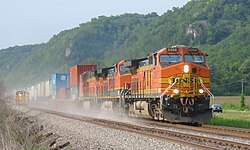
For administrative efficiency, BNSF is organized into two primary regions: the North Region and the South Region. These are further subdivided into ten operating divisions, which are then broken down into smaller subdivisions ranging from 10-mile branch lines to 300-mile mainlines.
While BNSF directly owns and operates over 24,000 miles of track, its total controlled trackage—including yard, siding, and additional main-line tracks—exceeds 50,000 miles.
Yards and Facilities
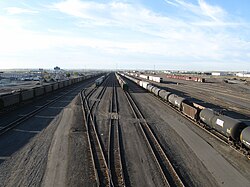
The railroad utilizes a sophisticated system of hump yards (used for sorting cars) and intermodal yards (used for transferring containers between rail and truck/ship). Key facilities include the Pasco Yard in Washington and the Alliance Yard in Texas.
Fleet and Equipment
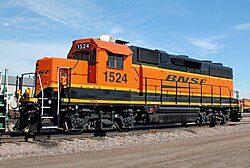
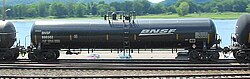
BNSF maintains a diverse fleet of rolling stock to handle various cargo types. As of 2018, the company operated 8,359 locomotives and 72,369 freight cars. The fleet is dominated by covered hoppers and gondolas, though it also includes specialized refrigerated "reefer" cars and automobile carriers.
Visual Identity and Locomotives
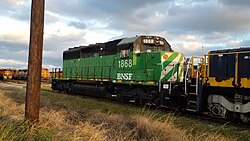
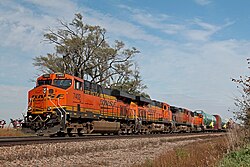
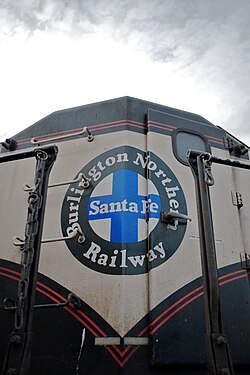
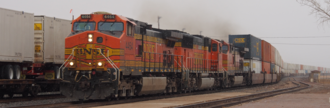
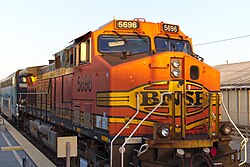
Following the 1995 merger, BNSF introduced several paint schemes to honor its combined heritage. The initial commemorative design blended the Santa Fe "Warbonnet" red-and-silver with the Burlington Northern "Executive" green and cream. Over time, the company transitioned through several standardized schemes, known as Heritage I through Heritage IV.
Common Paint Schemes
- BNSF Warbonnet: A nod to the classic Santa Fe look.
- Cascade Green: Based on the BN livery.
- Heritage I, II, III, and IV: Successive corporate evolutions of the BNSF brand.
Summary of BNSF Corporate Profile
| Category | Detail |
|---|---|
| Headquarters | Fort Worth, Texas |
| Reporting Mark | BNSF |
| Track Gauge | 4 ft 8 ½ in (Standard Gauge) |
| Total Track Length | 33,400 miles (Directly operated) |
| 2022 Net Income | US$ 5.496 billion |
| Total Assets (2022) | US$ 92.611 billion |
Frequently Asked Questions
Who owns BNSF Railway?
BNSF Railway is a wholly owned subsidiary of Berkshire Hathaway, the conglomerate led by Warren Buffett, which acquired the company in February 2010.
How was BNSF formed?
BNSF was created through the merger of the Atchison, Topeka and Santa Fe Railway and the Burlington Northern Railroad. The corporate merger began in 1995, and the railroads were formally merged on December 31, 1996.
Does BNSF operate passenger trains?
While primarily a freight railroad, BNSF operates trains for passenger services under contract (such as the Metra BNSF line) and allows various historic steam locomotives to operate excursions over its rails.
What is the difference between a hump yard and an intermodal yard?
A hump yard is used to sort freight cars by pushing them over a small hill (hump) so they roll into specific tracks by gravity. An intermodal yard is designed for the transfer of shipping containers between different modes of transport, such as rail, truck, and ship.
What is the significance of the "Heritage" paint schemes?
The Heritage schemes (I through IV) are locomotive liveries designed to represent the corporate evolution of BNSF and acknowledge the visual legacies of the two original railroads that formed the company.