Railroad Classes in the United States
In the United States, freight railroads are categorized into a tiered system known as railroad classes. This classification system is primarily used to designate carriers based on their annual revenue, which in turn determines their reporting requirements and the labor regulations they must follow. Originally established by the Interstate Commerce Commission (ICC) and now managed by the Surface Transportation Board (STB), these designations help organize the complex landscape of American rail transport.
The system divides carriers into three main tiers: Class I, Class II, and Class III. While Class I railroads are the massive transcontinental giants, Class II and III carriers serve as the vital connective tissue, moving freight from local industries to the main lines.
Key Facts
- Class I railroads are the largest carriers, with 2023 revenue thresholds exceeding $1,053,709,560.
- Class II railroads are mid-sized carriers, often referred to as regional railroads.
- Class III railroads are the smallest, typically serving as local shortlines.
- The Surface Transportation Board (STB) is the current agency responsible for defining and adjusting these revenue thresholds.
- There are currently six Class I freight railroad companies operating in the U.S.
The Evolution of Railroad Classification
The practice of classifying railroads began in 1911 under the Interstate Commerce Commission (ICC). At that time, a Class I railroad was defined as having an annual operating revenue of at least $1 million. By 1925, the industry was far more fragmented, with 174 Class I, 282 Class II, and 348 Class III railroads in operation.
As the industry consolidated through mergers and bankruptcies, the revenue thresholds were repeatedly raised to maintain the distinction between the tiers. For example, the Class I threshold rose to $3 million in 1956, $50 million by 1978, and $250 million by 1992. In 1979, a specific regulatory shift re-designated all switching and terminal railroads as Class III, regardless of their actual revenue.
Following the dissolution of the ICC in 1996, the STB took over these responsibilities. To account for inflation, the STB periodically adjusts the revenue bounds. As of 2023, the thresholds are as follows:
| Railroad Class | Annual Revenue Range |
|---|---|
| Class I | Greater than $1,053,709,560 |
| Class II | Between $47,299,851 and $1,053,709,560 |
| Class III | Less than $47,299,851 |
Class I Railroads: The Industry Giants
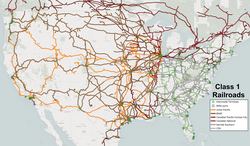
Class I railroads are the primary arteries of North American commerce. While there were 132 such railroads in 1900, consolidation has reduced this number to just six major freight companies as of April 2023. These carriers dominate the landscape, often operating as duopolies in specific regions.
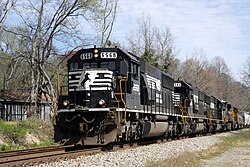
In the Western United States, BNSF Railway and Union Pacific Railroad control the majority of transcontinental lines. In the East, CSX Transportation and Norfolk Southern Railway manage most of the trackage, with the Mississippi River serving as a general dividing line. Additionally, Canadian National Railway (via its subsidiary Grand Trunk Corporation) operates north-south lines near the Mississippi, and CPKC (Canadian Pacific Kansas City) provides a unique link from Canada through the central U.S. into Mexico.
It is worth noting that some non-freight or international entities would meet Class I criteria if they were U.S. freight carriers. This includes the U.S. passenger service Amtrak, Canada's VIA Rail, and Mexico's Ferromex.
Class II and Class III Railroads
Class II: Regional Carriers
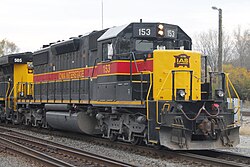
Class II railroads are mid-sized freight haulers. Within the industry, the Association of American Railroads (AAR) often refers to these as Regional Railroads, provided they operate at least 350 miles of track or earn at least $40 million annually. Examples include the Florida East Coast Railway, the Iowa Interstate Railroad, and the Alabama and Gulf Coast Railway.
Class III: Shortlines and Terminals
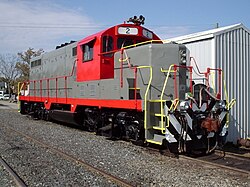
Class III railroads are typically local shortlines—smaller operations that serve a few towns or specific industries. Many of these were originally branch lines of larger railroads. Some are owned by holding companies like Watco or Genesee & Wyoming. Examples include the Buckingham Branch Railroad, the Maryland and Delaware Railroad, and the Finger Lakes Railway.
The AAR further divides non-Class I companies into local railroads (which engage in line-haul service) and switching and terminal railroads (which primarily move cars between other railroads or within a common terminal).
Frequently Asked Questions
Who determines the railroad classes in the U.S.?
The Surface Transportation Board (STB) is currently responsible for defining the revenue criteria and assigning railroad classes, having taken over this role from the Interstate Commerce Commission (ICC) in 1996.
Why are railroads classified by revenue?
Classification is used to determine reporting requirements and apply different labor regulations, particularly between Class II and Class III carriers.
How many Class I railroads currently operate in the U.S.?
As of April 2023, there are six Class I freight railroads: BNSF Railway, CSX Transportation, Canadian National Railway, CPKC, Norfolk Southern Railway, and Union Pacific Railroad.
What is the difference between a regional and a local railroad?
According to the Association of American Railroads, a regional railroad operates at least 350 miles or earns at least $40 million annually, while a local railroad is smaller but still provides line-haul service.
Do passenger railroads have a class?
While the classification system is designed for freight, passenger services like Amtrak and VIA Rail would qualify as Class I based on their revenue if they were freight carriers.