Bluebird Records: The Budget Label That Shaped American Music
In the early 1930s, the music industry faced a challenge: how to make records accessible to a public struggling through the Great Depression. The answer came in 1932 with the launch of Bluebird Records. Founded as a lower-priced subsidiary of RCA Victor, Bluebird revolutionized the market by offering high-quality music at a fraction of the standard cost.
While it began as a budget venture, Bluebird became far more than a discount label. It became a cultural powerhouse, capturing the raw energy of the Chicago blues scene and the sophistication of the Big Band era, ultimately influencing the trajectory of rhythm and blues and early rock and roll.
Key Facts
- Founded: 1932 by Eli Oberstein as a subsidiary of RCA Victor.
- Primary Genres: Blues, jazz, swing, and children's music.
- Legacy: Created the "Bluebird sound," a precursor to R&B and rock and roll.
- Current Ownership: Sony Music Entertainment (via RCA Records).
- Distribution: Currently handled by Sony Masterworks.
The History and Evolution of Bluebird
The Birth of the "Bluebird Sound"
Bluebird was established by RCA Victor executive Eli Oberstein to compete with other budget labels of the era. To keep costs low, records were produced quickly and cheaply. This efficiency led to the creation of the Bluebird sound, characterized by the use of a consistent session band for many recordings.
The label became the epicenter of Chicago blues, largely thanks to talent scout and producer Lester Melrose, who held a virtual monopoly on the local market. Through Melrose, Bluebird signed legendary musicians such as Big Bill Broonzy, Roosevelt Sykes, Washboard Sam, and Sonny Boy Williamson.
Expanding the Roster: Jazz, Swing, and Country
Beyond the blues, Bluebird was a major player in the jazz and big band movements. Its roster featured icons like Glenn Miller, Artie Shaw, Earl Hines, and Rudy Vallée. During World War II, the label expanded its reach by reissuing works from masters like Duke Ellington and Jelly Roll Morton.
The label also ventured into country music, recording the Monroe Brothers and the Delmore Brothers, while reissuing essential titles from the Carter Family and Jimmie Rodgers.
Post-War Transitions and Revivals
Following World War II, the Bluebird imprint was initially retired, with its catalog absorbed into the main RCA Victor label. However, the brand proved too valuable to abandon. It was revived in the 1950s for budget jazz and children's records, and again in the mid-1970s for a series of 2-LP big band and swing sets produced by Frank Driggs and Ethel Gabriel.
Today, the Bluebird name persists as a specialized imprint for CD reissues of jazz and pop titles originally released under RCA Victor.
Labels, Discs, and Market Strategy
RCA Victor experimented with several budget formats before Bluebird became the standard. This began with "Timely Tunes" in 1931, sold exclusively through Montgomery Ward stores.
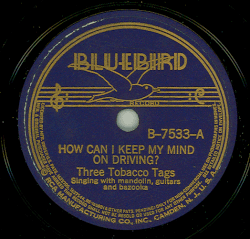
When Bluebird launched in July 1932, it initially released rare 8-inch discs—some selling for as little as 10¢—which were test-marketed at Woolworth's stores in New York City. These were released alongside identically numbered Electradisk records. By May 1933, Bluebird transitioned to a more general-interest budget label with a 35¢ price point (or 3 for $1), introducing the famous blue-on-beige "buff" label.
Other short-lived imprints, such as Sunrise and the Montgomery Ward label, were also used to distribute Bluebird content to different retail niches before Bluebird became the sole budget label until the launch of RCA Camden in 1953.
Bluebird Records Overview
| Category | Details |
|---|---|
| Founder | Eli Oberstein |
| Parent Company | RCA / Sony Music Entertainment |
| Key Locations | Camden (NJ), New York City, Chicago (IL) |
| Notable Eras | 1930s-40s (Peak), 1950s (Revival), 1970s (Reissues) |
| Pricing Strategy | Budget-priced (e.g., 10¢ to 35¢) |
Notable Artists
The Bluebird roster was a "who's who" of early 20th-century American music, including:
- Blues: Big Bill Broonzy, Sonny Boy Williamson I, Tampa Red, Roosevelt Sykes.
- Jazz & Swing: Glenn Miller, Artie Shaw, Lionel Hampton, Fletcher Henderson, Earl Hines.
- Pop & Vocal: Frank Sinatra, Dinah Shore, The Ink Spots, Rudy Vallée.
- Country: Jimmie Rodgers, The Carter Family, The Monroe Brothers.
Frequently Asked Questions
What was the "Bluebird sound"?
The "Bluebird sound" refers to the specific recording style resulting from the use of a recurring session band. This was a cost-cutting measure that created a consistent sonic identity, which later influenced the development of early rock and roll and rhythm and blues.
Who was Eli Oberstein?
Eli Oberstein was an executive at RCA Victor who founded Bluebird Records in 1932 to capture the budget-conscious music market during the Great Depression.
How did Bluebird Records influence the Chicago blues scene?
Through the efforts of talent scout Lester Melrose, Bluebird signed a vast number of Chicago-based blues musicians, effectively becoming the primary home for the genre during the 1930s.
Is Bluebird Records still active today?
While it no longer operates as a primary recording label for new artists, the Bluebird imprint is still used by Sony Music Entertainment for CD reissues of classic jazz and pop titles.
What were Electradisks?
Electradisks were budget records released concurrently with early Bluebird records, often featuring blue-on-orange labels and sold through specific retailers like Woolworth's.