The Comprehensive Guide to Blackberries: Botany, Cultivation, and Nutrition
Whether plucked from a wild thicket or purchased from a local market, the blackberry is one of the most beloved fruits in the world. Belonging to the genus Rubus within the Rosaceae family, these delicious treats are more complex than they appear. From their intricate botanical structure to their diverse roles in global agriculture, blackberries are a fascinating subject for gardeners, foragers, and food lovers alike.
Understanding the Blackberry: Botany and Structure
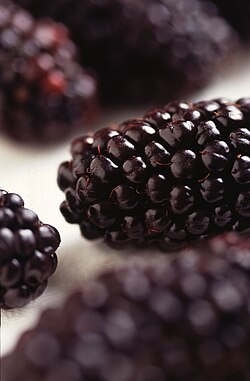
While many people use the term "berry" casually, the blackberry is technically an aggregate fruit. This means the fruit is composed of many tiny, individual drupelets (small, fleshy fruitlets) clustered together. A key way to distinguish a blackberry from its relative, the raspberry, is the torus, or the receptacle. When you pick a raspberry, the torus remains on the vine, leaving the fruit hollow. In contrast, when a blackberry is picked, the torus stays attached to the fruit, making it solid.
The plant itself is a perennial, meaning it lives for many years, and it grows using biennial stems known as canes.
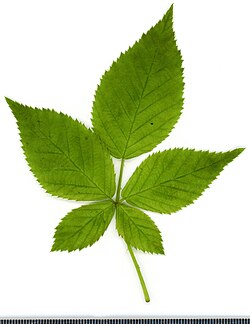
The Life Cycle of the Blackberry Plant
Blackberry canes follow a specific two-year growth pattern. In the first year, the plant produces primocanes. These new stems can reach lengths of 3 to 6 meters (9.8 to 19.7 feet), trailing along the ground and producing large, palmate compound leaves. Notably, primocanes do not produce flowers or fruit in their first year.
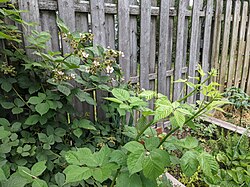
In the second year, these canes become floricanes. These are non-growing stems where the lateral buds open to produce flowers. Most blackberry canes also feature short, curved, sharp thorns, though modern agricultural science has developed various thornless cultivars to make harvesting easier.
Flowers and Pollination
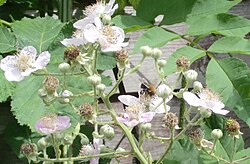
In late spring and early summer, the plant produces flowers at the tips of the branches. These blossoms are typically about 2–3 centimeters in diameter and feature five white-pink petals.
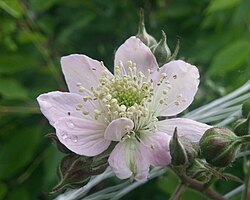
Each drupelet within the fruit develops from an ovule that must be fertilized by pollen. Successful fruit development relies heavily on pollinators; if there are inadequate pollinator visits, the fruit may develop incompletely or appear "crumbly."
Blackberry Cultivars and Farming
Blackberry production is a significant global industry. Mexico is a leading producer, primarily exporting fresh fruit to North American and European markets. In the United States, Oregon stands as the top commercial producer. Because blackberries can be incredibly productive—potentially yielding up to 20,000 pounds (9,100 kg) per acre—they are highly attractive for commercial farming.
Farmers and breeders have developed several distinct types of blackberries to suit different needs:
- Trailing Blackberries: Vigorous plants that require a trellis for support. They are common in climates like the Mediterranean, Chile, and New Zealand.
- Erect Blackberries: These are less vigorous and spread underground via root initials, similar to raspberries.
- Thornless Cultivars: Developed to allow for efficient machine-harvesting, these varieties (such as 'Triple Crown' or 'Black Diamond') offer larger, firmer fruit and improved flavor without the struggle of prickles.
- Primocane-Fruiting (Everbearing): These specialized cultivars, such as 'Prime-Jan', flower in midsummer and produce a second crop in late summer or fall.
Ecology and Environmental Impact
In the wild, blackberries play a vital role in their ecosystems. Their leaves serve as food for various caterpillars and grazing mammals like deer. Once the fruit matures, it is eaten by birds and mammals—including red foxes, American black bears, and Eurasian badgers—which helps disperse the seeds throughout the environment.
However, the plant's vigorous growth can also make it a problem. In regions like the Pacific Northwest of North America, Australia, Chile, and New Zealand, certain species like the Himalayan blackberry (*Rubus armeniacus*) are considered invasive and noxious weeds because they can grow unchecked in parks and woodlands.
Nutritional Profile and Uses
Blackberries are not only delicious but also nutrient-dense. They are a significant source of dietary fiber, Vitamin C, manganese, and Vitamin K. They also contain antioxidants known as anthocyanins, which are responsible for the fruit's deep, dark color.
| Nutrient | Quantity | % Daily Value (DV) |
|---|---|---|
| Energy | 43 kcal | - |
| Carbohydrates | 9.61 g | - |
| Dietary Fiber | 5.3 g | 20%+ |
| Vitamin C | 23% DV | 23% |
| Manganese | 28% DV | 28% |
| Vitamin K | 17% DV | 17% |
| Copper | 18% DV | 18% |
Beyond fresh consumption, blackberries are used in jams, jellies, pies, and cordials. Historically, they have even been used to dye fabrics and hair, or as a traditional medicinal remedy for stomach issues.
Key Facts
- Scientific Genus: Rubus.
- Fruit Type: Aggregate fruit composed of small drupelets.
- Growth Habit: Perennial plants with biennial canes (primocanes and floricanes).
- Commercial Yield: Can reach up to 20,000 pounds per acre.
- Top Producers: Mexico (fresh export) and Oregon, USA (commercial production).
- Nutrient Highlights: High in fiber, Vitamin C, and manganese.
Frequently Asked Questions
What is the main difference between a blackberry and a raspberry?
The primary difference is the torus (the receptacle). When a raspberry is picked, the torus stays on the vine, leaving the fruit hollow. When a blackberry is picked, the torus remains attached to the fruit, making it solid.
What are primocanes and floricanes?
These terms describe the age of the blackberry stems. A primocane is a first-year stem that grows long but does not produce flowers. A floricane is a second-year stem that produces the flowers and fruit.
Are blackberries considered invasive?
While many species are beneficial to local wildlife, some, such as the Himalayan blackberry (*Rubus armeniacus*), are considered invasive and noxious weeds in certain regions like the Pacific Northwest because they grow aggressively and can dominate ecosystems.
Why are some blackberries thornless?
Thornless varieties are specialized cultivars developed through breeding programs (such as those by the USDA) to make the plants easier to manage and to allow for efficient machine-harvesting in commercial farming.
Can blackberries be grown in cold climates?
Most blackberries struggle in temperatures below −10 °F (−23 °C). However, specific hardy cultivars like 'Illini Hardy' have been developed to survive much colder temperatures, making them suitable for more northern regions.