The Comprehensive Guide to Bitter Melon (Momordica charantia)
Known by many names—including bitter gourd, goya, and karela—Momordica charantia is a tropical and subtropical vine celebrated for its unique, pungent flavor and diverse culinary applications. A member of the Cucurbitaceae (the gourd family), this versatile plant is grown extensively across Asia, Africa, and the Caribbean. While its intense bitterness may be daunting to some, it is a staple ingredient in many global cuisines and a subject of interest in traditional herbal medicine.
What is Bitter Melon?
Bitter melon is a herbaceous, tendril-bearing vine that can reach lengths of up to 5 meters (16 ft). It is native to the Old World tropics and subtropics, extending into the South Pacific. Historically, it served as a dry-season staple for ǃKung hunter-gatherers in Africa and Asia. Over time, wild and semi-domesticated variants spread across Asia, with full domestication likely occurring in Southeast Asia.
The plant is a frost-tender annual in temperate regions and a perennial in the tropics, thriving best in USDA hardiness zones 9 to 11. It produces separate yellow male and female flowers, typically flowering from June to July and fruiting between September and November in the Northern Hemisphere.
Botanical Description and Growth
The vine features simple, alternate leaves measuring 4–12 cm (1.6–4.7 in) across, characterized by three to seven deeply separated lobes. The fruit is most recognizable by its oblong shape and distinctive warty exterior. Internally, the fruit is hollow, consisting of a thin layer of flesh surrounding a central seed cavity filled with pith and large, flat seeds.
The fruit undergoes a significant transformation as it matures. It is most commonly harvested and eaten when green or just beginning to turn yellow. At this stage, the flesh is crunchy and watery, similar to a cucumber or green bell pepper, though significantly more bitter. As the fruit fully ripens, it turns orange and soft, eventually splitting open to reveal seeds covered in a bright red pulp.
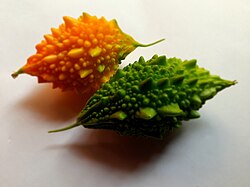
Varieties of Bitter Melon
Depending on the region and variety, the shape and bitterness of the fruit can vary substantially. The most prominent varieties include:
- Chinese Variety: Typically 20–30 cm (7.9–11.8 in) long, oblong with blunt ends, pale green, and featuring a slightly undulating warty surface.
- Indian Variety: Narrower and pointed at both ends, this variety is covered in jagged, triangular "teeth" and ridges, ranging in color from green to white.
- Miniature Varieties: Measuring only 6–10 cm (2.4–3.9 in), these are popular in South Asian countries like India, Pakistan, Bangladesh, and Nepal, where they are often used as stuffed vegetables.
Nutritional Profile and Health Considerations
Bitter melon is low in calories but rich in essential vitamins and minerals, particularly Vitamin C and folate.
| Nutrient | Amount | % Daily Value (DV) |
|---|---|---|
| Energy | 19 kcal (79 kJ) | - |
| Carbohydrates | 4.32 g | - |
| Dietary Fiber | 2 g | - |
| Protein | 0.84 g | - |
| Vitamin C | - | 37% |
| Folate (B9) | - | 13% |
| Potassium | - | 11% |
| Zinc | - | 7% |
Safety and Adverse Effects
While widely consumed, there are important safety precautions associated with M. charantia:
- Toxicity: The mature seeds and fully ripe fruit are toxic.
- Pregnancy: Bitter melon is contraindicated for pregnant women as it may induce contractions, bleeding, and miscarriage.
- General Side Effects: Some individuals may experience gastrointestinal discomfort.
Culinary Uses Around the World
Bitter melon is generally consumed cooked during its green or early yellowing stage. To reduce the intense bitterness, raw fruit can be soaked in cold water before preparation. Young shoots and leaves are also edible as greens.
Asia
- China: Used in stir-fries (often with pork and douchi), soups, and herbal teas. It is even used as a bittering agent in some beers.
- India: A staple in both North and South Indian cuisines. It is prepared as sabzi, stuffed with spices, or mixed with coconut in dishes like thoran and theeyal. In Bengal, it is a key part of the vegetable medley known as Shukto.
- Southeast Asia: In Vietnam, it is used in summer soups and during the Tết holiday. In Thailand, it is often stuffed with minced pork and garlic in a clear broth. In the Philippines, it is known as Ampalaya and used in the vegetable stew pinakbet.
- Okinawa: Known as gōyā, it is a signature ingredient of Okinawan cuisine.
- Pakistan: Often cooked with onions and spices or boiled and stuffed with minced beef.
Africa and the Caribbean
- Trinidad and Tobago: Known as caraille or carilley, it is typically sautéed with onion, garlic, and scotch bonnet peppers.
- Mauritius: Referred to as margose or margoze.
Research and Herbal Medicine
Bitter melon has a long history of use in Asian and African herbal medicine systems. However, modern scientific research provides a nuanced view of its efficacy. Specifically, studies indicate that Momordica charantia does not significantly decrease A1c or fasting blood glucose levels—key indicators of blood glucose control—when administered in tablet or capsule form.
Key Facts
- Scientific Name: Momordica charantia.
- Family: Cucurbitaceae (Gourd family).
- Primary Varieties: Chinese (oblong) and Indian (jagged/pointed).
- Key Nutrient: Exceptionally high in Vitamin C (37% DV per 100g).
- Critical Warning: Contraindicated during pregnancy due to risk of miscarriage.
- Toxicity: Ripe fruits and mature seeds are toxic.
- Growth Habit: A vine that grows up to 5 meters in length.
Frequently Asked Questions
Is bitter melon safe to eat during pregnancy?
No. Bitter melon is contraindicated for pregnant women because it can induce contractions, bleeding, and potentially lead to miscarriage.
How can I make bitter melon taste less bitter?
The raw fruit can be soaked in cold water and drained to remove some of the strong bitter flavors before cooking.
What is the difference between Chinese and Indian bitter melon?
The Chinese variety is generally oblong with blunt ends and a pale green, undulating surface. The Indian variety is narrower, pointed at both ends, and features jagged, triangular ridges.
Can bitter melon be used to treat diabetes?
While used in traditional medicine, research shows that taking Momordica charantia in capsule or tablet form does not significantly decrease fasting blood glucose levels or A1c.
Are the seeds of the bitter melon edible?
Seeds in unripe fruits are not intensely bitter and can be removed before cooking. However, mature seeds are toxic and should not be consumed.
Which parts of the plant are edible?
The fruit (primarily in the green or early yellow stage), as well as the young shoots and leaves, are edible.