Ascorbic Acid: Molecular Structure, Chemical Properties, and Industrial Synthesis
Ascorbic acid, widely known as Vitamin C, is an organic compound with the chemical formula C6H8O6. Originally identified as hexuronic acid, this white to light-yellow solid is a powerful reducing agent that dissolves readily in water to create mildly acidic solutions. While most recognized for its biological importance, its chemical behavior as a reductone—a compound containing a specific structural pattern that enhances acidity and reducing power—makes it invaluable in both industrial and laboratory settings.

Key Facts
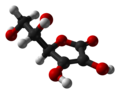
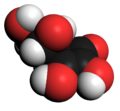
- Chemical Formula: C6H8O6
- Molar Mass: 176.124 g·mol
- Common Name: Vitamin C
- Food Additive Code: E300
- Primary Use: Antioxidant and food preservative
- Industrial Source: Primarily synthesized from glucose
Historical Discovery and Nomenclature
The journey to identifying ascorbic acid began in the 18th century when James Lind demonstrated the antiscorbutic (scurvy-preventing) properties of certain foods. By 1907, Axel Holst and Theodor Frølich established that the factor preventing scurvy was a water-soluble chemical substance.
Between 1928 and 1932, Albert Szent-Györgyi isolated the substance from plants and animal adrenal glands, initially naming it "hexuronic acid." In 1932, Charles Glen King confirmed its role as the antiscorbutic factor. Shortly after, sugar chemist Walter Norman Haworth deduced its correct structure and optical-isomeric nature, reporting the first synthesis in 1934. Haworth and Szent-Györgyi subsequently proposed the name "a-scorbic acid," later refined to l-ascorbic acid. Their groundbreaking work earned them Nobel Prizes in Chemistry and Physiology or Medicine in 1937.
Chemical Properties and Reactivity
Acidity and Structure
Ascorbic acid is a furan-based lactone of 2-ketogluconic acid. Its structure features an enediol (a compound with two hydroxyl groups attached to a double-bonded carbon) adjacent to a carbonyl group. This specific arrangement increases the acidity of one of the enol hydroxyl groups, making it significantly more acidic than compounds with isolated hydroxyl groups. When deprotonated, it forms the ascorbate anion, which is stabilized by electron delocalization through resonance.

Oxidation and Free Radicals
As a reducing agent, ascorbic acid undergoes oxidation. The process typically involves the formation of a semidehydroascorbate radical, which then produces dehydroascorbate. The transition to pseudodehydroascorbate is thermodynamically disfavored, a property that helps prevent the propagation of free radical chain reactions, such as autoxidation.


Aqueous solutions of dehydroascorbate are unstable and undergo hydrolysis with a half-life of 5–15 minutes at 37 °C, breaking down into products such as diketogulonic acid, xylonic acid, threonic acid, and oxalic acid.
Conversion to Oxalate
Research has shown that ascorbic acid can be converted into oxalate, a primary component of calcium oxalate kidney stones. This occurs when dehydroascorbic acid (DHA) irreversibly degrades into 2,3-diketogulonic acid (DKG), which further breaks down into oxalate and sugars. While some early studies suggested this could contribute significantly to urinary oxalate, clinical significance remains inconclusive, though some associations have been noted with high-dose supplementation in men.
Industrial Synthesis and Applications
The Reichstein Process and Modern Methods
Approximately 70% of the global supply of ascorbic acid is produced in China. The traditional industrial method is based on the Reichstein process, a five-step sequence starting with the catalytic hydrogenation of glucose to sorbitol, followed by oxidation to sorbose via Acetobacter suboxydans. The process then uses acetone to protect hydroxyl groups before final oxidation and ring-closing lactonization.
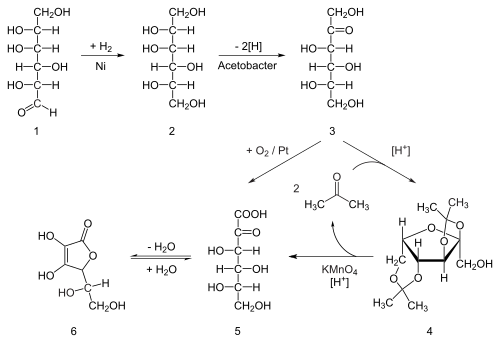
Modern biotechnological advancements have introduced a more efficient route that bypasses acetone-protecting groups. This method uses genetically modified microbes, such as mutant Erwinia, to oxidize sorbose directly into 2-ketogluconic acid (2-KGA), which then undergoes dehydration to form ascorbic acid.
Practical Uses
- Food Industry: Used as additive E300 to prevent oxidation and discoloration.
- Photography: Employed as a reductant in developer solutions.
- Preservation: Used generally as a preservative due to its ease of oxidation.
- Chemical Conversion: Used by some individuals to convert heroin base into a water-soluble salt for injection.
Technical Specifications Summary
| Property | Value/Description |
|---|---|
| IUPAC Name | l-threo-Hex-2-enono-1,4-lactone |
| Chemical Formula | C6H8O6 |
| Molar Mass | 176.124 g·mol |
| Melting Point | 190 to 192 °C (decomposes) |
| Water Solubility | 330 g/L |
| pKa | 4.10 (first), 11.6 (second) |
| LD50 (Oral, Rat) | 11.9 g/kg |
Frequently Asked Questions
What is the difference between ascorbic acid and Vitamin C?
In most contexts, they are the same. Ascorbic acid is the specific chemical name for the molecule that functions as Vitamin C in biological systems.
How is ascorbic acid produced on an industrial scale?
It is primarily produced from glucose. While the historical Reichstein process is well-known, most modern production uses a biotechnological process involving genetically modified microbes to convert sorbose into 2-ketogluconic acid.
Can ascorbic acid contribute to kidney stones?
Ascorbic acid can be metabolized into oxalate, which is a component of kidney stones. However, the clinical link between Vitamin C intake and stone formation is still debated and remains inconclusive in many large studies.
Why is ascorbic acid used in food?
It is used as a food additive (E300) because it acts as an antioxidant, preventing the oxidation of other ingredients and stopping food from discoloring during storage.
What makes ascorbic acid more acidic than other similar molecules?
Its acidity is due to the enediol structure adjacent to a carbonyl group, which allows the resulting ascorbate anion to be stabilized through resonance.