Bee Hummingbird: The World's Smallest Bird
The bee hummingbird (Mellisuga helenae), also known as the zunzuncito or Helena hummingbird, holds the remarkable title of the smallest known bird in existence. Native exclusively to the island of Cuba and its surrounding archipelago, this tiny avian marvel is a testament to the diversity of nature, blending extreme miniaturization with high-energy performance.
Because birds are scientifically recognized as a living form of theropod dinosaurs (avian dinosaurs), the bee hummingbird is also characterized as the smallest known dinosaur in the fossil record.
Key Facts
- Status: Near Threatened (IUCN 3.1) and listed under CITES Appendix II.
- Size: Males average 5.5 cm in length; females average 6.1 cm.
- Weight: Males weigh approximately 1.95 g, while females weigh about 2.6 g.
- Diet: Primarily flower nectar and small insects.
- Range: Endemic to the Cuban archipelago.
- Flight: Wing beats range from 80 to 200 times per second.
Physical Characteristics and Appearance
The bee hummingbird is distinguished by its rounded, plump appearance, which differs from the more slender look of other small hummingbird species. Its plumage is highly iridescent, meaning the colors shift and shimmer depending on the angle of the light.
Males are particularly striking, featuring a green pileum (the top of the head) and a bright red throat. When exposed to sunlight, they display an iridescent scarlet gorget—a patch of colorful feathers on the throat—accompanied by elongated lateral plumes and bluish upper parts. Their underparts are generally greyish white. During the mating season, the head, chin, and throat of the male shift toward reddish or pink hues.
Females are slightly larger than males and possess a more muted bluish-green plumage with a pale gray underside. A distinguishing mark for females is the presence of white spots on the tips of their tail feathers.
The bird's slender, pointed bill is a specialized tool adapted for probing deep into flowers to reach nectar.
Diet and Ecological Role
The bee hummingbird is a diurnal bird that sustains its high metabolism by consuming up to half its body weight in food daily. Its primary source of energy is nectar, which it extracts by rapidly moving its tongue in and out of flowers. To supplement this sugar-rich diet, it occasionally hunts spiders and small insects.
In a single day, a bee hummingbird may visit as many as 1,500 flowers. This activity makes the bird a vital pollinator; as it feeds, pollen adheres to its bill and head, which is then transferred to the next flower, facilitating plant reproduction.
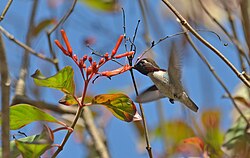
Plant Interactions
The bee hummingbird has been observed visiting ten specific plant species, nine of which are native to Cuba. This relationship is a prime example of coevolution, where the bird and the plants have evolved together. The flowers the bee hummingbird prefers are typically odorless, brightly colored, and possess long, narrow tubular corollas (the fused petals of a flower) containing dilute nectar.
| Plant Name | Family |
|---|---|
| Hamelia patens | Rubiaceae |
| Chrysobalanus icaco | Chrysobalanaceae |
| Pavonia paludicola | Malvaceae |
| Forsteronia corymbosa | Apocynaceae |
| Lysiloma latisiliquum | Mimosaceae |
| Turnera ulmifolia | Passifloraceae |
| Antigonon leptopus | Polygonaceae |
| Clerodendrum aculeatum | Verbenaceae |
| Tournefortia hirsutissima | Boraginaceae |
| Cissus obovata | Vitaceae |
Flight and Behavior
To maintain its position while feeding, the bee hummingbird beats its wings between 80 and 200 times per second, allowing it to hover stationary in mid-air. When traveling, it can reach speeds of 40–48 km/h.
The bird is known for its "high pitched, jumbled twitter" call. Males are territorial and will frequently sing from the highest tree in their area to signal their presence.
Habitat and Distribution
The bee hummingbird is endemic to the Cuban archipelago, including the main island and the Isla de la Juventud. They prefer areas of thick growth characterized by epiphytes (plants that grow on other plants) and lianas (woody climbing vines).
Their population is fragmented across several key regions, including the mogote (steep-sided limestone hills) areas of Pinar del Río Province, the Zapata Swamp in Matanzas Province, and various sites in eastern Cuba, such as the Alexander Humboldt National Park and the Baitiquirí Ecological Reserve.
Breeding and Life Cycle
Bee hummingbirds reach sexual maturity at one year of age. The breeding season occurs from March to June. The female is solely responsible for nest construction, incubation, and early care.
The nest is a small, cup-shaped structure approximately 2.5 cm in diameter, built 3–5 meters above the ground. Females use a combination of cobwebs, lichen, and bark, lining the interior with soft plant wool. Common nesting sites include juvenile ocuje (Calophyllum antillanum) and mature jucaro (Terminalia buceras) trees.
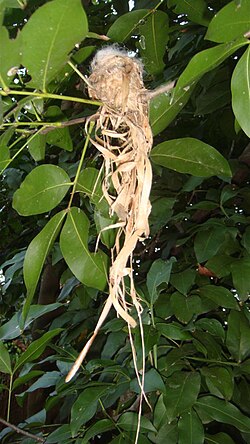
The female lays one or two eggs, each roughly the size of a coffee bean. After a 21-day incubation period and 2 days for hatching, the mother provides 18 days of care. During this time, she hunts insects to feed the chicks. In the final 4–5 days, the juveniles practice flying before leaving the nest, which is used only once per season.
In the wild, the bee hummingbird typically lives up to seven years, though they can reach 10 years in captivity.
Frequently Asked Questions
What is the smallest bird in the world?
The bee hummingbird (Mellisuga helenae) is the smallest known bird, with males averaging only 5.5 cm in length and weighing about 1.95 g.
Where can the bee hummingbird be found?
This species is endemic to the Cuban archipelago, meaning it is found naturally only in Cuba and its surrounding islands.
Why is the bee hummingbird called a dinosaur?
Because modern birds are descendants of theropod dinosaurs, the bee hummingbird is technically the smallest living dinosaur and the smallest known dinosaur in the fossil record.
How many flowers does a bee hummingbird visit in a day?
A single bee hummingbird may visit up to 1,500 flowers in one day to satisfy its high energy requirements.
What is the diet of the bee hummingbird?
Its diet consists primarily of flower nectar, supplemented by the occasional consumption of small insects and spiders.