Calliope Hummingbird: The Smallest Long-Distance Migrant of North America
The Calliope hummingbird (Selasphorus calliope) holds a remarkable title: it is the smallest bird native to both the United States and Canada. Named after Calliope, the Greek muse, this tiny avian wonder is not only a marvel of size but also of endurance. Despite its diminutive stature, it is recognized as the smallest known long-distance bird migrant, traveling approximately 9,000 km (5,600 mi) twice a year.
Once classified under its own genus, Stellula (meaning "little star"), modern research has placed it within the genus Selasphorus. From the high peaks of the Rocky Mountains to the tropical landscapes of Central America, the Calliope hummingbird is a testament to biological efficiency and resilience.
Key Facts
- Smallest Native Bird: The smallest breeding bird found in Canada and the United States.
- Extreme Migration: Completes a round-trip migration of roughly 18,000 km annually.
- Weight: An incredibly light body weighing only 2 to 3 grams.
- Conservation Status: Listed as Least Concern by the IUCN, though monitored due to its restricted wintering range.
- Unique Courtship: Males use a combination of high-speed dives, vocalizations, and wing-fluttering to attract mates.
Physical Description
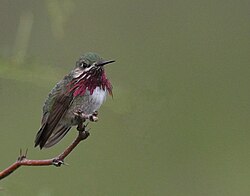
An adult Calliope hummingbird typically measures between 7 and 10 cm (2.8–3.9 in) in length with a wingspan of about 11 cm (4.3 in). Their plumage is characterized by a glossy green back and crown paired with white underparts.
Sexual dimorphism is evident in their appearance. Adult males possess a gorget (the colorful patch of feathers on the throat) with wine-red streaks. During territorial disputes or courtship, these feathers distend outward to make the male appear more prominent. Females and immature birds are more subtle, featuring a pinkish wash on the flanks and dark streaks on the throat.
While they resemble the Rufous and Allen's hummingbirds, the Calliope is smaller and lacks the contrasting rufous markings and long central tail feathers found in those species.
Habitat and Distribution
The Calliope hummingbird is highly adaptable, breeding in various open shrub habitats across western North America, from southern British Columbia and Alberta down to Colorado and southern California. They are frequently found at high altitudes in the Rocky Mountains, with nesting sites recorded from 600 ft (180 m) in the Pacific Northwest up to the tree line at over 11,000 ft (3,400 m).
Their breeding grounds include mountain meadows, open montane forests, and thickets of alder and willow. During the winter, they migrate to the Southwestern United States, northern Mexico, and eventually settle in southwestern Mexico, often inhabiting deserts, semi-desert regions, and lowland brushy areas.
Behavior and Diet
These birds are opportunistic feeders. They use long, extendable tongues to drink nectar from flowers, which in turn helps pollinate plants such as columbine, penstemon, paintbrush, trumpet gilia, and elephant head. To supplement their diet with protein, they catch small insects and spiders on the wing or drink sap from holes made by sapsuckers.
Breeding and Nesting
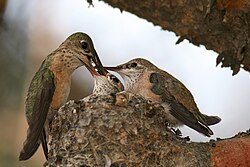
Males arrive at breeding grounds between mid-April and early May to establish and defend territories. Interestingly, the male plays no role in raising the offspring and often departs before the eggs hatch. The female constructs an open cup nest, typically in a conifer tree, often building it upon the base of a large pine cone to mimic its appearance. She lays two eggs in late May or early July, which hatch after 15 to 16 days of incubation. The young typically achieve flight within 20 days of hatching.
The Science of Humming
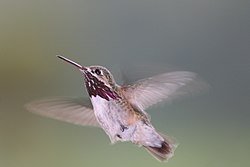
The characteristic "humming" sound is produced by rapid wingbeats during hovering and flight. This sound is created by aerodynamic forces during both the downstroke and upstroke, resulting in acoustic oscillations. For the hummingbird, this serves as a form of audible communication to signal the presence of a competitor or a potential mate.
Courtship and Sonation
Courtship is a high-energy performance. Males increase their wingbeat frequency to up to 95 flaps per second—42% higher than normal—creating a loud buzz. This is followed by a steep dive from a height of 20 m (66 ft). This descent causes sonation (the production of sound by non-vocal organs), where the wing and tail feathers flutter and strike each other to produce specific acoustic signals intended to attract females.
Temperature Regulation
Due to their high metabolic rate and small size, Calliope hummingbirds face significant challenges in dissipating body heat, especially in humid climates. They utilize a high surface-to-volume ratio to improve convective cooling via air movement from their wings.
When temperatures exceed 36 °C (97 °F), passive cooling is reduced. The birds then rely on evaporation and exhalation, shedding heat through areas with thin or no feathering, such as the feet, shoulders, and around the eyes. While hovering, the rapid beating of their wings may also aid in convective heat loss from their extended feet.
Conservation and Threats
With a stable breeding population of approximately 4.5 million as of 2019, the species is currently listed as Least Concern. However, because they rely on a restricted wintering range in Mexico and undertake such an arduous migration, they remain on a watchlist.
The primary threat to the Calliope hummingbird is extreme cold spells, which can drastically reduce the availability of nectar and insects. Despite their size, they are known to be aggressive, often defending their territory against larger birds like American Robins or Gray Flycatchers.
| Feature | Detail |
|---|---|
| Scientific Name | Selasphorus calliope |
| Average Weight | 2 to 3 g |
| Average Length | 7–10 cm |
| Migration Distance | ~9,000 km each way |
| Breeding Range | Western US and Canada |
| Wintering Range | Mexico and Central America |
| Conservation Status | Least Concern (IUCN 3.1) |
Frequently Asked Questions
What makes the Calliope hummingbird unique among North American birds?
It is the smallest breeding bird native to the United States and Canada and is believed to be the smallest-bodied long-distance migrant in the world.
How do male Calliope hummingbirds attract females?
Males perform a complex display involving high-frequency wingbeats (up to 95 flaps per second), a high-speed dive from 20 meters, and the extension of their purple gorget feathers to appear larger.
What do Calliope hummingbirds eat?
Their diet consists primarily of nectar from various wildflowers, but they also consume small insects, spiders, and sap from sapsucker holes for additional nutrients.
How do these tiny birds handle extreme heat?
They dissipate heat through exhalation and via unfeathered areas of the body, such as the feet, shoulders, and around the eyes, utilizing their high surface-to-volume ratio for convective cooling.
Where do Calliope hummingbirds build their nests?
Females typically build open cup nests in conifer trees, often utilizing the base of a large pine cone to camouflage the nest, making it resemble a pine cone itself.