Saffron Finch: The Golden Tanager of South America
The Saffron finch (Sicalis flaveola) is a vibrant bird native to South America, renowned for its striking yellow plumage. While often mistaken for a canary due to its appearance and song, it is actually a member of the tanager family (Thraupidae) and is closely related to seedeaters. These birds are common sights in open and semi-open lowland areas, though they are notably absent from the Amazon Basin.
Their distribution is extensive, spanning Colombia, northern Venezuela, western Ecuador, western Peru, eastern and southern Brazil, Bolivia, Paraguay, Uruguay, northern Argentina, and Trinidad and Tobago. Beyond their native range, the Saffron finch has been introduced to various regions, including Hawaii, Panama, Puerto Rico, and Jamaica.
Key Facts
- Scientific Name: Sicalis flaveola
- Conservation Status: Least Concern (IUCN 3.1)
- Distinctive Feature: Males possess a bright orange crown.
- Dietary Group: Closely related to seedeaters.
- Behavior: Males are polygamous and highly territorial.
Taxonomy and Classification
The Saffron finch was first described in 1766 by the Swedish naturalist Carl Linnaeus in the 12th edition of Systema Naturae. Originally named Fringilla flaveola, the specific epithet is derived from the Latin word flavus, meaning "golden" or "yellow." In 1828, the German zoologist Friedrich Boie moved the species into the genus Sicalis.
Ornithologists currently recognize five distinct subspecies based on their geographic distribution:
- S. f. flaveola: Found in Trinidad, Colombia, Venezuela, and the Guianas.
- S. f. valida: Native to Ecuador and northwest Peru.
- S. f. brasiliensis: Located in east Brazil.
- S. f. pelzelni: Found in east Bolivia, Paraguay, southeast Brazil, north Argentina, and Uruguay.
- S. f. koenigi: Native to northwest Argentina.
Physical Description
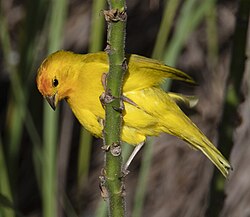
The male Saffron finch is characterized by bright yellow feathers and a distinctive orange crown. This crown is a key identifier, as it separates the species from most other yellow finches, with the orange-fronted yellow finch being the only major exception.
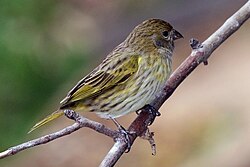
Females are generally more subtle in appearance. While they are often just a duller version of the male, the southern subspecies (S. f. pelzelni) exhibits a more marked difference, with females appearing olive-brown and featuring heavy dark streaks.
Breeding and Behavior
Saffron finches are cavity nesters, meaning they seek out existing holes or shelters rather than building open nests. They frequently utilize abandoned rufous hornero nests, bamboo branches, or the undersides of house roofs. Because they are tolerant of human proximity, they are often found in suburban areas and are frequent visitors to bird tables.
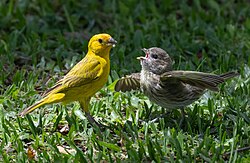
The species is known for a pleasant, though repetitive, song. This combination of beauty and melody has made them popular as caged birds. In the wild, males are polygamous, typically mating with two females during a single nesting season. Their strong territorial nature has unfortunately led to their use in blood sporting, where males are placed in cages to fight.
Species Summary
| Attribute | Details |
|---|---|
| Family | Thraupidae (Tanagers) |
| Native Range | South America (outside Amazon Basin) |
| Introduced Range | Hawaii, Panama, Puerto Rico, Jamaica |
| Male Coloration | Bright yellow with orange crown |
| Conservation Status | Least Concern |
Frequently Asked Questions
Is the Saffron finch a true canary?
No. Although it is commonly referred to as a canary and shares a similar appearance, it is not related to the Atlantic canary. It is a tanager closely related to seedeaters.
Where can the Saffron finch be found in the wild?
They are found throughout much of South America, including Brazil, Argentina, Colombia, and Venezuela, typically inhabiting open and semi-open lowlands outside the Amazon Basin.
How can you tell a male Saffron finch from other yellow finches?
The most distinguishing feature of the male is its bright orange crown, which is not present in most other yellow finch species.
What are the nesting habits of the Saffron finch?
They typically nest in cavities, such as bamboo branches, abandoned rufous hornero nests, or even under the roofs of human dwellings.
Are Saffron finches endangered?
No, the Saffron finch is currently classified as "Least Concern" by the IUCN, indicating a stable population across its range.