Rufous Hornero: The Master Architect of South America
The rufous hornero (Furnarius rufus), also known as the red ovenbird, is a medium-sized bird celebrated for its extraordinary nest-building skills. A member of the Furnariidae family, this species is not only a common sight across eastern South America but also holds the prestigious title of the national bird of Argentina.
These birds are highly synanthropic, meaning they thrive in environments modified by humans. They are frequently found in agricultural lands, pastures, second-growth scrub, and urban suburbs, making them one of the most recognizable avian species in their range.
Key Facts
- National Status: National bird of Argentina.
- Conservation Status: Least Concern (IUCN 3.1).
- Distinctive Feature: Builds thick clay nests resembling wood-fired ovens.
- Range: Brazil, Bolivia, Paraguay, Uruguay, and Argentina (extending to northern Patagonia).
- Diet: Primarily insects and other arthropods.
Taxonomy and Origins
The scientific history of the rufous hornero began in 1767 with Philibert Commerson, who collected a specimen during Louis Antoine de Bougainville's expedition. While initially noted as Turdus fulvus, the bird was first scientifically described as Merops rufus by German naturalist Johann Friedrich Gmelin in 1788.
The current genus name, Furnarius, is derived from the Latin word furnus, meaning "oven." This is mirrored in the Spanish name "hornero," which comes from horno (oven). The specific epithet rufus comes from the Latin rufum, meaning "red" or "reddish." Today, the rufous hornero is closely related to the crested hornero, its sister species.
Recognized Subspecies
Based on size and plumage, scientists recognize four distinct subspecies:
- F. r. commersoni: Found in central/east Bolivia, southwest Brazil, and northwest Argentina.
- F. r. paraguayae: Found in Paraguay and northern Argentina.
- F. r. rufus: Found in southeast Brazil, Uruguay, and central Argentina.
- F. r. albogularis: Found in eastern Brazil.
Physical Description
The rufous hornero is a medium-sized bird, typically measuring 18 to 20 centimeters (7–8 inches) in length and weighing between 31 and 58 grams (1.1–2.05 oz). Males are generally heavier and larger than females.
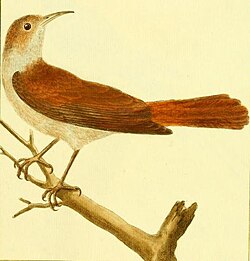
Their plumage is characterized by a reddish-brown back, a dull brown crown, and pale buffy-brown underparts with a whitish throat. Their wings are pale brown, featuring blackish flight feathers and cinnamon wingbars. A key tool for their survival is the 2.5-centimeter (1.0 inch) horn-colored bill, which is slender and slightly decurved, perfectly adapted for foraging insects from the ground.
Behavior and Ecology
Rufous horneros are ground-foragers that walk while searching for insects and arthropods, though they are opportunistic enough to eat scraps like bread crumbs. One of the most fascinating aspects of their behavior is their vocalization.
While the sexes look alike, their songs are sexually distinct. During duets, the male produces a faster rapid trill than the female. Interestingly, both birds beat their wings at their sides while singing, and the rate of the wingbeat matches the rate of their trill, allowing observers to identify the sex of the bird by sight.
Breeding and the "Oven" Nest
The rufous hornero is monogamous, often forming long-term or lifelong pair bonds. Breeding occurs during the austral summer, with eggs laid between August and December.
The species is most famous for its nest: a large, thick clay structure placed on tree branches, fence posts, telephone poles, or buildings. These nests can be completed in as little as five days, though some take months. Both parents contribute to the construction, incubation, and feeding of the young.
A typical clutch consists of two to four eggs, incubated for 14–18 days. After hatching, chicks are fed for 23–26 days. Young birds often remain in their natal territory for about six months, sometimes staying until the following breeding season.
Nest Reuse and Ecosystem Impact
Horneros may repair old nests or build new ones nearby, often resulting in clusters of "ovens." These abandoned structures provide vital housing for other bird species, such as the saffron finch, which frequently moves into unused hornero nests.
Conservation and Threats
The rufous hornero is listed as Least Concern by the IUCN. It has adapted exceptionally well to human-altered landscapes, which has helped maintain its population. While they face predation from snakes, lizards, small mammals, domestic cats, and birds of prey like the black-chested buzzard-eagle, their sturdy, covered nests provide a significant layer of protection for their young.
| Feature | Details |
|---|---|
| Scientific Name | Furnarius rufus |
| Average Size | 18–20 cm |
| Weight | 31–58 g |
| Primary Diet | Insects and arthropods |
| Nest Material | Clay/Mud |
| Conservation Status | Least Concern |
Frequently Asked Questions
Why is it called an ovenbird?
It is called an ovenbird because it constructs a thick-walled mud nest that resembles a traditional wood-fired clay oven.
How can you tell a male rufous hornero from a female?
Since they look nearly identical, the easiest way to distinguish them is by their singing; males have a faster trill and faster wing-beating during duets than females.
Where is the rufous hornero found?
They are native to eastern South America, including Brazil, Bolivia, Paraguay, Uruguay, and Argentina.
Is the rufous hornero an endangered species?
No, it is classified as Least Concern by the IUCN because it adapts well to human environments and has a wide distribution.
What do rufous horneros eat?
Their diet consists mainly of insects and other arthropods found while foraging on the ground, though they occasionally eat human food scraps.