Broad-tailed Hummingbird
The broad-tailed hummingbird (Selasphorus platycercus) is a medium-sized avian species native to the highland regions of the western United States, Western Canada, Mexico, and Guatemala. Known for its distinctive flight sounds and vibrant plumage, this bird is a master of the high-altitude landscapes it inhabits.
Key Facts
- Scientific Name: Selasphorus platycercus
- Conservation Status: Least Concern (IUCN 3.1)
- Average Weight: Approximately 3.6 grams (0.13 oz)
- Length: 4 inches (10 cm)
- Distinctive Feature: A rounded black tail that extends beyond the wing tips.
- Population: Estimated at 9.8 million individuals.
Physical Description and Sexual Dimorphism
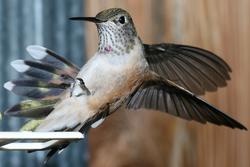
The broad-tailed hummingbird measures 4 inches in length with a wingspan of 5.25 inches. Both males and females share an iridescent green back, a white eye ring, and the namesake rounded black tail. However, the species exhibits sexual dimorphism—a biological phenomenon where males and females of the same species possess different physical characteristics.
Males are distinguished by a bright rose-red gorget (a patch of colorful feathers on the throat). Females possess paler overall coloration, cinnamon-colored flanks, and spotted cheeks, which are absent in the males. Interestingly, females tend to be slightly larger than their male counterparts.
Vocalizations and Wing Communication
Communication for the broad-tailed hummingbird extends beyond traditional calls. While they produce a sharp, repeating "cheet" sound, they also utilize their wing beats as signals.
Wing Hum vs. Wing Trills
- Wing Hum: A general sound produced during flight, ranging from 35 to 100 Hz, used by both sexes for communication.
- Wing Trills: A specialized buzzing sound produced exclusively by males during courtship. This sound is created as air passes rapidly through the 9th and 10th primary feathers. These trills are highly effective, audible to other males up to 50 meters away and to females up to 75 meters away.
Research indicates that these wing trills are vital for social hierarchy; males unable to produce this sound are more likely to lose their territory to aggressive competitors.
Taxonomy and Classification
Belonging to the order Apodiformes and the family Trochilidae, the broad-tailed hummingbird is part of the "Bee group" within the Selasphorus genus. This genus consists of six members, typically characterized by rufous (reddish-brown) plumage and males with orange to purple neck gorgets.
| Category | Details |
|---|---|
| Genus | Selasphorus |
| Family | Trochilidae |
| Breeding Range | Western Canada, Western US, Mexico, Guatemala |
| Wintering Range | Southern Mexico and Guatemala |
| Conservation Status | Least Concern |
Habitat and Distribution
These birds are typically found in the understory or beneath the canopies of oak and pine woodlands. They forage in grasslands, shrubs, and open areas rich with flowers. Their primary breeding habitats include montane valleys, foothills, subalpine meadows, and stands of spruce or aspen.
While they are found as far north as central Montana for breeding, sightings in British Columbia are considered accidental migrations. In southern Mexico and Guatemala, some populations are sedentary, meaning they do not migrate.
Migration and Diet
The species practices partial migration. Males typically arrive at the breeding grounds first, followed by the females. While the exact migratory routes are unknown, the birds generally move between their northern breeding grounds and wintering sites in Guatemala and southern Mexico.
Their diet consists of insects and nectar from "hummingbird-flowered" plants. These plants, such as Aquilegia elegantula, are characterized by tubular red corollas and high nectar production.
Reproduction and Nesting
Broad-tailed hummingbirds have a promiscuous mating system and do not form long-term pair bonds. Breeding timing is closely synchronized with peak flower production.
Courtship and Nesting
To attract mates, males perform aerial displays, diving from great heights while producing their characteristic wing trills. Once a mate is sought, the female handles nest construction entirely on her own, a process taking 4 to 5 days.
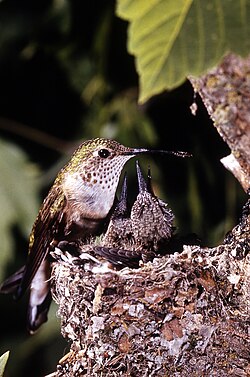
The nest is a small cup shape attached to a tree branch using spider webs and camouflaged with moss, lichen, and tree debris. Notably, 70% of females return to the same nest site year after year. Some females may even steal nesting materials from others.
Brooding and Development
The female lays two white eggs (1.2–1.5 cm in length) and incubates them for 16 to 19 days. The chicks are altricial, meaning they are born underdeveloped and require significant care. They typically develop feathers within 10 to 12 days, and the female remains with the young for several weeks after they fledge.
Conservation Status
The IUCN classifies the broad-tailed hummingbird as Least Concern, supported by a massive range of 1,660,000 square kilometers and an estimated population of 9.8 million. Despite this, one survey noted a 52% population decline between 1966 and 2015. The species appears capable of adapting to habitats modified by human activity.
Frequently Asked Questions
How do male and female broad-tailed hummingbirds differ?
Males have a bright rose-red throat (gorget), while females have paler coloration, spotted cheeks, and cinnamon-colored flanks. Females are also generally slightly larger than males.
What is a "wing trill" and why is it important?
A wing trill is a buzzing sound produced by males during courtship as air passes through specific primary feathers. It is used to attract females and defend territories against other males.
Do broad-tailed hummingbirds migrate every year?
They exhibit partial migration. While many travel between North America and Central America, some populations in southern Mexico and Guatemala are sedentary and stay in one place year-round.
What do broad-tailed hummingbirds eat?
Their diet consists primarily of insects and nectar from tubular, red, high-nectar flowers, such as those of the Aquilegia elegantula.
How is the nest of a broad-tailed hummingbird constructed?
The female builds the cup-shaped nest alone using spider webs to secure it to a branch, then camouflages it with lichen, moss, and other plant materials.