Beckford's Political Influence and the Struggle for Liberty
In the complex landscape of 18th-century British politics, few figures blended immense wealth with bold civic leadership as distinctly as Beckford. A powerhouse in the City of London, Beckford leveraged his fortune—built upon the West Indies sugar industry—to shape the political trajectory of his era, championing the Whig cause and challenging the established protocols of the monarchy.
Rise to Civic Power
Beckford's ascent through the administrative ranks of London was steady and significant. He first became an alderman in 1752, followed by his appointment as Sheriff of London in 1756. His influence peaked with his election as Lord Mayor of London, a prestigious position he held twice, first in 1762 and again in 1769. Beyond local governance, he entered national politics in 1754 when he was returned as a Member of Parliament (MP) for the City of London.
Political Patronage and Strategic Influence
As a wealthy patron, Beckford utilized his "interest"—his social and financial leverage—to support key political figures. Most notably, he sponsored and encouraged the rise of William Pitt the Elder. His political alignment was firmly with the Whigs, and he remained a staunch defender of the West Indies sugar industry, the primary source of his wealth.
Beckford's influence extended to the media of the day. In 1753, alongside his Bedfordite allies, he helped finance The Protester, a weekly opposition paper edited by James Ralph. The publication was highly regarded by contemporaries, with Bedford's secretary, Richard Rigby, praising its opening issue as an excellent preface to a political paper.
His strategic mind was also applied to colonial warfare. In September 1758, Beckford wrote to Pitt urging an immediate attack on the French colony of Martinique. He argued that the conquest would be easy because the inhabitants lacked sufficient food to support themselves and their slaves for more than a month without foreign supplies. He estimated the value of the island's livestock and enslaved population at over four million sterling.
Social Standing and Public Image
Despite some ridicule regarding his faulty Latin, Beckford's immense wealth and social position commanded respect. He was known for hosting lavish feasts, one of which reportedly cost £10,000. His social gravity was evidenced by a grand procession in his honor, which included members of the House of Commons and a staggering array of nobility from the House of Lords: six dukes, two marquises, twenty-three earls, four viscounts, and fourteen barons.
Beyond the luxury, Beckford gained popular support by promoting political liberalism, positioning himself in opposition to the "King's Friends," the faction loyal to the monarch.
Defying the Crown
Beckford's commitment to liberty was most evident in his support for John Wilkes. Following Wilkes' release, Beckford displayed a massive banner at his home with the word "Liberty" embroidered in white letters three feet (0.91 m) high.
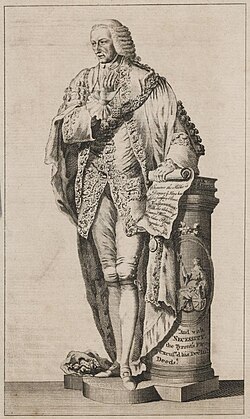
This spirit of defiance culminated on May 23, 1770, when Beckford publicly admonished King George III. In a shocking breach of contemporary protocol, he requested that the King dissolve Parliament and remove his civil councillors, citing the constitution established during the Glorious and Necessary Revolution. While King George was reportedly more offended by the breach of etiquette than the request itself, the act endeared Beckford to the Common Councilmen of London. In gratitude, they erected a monument in the Guildhall featuring a life-size statue of Beckford atop a stone tablet engraved in gold with the words he used to admonish the King.
Key Facts
- Civic Roles: Served as Alderman (1752), Sheriff of London (1756), and Lord Mayor of London (1762 and 1769).
- Parliamentary Career: Elected MP for the City of London in 1754.
- Financial Source: His fortune was derived from the West Indies sugar industry.
- Political Alliances: Supported William Pitt the Elder and the Whig cause.
- Notable Defiance: Publicly asked King George III to dissolve Parliament in 1770.
- Civic Honor: Commemorated with a life-size statue in London's Guildhall.
| Year | Achievement / Event | Significance |
|---|---|---|
| 1752 | Became Alderman | Entry into high civic office |
| 1754 | Elected MP | Representation of the City of London in Parliament |
| 1756 | Sheriff of London | Further advancement in city administration |
| 1762 & 1769 | Lord Mayor of London | Highest civic office in the City of London |
| 1770 | Admonishment of George III | Public challenge to royal authority and protocol |
Frequently Asked Questions
How did Beckford acquire his wealth?
Beckford's fortune was generated through his involvement in the West Indies sugar industry.
Who was William Pitt the Elder in relation to Beckford?
William Pitt the Elder was a political figure whom Beckford sponsored and encouraged, using his wealth and influence to support Pitt's political rise.
Why was Beckford's request to King George III considered scandalous?
It was considered scandalous because he broke contemporary protocol by publicly asking the King to dissolve Parliament and remove his civil councillors.
What was the significance of the banner Beckford displayed?
The banner, featuring the word "Liberty" in 3-foot-high letters, was a public demonstration of his ardent support for John Wilkes.
How did the City of London honor Beckford's defiance of the King?
The Common Councilmen of London expressed their gratitude by erecting a monument in the Guildhall, which included a life-size statue of Beckford and a gold-engraved tablet of his words to the King.